


Vanar Chain, I keep coming back to one simple idea that most Layer 1 discussions avoid, which is that Vanar is not really trying to win the same game as chains that compete on technical bragging rights, because its identity makes far more sense when you judge it like a consumer platform that happens to use blockchain as the settlement layer. That shift in lens changes everything about how progress should be measured, because it forces you to stop caring about noisy indicators like momentary trading attention and start caring about the kinds of proof points that real consumer ecosystems eventually cannot hide, such as whether people show up through actual products, whether they do something meaningful that feels like a genuine activity rather than a forced onchain task, and whether they return because the experience is enjoyable enough to become a habit.
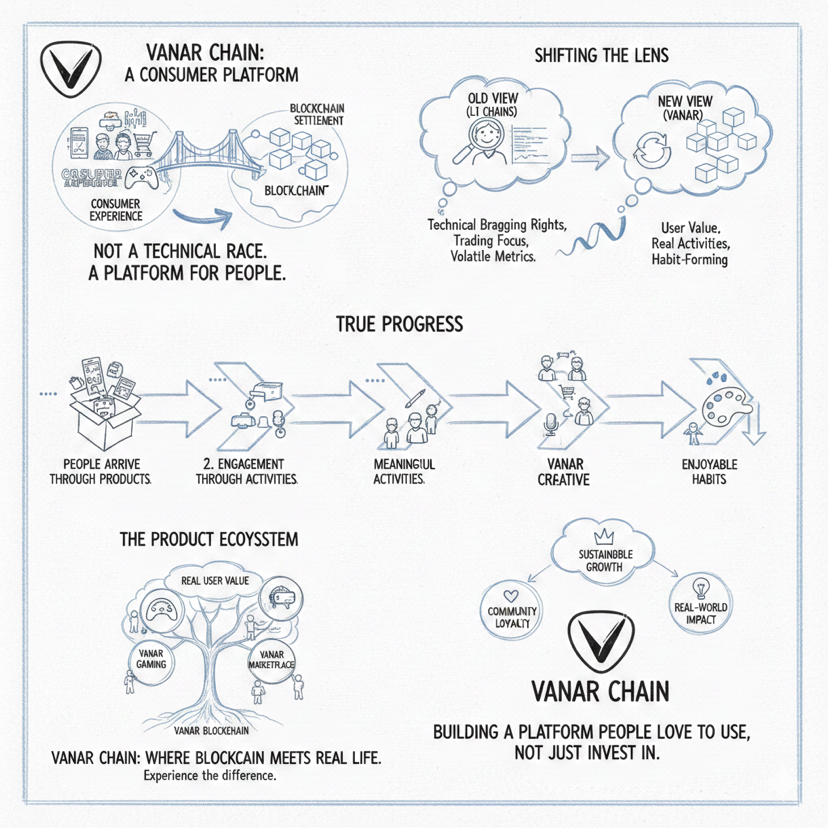 The thesis I keep testing is straightforward but demanding, because it treats Vanar like a platform that must earn repeat behavior instead of a chain that can rely on narratives, and it assumes that the real adoption funnel comes through experiences that people already understand in their daily lives, such as interactive worlds, game loops, digital ownership that has a purpose inside those worlds, and social participation that grows over time. In that frame, Virtua Metaverse and the VGN games network are not simply ecosystem labels that look good on a deck, because they represent the kind of surface area where adoption can be witnessed directly, meaning that if Vanar is truly onboarding mainstream users then the chain will start to look less like a crypto destination and more like a place where people arrive to play, explore, collect, trade, and coordinate with others without feeling like they have to learn a new financial system first.
Real adoption in this context is not the moment a wallet exists, and it is not the moment a token is purchased, and it is not the moment an account is created because a campaign pushed curiosity for an hour, because those are the easiest numbers to inflate and the hardest numbers to trust. Real adoption is repeated activity inside the product loop, where a user returns weekly because the experience was worth repeating, and where the actions they take are meaningful in a way that resembles normal consumer behavior, such as entering an interactive space, completing a quest, acquiring an item that actually changes what they can do next, participating in a timed event that feels social and memorable, or trading something because it has genuine usefulness inside the economy of the experience rather than being a purely speculative object.
That is why the most honest way to judge Vanar is to treat the next 90 days, the next six months, and the next twelve months as three different tests, each with its own proof signals, because early momentum can be faked but sustained retention cannot be faked for long without real product quality and real content cadence. Over the next 90 days, the first thing Vanar must prove is product readiness in the way consumer platforms are judged, which means onboarding has to become smooth enough that a normal user can start using a game or metaverse feature without a confusing sequence of steps, and it also means account recovery and support flows must be clear and forgiving, because in consumer markets people lose access, change devices, forget credentials, and make mistakes constantly, and the platform that cannot rescue them quickly never earns trust. At the same time, the platform has to stay stable during spikes, because consumer products are not adopted in a perfectly flat line, they are adopted around moments, and those moments include content drops, community events, seasonal releases, and timed experiences that cause sudden load, and if the system becomes unreliable precisely when excitement peaks then the user’s first impression becomes a permanent negative memory.
Once readiness is on track, the next 90 day proof signal becomes user activity that is reported and understood at the product level rather than hidden inside chain wide totals, because if Vanar is truly a consumer first ecosystem then the only numbers that matter are the ones that describe how each flagship product is performing. Daily active users and weekly active users should be visible per product, and new user conversion should be described as the percentage of new users who complete a first meaningful action in the first session, because that single measure captures whether onboarding friction has been reduced enough and whether the product loop is engaging enough to pull the user into a real experience rather than a superficial click. Retention should be tracked in a way that makes sense for consumer products, where day one retention reflects the quality of the first experience, day seven retention reflects whether the loop is enjoyable and repeatable, and day thirty retention reflects whether content cadence and depth are strong enough to support long term habit formation, and when those retention curves are improving you can usually feel the platform moving from experimentation into early product truth.
In the same 90 day window, there is also a specific kind of ecosystem signal that matters more than any broad statement about growth, which is whether shipping becomes observable and predictable, because consumer adoption does not grow on ideas alone, it grows on updates that show up on time and give users a reason to return. In a games and metaverse oriented ecosystem, content cadence is the oxygen that sustains retention, and the simplest way to test whether cadence exists is to watch whether seasonal updates arrive in a rhythm that users can anticipate, while also watching whether developer and studio communication is tied to actual launch dates and usable experiences rather than announcements that float without deadlines. When a project is truly progressing, you start to see fewer vague promises and more concrete delivery, and the audience begins to respond not with hype but with routine, because routine is what adoption looks like in real life.
At six months, the checklist becomes stricter because the platform must show signs of market fit forming, which is where distribution, token utility, and network behavior must begin aligning with product usage instead of moving in separate directions. Distribution in consumer ecosystems is frequently misunderstood, because reach is not conversion and attention is not retention, so the real question becomes whether activations and campaigns translate into measurable new users inside products, and whether those users actually perform meaningful actions and return again next week. A single activation can always be explained away as marketing spend or temporary curiosity, but repeat activations are harder to dismiss, because repetition suggests the distribution partner saw outcomes that justified returning, and this is one of the cleanest ways to detect whether the ecosystem is generating real value beyond noise.
Economics also has to mature by the six month mark, because this is the period where VANRY must prove it belongs inside the product loops rather than living outside them as an abstract asset. Utility must feel natural in context, which can include access, fees, settlement, crafting mechanics, rewards tied to participation, or governance that actually influences what users experience, but whatever the mechanism is, it must become more important as usage rises, because otherwise the token’s relationship to adoption stays weak. Incentives require special scrutiny here, because rewards can buy activity but they rarely buy love, so the platform needs to show that engagement remains healthy even as incentive intensity is controlled, and the healthiest sign is when the value of participating in the product loop feels larger than the value of farming a reward, because that is how real consumer systems protect themselves against boom and bust cycles.
Network signals at six months should also become more coherent, because wallet growth without usage correlation is one of the oldest illusions in this space, so the evidence you want is wallet growth that moves alongside daily and weekly actives, meaningful actions, and retention improvements, rather than wallet counts that spike sharply and then fade. Onchain activity should map to product events and content drops in a way that makes sense, and over time the baseline should rise if the platform is building habits, because habits create steadier demand than one time events, and steady demand is what turns a promising ecosystem into a durable one.
By twelve months, the checklist evolves into a sustainability test, where the platform must prove it can scale without relying on constant novelty or permanent subsidy, and where community and developer pipelines must show depth. Retention at this stage is not only about whether users return, it is about whether cohorts stay active across multiple content seasons, because seasonal loops are the natural heartbeat of games and interactive worlds, and the strongest signal of real traction is when the same cohorts continue participating as new content arrives, because that indicates the platform has become part of the user’s routine rather than a one time curiosity. Community should also begin creating its own internal economy, where users trade, collect, and coordinate because it is genuinely useful and enjoyable, which means item economies should have real sinks and real reasons to exist, and social participation should be meaningful enough that people show up for events, collaboration, and status that is earned through time and skill, not merely through financial positioning.
The developer and content pipeline must also diversify by the twelve month mark, because a single studio or a single product loop creates concentration risk, and a platform thesis requires multiple teams shipping on a predictable schedule. The strongest platforms become easier to build on over time, which means tooling improves, documentation becomes clearer, integration becomes simpler, and time to ship compresses, and you can usually sense this improvement because releases start arriving with less drama and more reliability, while the ecosystem’s creative output begins to feel like a calendar rather than a lottery. When that happens, adoption stops depending on one flagship moment and starts compounding through repeated delivery.
Revenue and value capture are the final proof point at twelve months, because this is where the platform must show that real demand exists and that the ecosystem captures value in a way that grows naturally as usage grows. Sustainable fee and marketplace revenue should be tied to real product activity, and the explanation of how value accrues should be plain enough that it can be understood without jargon, because if the value story only makes sense inside complex token narratives then it is usually compensating for weak product demand. A durable consumer platform does not need constant incentives to keep people active, because the product experience itself creates demand, and the economic layer simply captures a portion of that demand in a way that remains stable as the user base expands.
If I had to summarize the entire adoption checklist into something you can revisit weekly without getting lost, I would frame it as a simple scoreboard that forces honesty, where you track daily and weekly active users per flagship product, retention at day one day seven and day thirty, meaningful actions per user per week, the percentage of new users who complete a first meaningful action in their first session, the presence of distribution campaigns that visibly convert into active product users and then repeat, the extent to which VANRY is used inside the product loops rather than merely held, the frequency and reliability of content releases, and the platform’s stability during moments of high activity. When those numbers and observations improve together, you are not watching a chain chase attention, you are watching a consumer platform earn repeat behavior.
Over the last day, I did not observe a single clear moment that would change this adoption framework by itself, and that is not a negative, because the most important progress for a consumer first ecosystem often happens in the quiet work that improves onboarding, strengthens stability, tightens the content pipeline, and refines product loops so retention rises steadily rather than spiking unpredictably. If Vanar is moving in the right direction, the clearest evidence will not be dramatic, it will be visible in smoother first sessions, fewer failed experiences during peak moments, more consistent content cadence, and retention curves that stop collapsing after the first week.
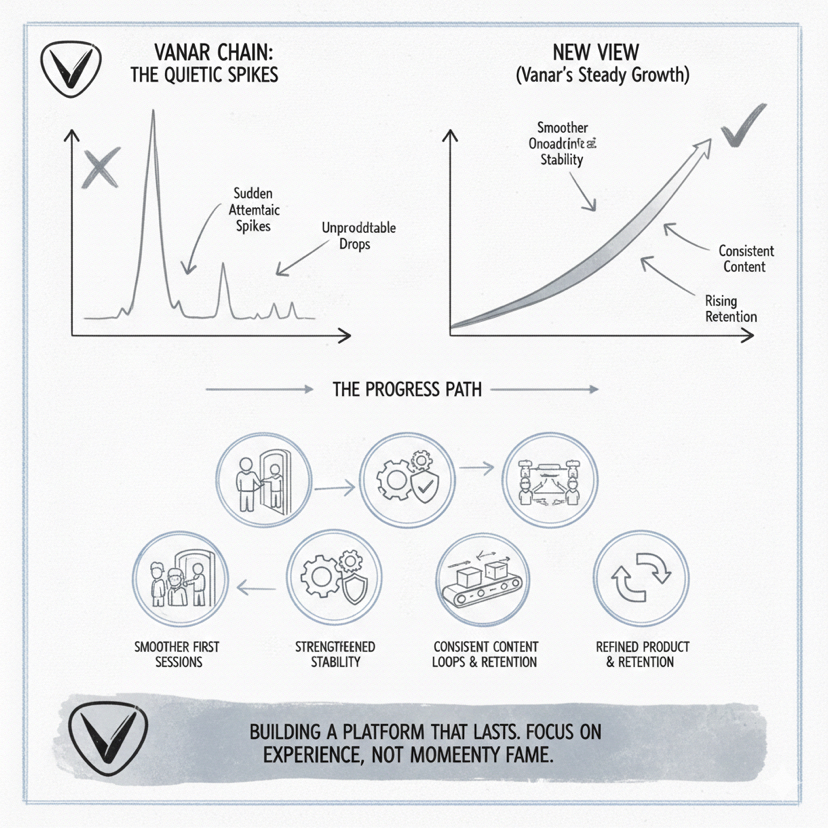
If Vanar hits this checklist, the narrative naturally becomes larger than an L1 story, because the platform would be proving that it can onboard users through real products, keep them engaged through a reliable shipping rhythm, and capture value through VANRY in ways that scale with actual usage. If Vanar does not hit the checklist, the likely failure mode will not be that the chain lacked ambition, it will be that consumer reality exposed weak loops, inconsistent cadence, and economics that could not stand on organic demand, and the best part about using a checklist is that you do not need to argue about it, because the evidence either accumulates in the timeframe or it does not.
