Stablecoins have become a practical bridge between traditional finance and blockchain networks. They are used for remittances, payroll, treasury operations, cross border trade, and on chain settlement. Yet as their role expands, one critical question becomes more important: how neutral and resilient is the infrastructure supporting them?
When people talk about blockchain performance, they often focus on speed or cost. But for stablecoin settlement at scale, neutrality and censorship resistance are equally important. If stablecoins are to function as reliable digital dollars or settlement assets, the base layer they rely on must be structurally robust, politically neutral, and technically secure. This is where @plasma takes a distinct architectural direction.
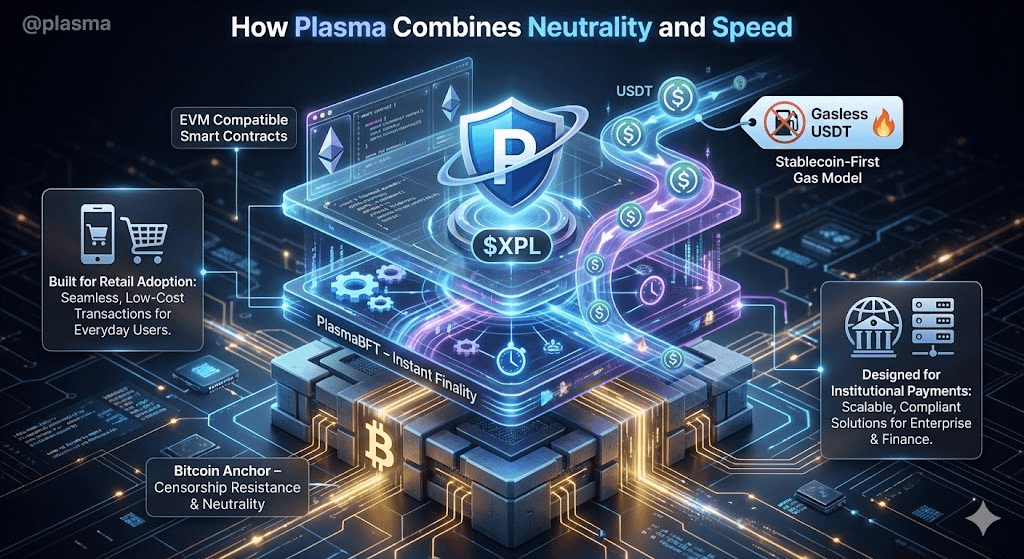
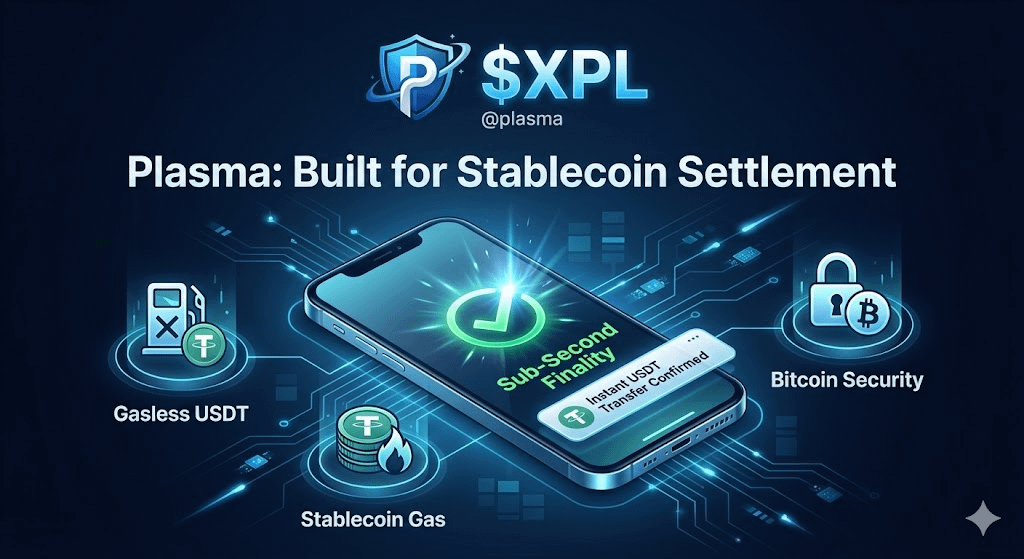
Plasma is a Layer 1 blockchain purpose built for stablecoin settlement. While many networks support stablecoins as applications within broader ecosystems, Plasma designs the base layer specifically around their needs. One of its most defining characteristics is Bitcoin anchored security, combined with Plasma BFT for sub second finality and full EVM compatibility through Reth. Its native token, $XPL, supports the network’s operational and economic structure. To understand why this matters, we need to examine the concept of neutrality in financial infrastructure.
Traditional payment systems rely on centralized clearing houses, correspondent banking networks, and regional settlement frameworks. These systems function efficiently in many contexts, but they are subject to jurisdictional constraints, policy changes, and institutional dependencies. For global stablecoin usage, especially in high adoption markets, reliance on a single centralized authority introduces systemic risk.
Blockchain technology originally emerged as an alternative precisely because of its decentralized trust model. However, not all blockchains are designed with the same security philosophy. Some prioritize flexibility or rapid experimentation. Others focus on throughput. Plasma’s architecture signals a different priority: combining performance with anchored neutrality. Bitcoin anchoring is central to this thesis.
Bitcoin remains the most established and battle tested blockchain in existence. Its proof of work security model, global distribution of miners, and long operational history contribute to its reputation for resilience. By anchoring to Bitcoin, Plasma integrates an additional layer of security and neutrality into its design.
In practical terms, this strengthens censorship resistance and reduces the likelihood that a single actor or coordinated group can influence settlement integrity. For institutions considering blockchain based settlement, this form of structural assurance is not theoretical. It directly affects compliance planning, risk assessment, and long term infrastructure strategy.
Speed remains critical, of course. Financial settlement cannot depend on slow confirmation times. PlasmaBFT addresses this by delivering sub second finality. Transactions settle almost instantly, which is essential for point of sale payments, cross border transfers, and automated financial workflows.
The combination of Bitcoin anchored security and fast finality creates an interesting balance. On one hand, you have deep security guarantees. On the other, you have real time usability. Most networks tend to emphasize one over the other. Plasma attempts to integrate both within a stablecoin focused framework.
Another major friction point in stablecoin usage is fee management. On many blockchains, users must hold a separate native token solely to pay transaction fees. For experienced participants, this is manageable. For retail users or businesses that simply want to transact in stablecoins, it introduces operational complexity.
Plasma introduces a stablecoin first gas model, including gasless USDT transfers and the ability to use stablecoins directly for gas. This design choice aligns the user experience with the asset being transacted. Instead of navigating multiple tokens and balances, users can operate within a simplified stablecoin environment.
For high adoption markets, where stablecoins are often used as a day to day store of value or medium of exchange, this simplicity matters. Reduced friction increases usability. Increased usability drives sustainable adoption.
From a developer perspective, full EVM compatibility through Reth ensures that existing Ethereum smart contracts can be deployed with minimal modification. This lowers the integration barrier for payment platforms, wallets, and financial applications. Developers do not need to learn an entirely new programming model. They can build using established tooling while benefiting from Plasma’s stablecoin optimized environment.
The role of $XPL within this ecosystem is foundational. As the native token, it supports validator incentives, governance mechanisms, and the broader economic framework of the network. Rather than serving as a peripheral asset, it underpins the system that enables stablecoin settlement to function efficiently and securely.
When evaluating long term blockchain infrastructure, it is useful to separate narrative cycles from structural design. Many projects emphasize ecosystem expansion or experimental applications. Plasma, in contrast, appears to concentrate on a narrower but highly consequential objective: becoming a neutral, high performance settlement layer for stablecoins.
This specialization aligns with observable financial trends. Stablecoins are increasingly used in cross border commerce, decentralized finance, and institutional treasury management. As tokenized real world assets gain traction, stablecoins often act as the primary settlement asset. In such an environment, the base layer must offer reliability that approaches traditional financial infrastructure while preserving blockchain advantages.
Neutrality, security, speed, and usability are not independent variables. They interact. A network that is fast but lacks neutrality may face trust challenges. A network that is secure but slow may struggle with practical adoption. Plasma’s architecture suggests an attempt to reconcile these dimensions within a single Layer 1 framework.
For retail users, this translates into faster, simpler transactions anchored to a resilient security model. For institutions, it provides a foundation that aligns more closely with risk management requirements and long term planning. For developers, it offers compatibility and performance without sacrificing the stablecoin first design philosophy.
Under the broader #plasma vision, the network positions itself not as a general purpose experimentation layer, but as infrastructure tailored for one of the most significant use cases in blockchain today. By integrating Bitcoin anchored security, sub second finality, and stablecoin centric gas mechanics, @Plasma presents a coherent architectural thesis.
As digital finance evolves, infrastructure choices will determine which networks support durable adoption. Stablecoins are already embedded in global payment flows. The next phase is about optimizing the rails beneath them.
In that context, Plasma’s approach, supported by $XPL , represents a deliberate step toward building settlement infrastructure that is not only fast, but structurally neutral and resilient. That focus on foundational design may ultimately define its long term relevance in the broader blockchain landscape.