

Plasma began as a Layer-2 scaling framework for Ethereum. It was designed to reduce congestion by moving transaction execution off the main chain while preserving security through cryptographic commitments.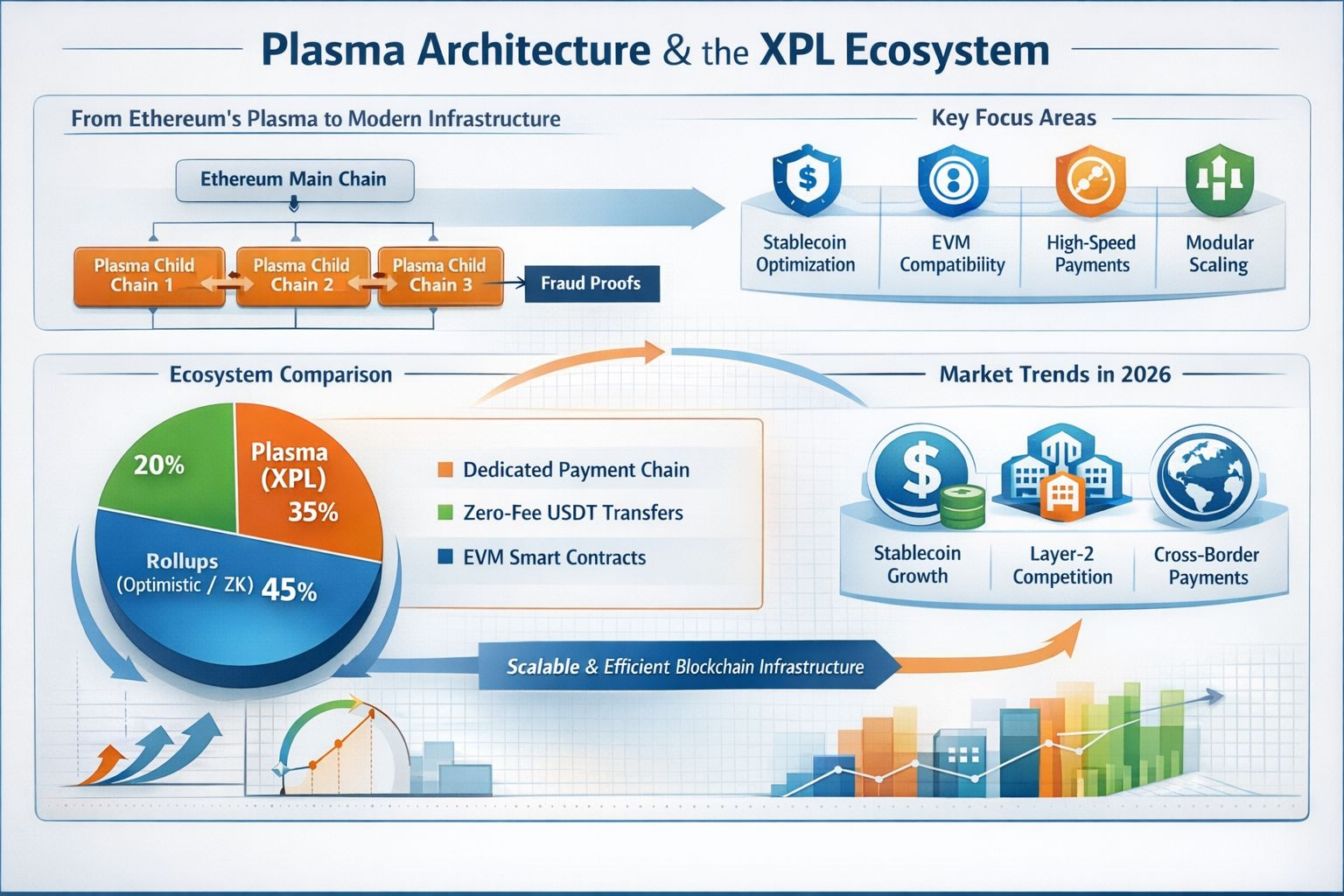
Proposed by and , Plasma introduced a hierarchical model where child chains process transactions independently and periodically anchor their state to . This structure allowed Ethereum to remain the settlement layer while execution occurred elsewhere.
Although rollups later became dominant in the Layer-2 discussion, the architectural philosophy behind Plasma did not disappear. It evolved. That evolution is visible in modern infrastructure projects such as and its ecosystem token XPL.
Classic Plasma focused heavily on fraud proofs and exit mechanisms. It was primarily an Ethereum scaling extension. Modern Plasma-inspired chains, however, operate as dedicated execution environments. They are optimized for high-throughput transactions, stablecoin transfers, EVM compatibility, and low transaction costs. Rather than functioning strictly as child chains, they position themselves as efficient transaction layers that still respect the core principle of separating execution from settlement.
In today’s landscape, XPL represents a shift from research experimentation to applied infrastructure. The ecosystem emphasizes stablecoin efficiency, enabling faster and cheaper transfers suited for payment rails. It maintains EVM compatibility so developers can deploy applications using familiar Ethereum tooling. The architecture also supports modular scaling, allowing integration with broader ecosystems instead of relying on a single scaling model. Most importantly, the focus is on transactional utility rather than speculative narratives.
The broader blockchain market in 2026 is shaped by stablecoin growth, Layer-2 competition, and infrastructure efficiency. Plasma-style architecture aligns naturally with these themes. As stablecoins become central to on-chain finance and cross-border settlement, networks optimized for cost-effective and high-speed execution gain structural relevance. This is where Plasma-based ecosystems attempt to differentiate themselves.
The difference between early Plasma projects and modern implementations like XPL lies in positioning. Early Plasma aimed to scale Ethereum directly. Modern Plasma ecosystems aim to power payment infrastructure and high-frequency transactional environments. If adoption continues shifting toward microtransactions, payment-heavy applications, and enterprise settlement systems, optimized execution layers become increasingly valuable.
Plasma was not simply an abandoned scaling idea. It was an architectural phase that influenced how blockchain systems think about modularity and execution layers. Projects like XPL demonstrate that the concept has matured beyond experimentation. In a market increasingly driven by practical utility, Plasma-inspired infrastructure is competing not for hype cycles, but for long-term transactional relevance.


