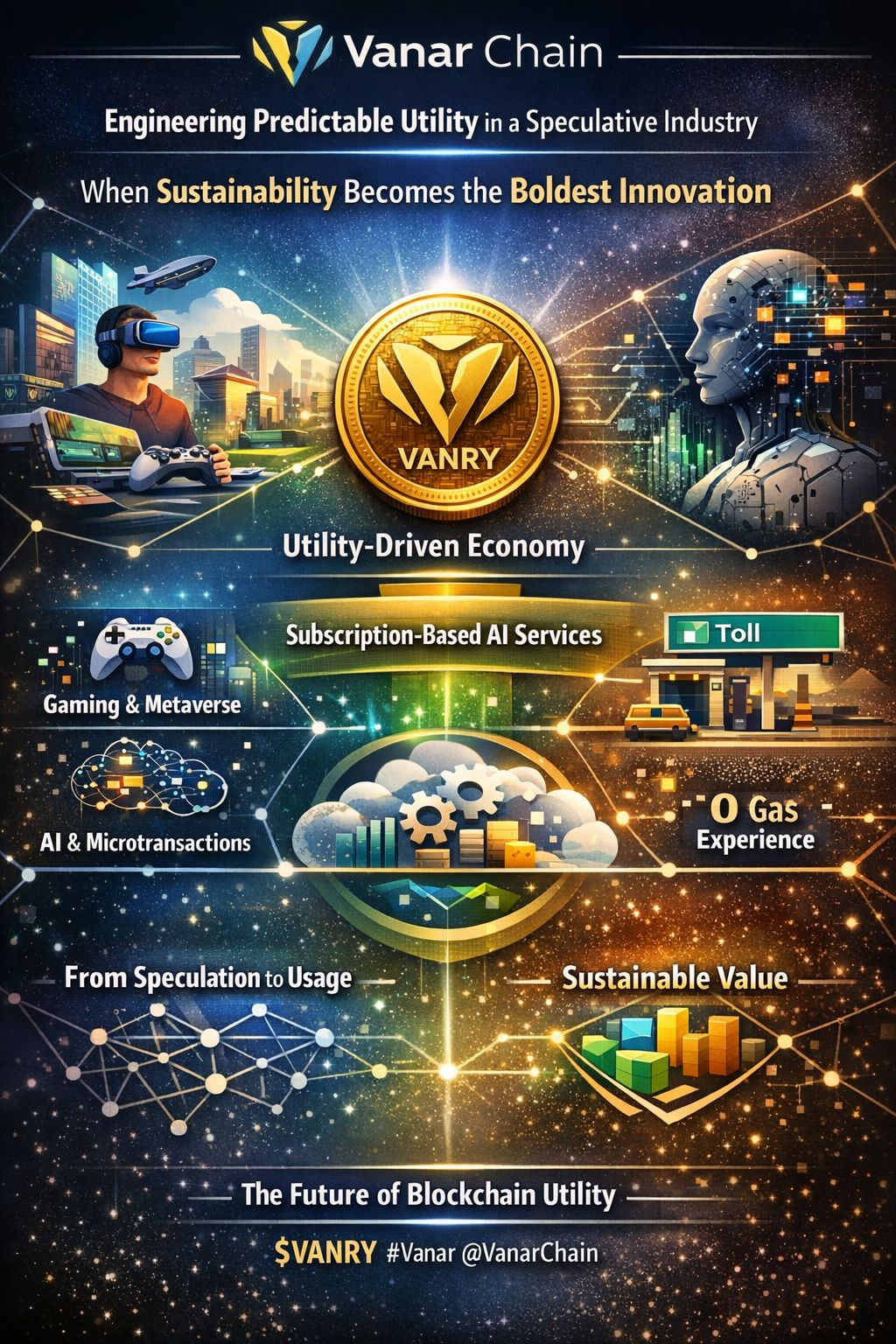
When Sustainability Becomes the Boldest Innovation
In a blockchain industry driven by liquidity cycles and narrative rotations, Vanar Chain is quietly pursuing a different thesis: that value should be engineered through usage, not speculation.
At the center of this shift sits VANRY—a token increasingly positioned not as a passive store of value, but as an operational unit inside an expanding digital economy.
From Feature-First to Utility-First
Vanar’s evolution reflects a broader realization across Web3: features attract attention, but repeatable usage sustains networks. Through deep integration across gaming, AI services, microtransactions, and metaverse experiences, Vanar is diversifying its sources of token demand.
Platforms like Virtua and the VGN Games Network demonstrate this applied approach. Gaming economies generate ongoing activity—asset purchases, upgrades, marketplace interactions—creating natural token velocity. When paired with AI services and semantic memory infrastructure like myNeutron, usage extends beyond entertainment into productivity and data intelligence.
This diversity matters. Networks dependent on a single narrative often struggle when sentiment shifts. A multi-vertical utility model builds resilience.
Subscription Economics: The Structural Shift
Vanar’s most strategic pivot may be its move toward subscription-based AI services denominated in VANRY.
Historically, blockchain products relied on sporadic transactions. Demand was unpredictable, and so was token velocity. Subscription models change that dynamic. When developers integrate AI reasoning workflows, memory indexing, or analytics layers into their stack, payments become recurring. Token demand becomes structured rather than speculative.
This mirrors traditional cloud economics. Companies budget monthly for compute, storage, and API calls. Vanar applies similar logic on-chain. If AI services become embedded in builders’ workflows, VANRY transitions from optional to operational.
The shift is subtle but powerful.
0 Gas: Removing Friction from the Equation
Web3 still struggles with user experience. Constant confirmations and visible gas fees break immersion—particularly in gaming and consumer applications.
Vanar’s 0 Gas design abstracts that friction. End users interact seamlessly while backend systems and B2B entities handle technical settlement. The vision resembles automated toll systems on highways: invisible, efficient, uninterrupted.
When complexity disappears, adoption accelerates.
Beyond a Single Chain
Vanar’s roadmap suggests its AI infrastructure may extend beyond its native chain. If semantic memory and AI tooling serve applications across ecosystems while VANRY remains the settlement layer, demand could emerge cross-chain.
This reframes Vanar from “another L1” to a potential AI infrastructure provider within Web3—a far more durable positioning.
The Real Test
Subscriptions do not guarantee success. They require tangible value. AI tools must save time, reduce costs, or enhance decision-making. Documentation must be clear. Billing must be transparent. Onboarding must scale.
If Vanar executes here, it transforms token economics from hype-driven cycles into repeatable, measurable usage.
Conclusion
Vanar’s strategy reflects business discipline rather than marketing drama. By tying token demand to subscriptions, gaming economies, AI infrastructure, and seamless UX, it is attempting to anchor value in activity rather than attention.
In a market addicted to volatility, that approach feels almost unconventional.
But sometimes, sustainability is the boldest innovation of all.