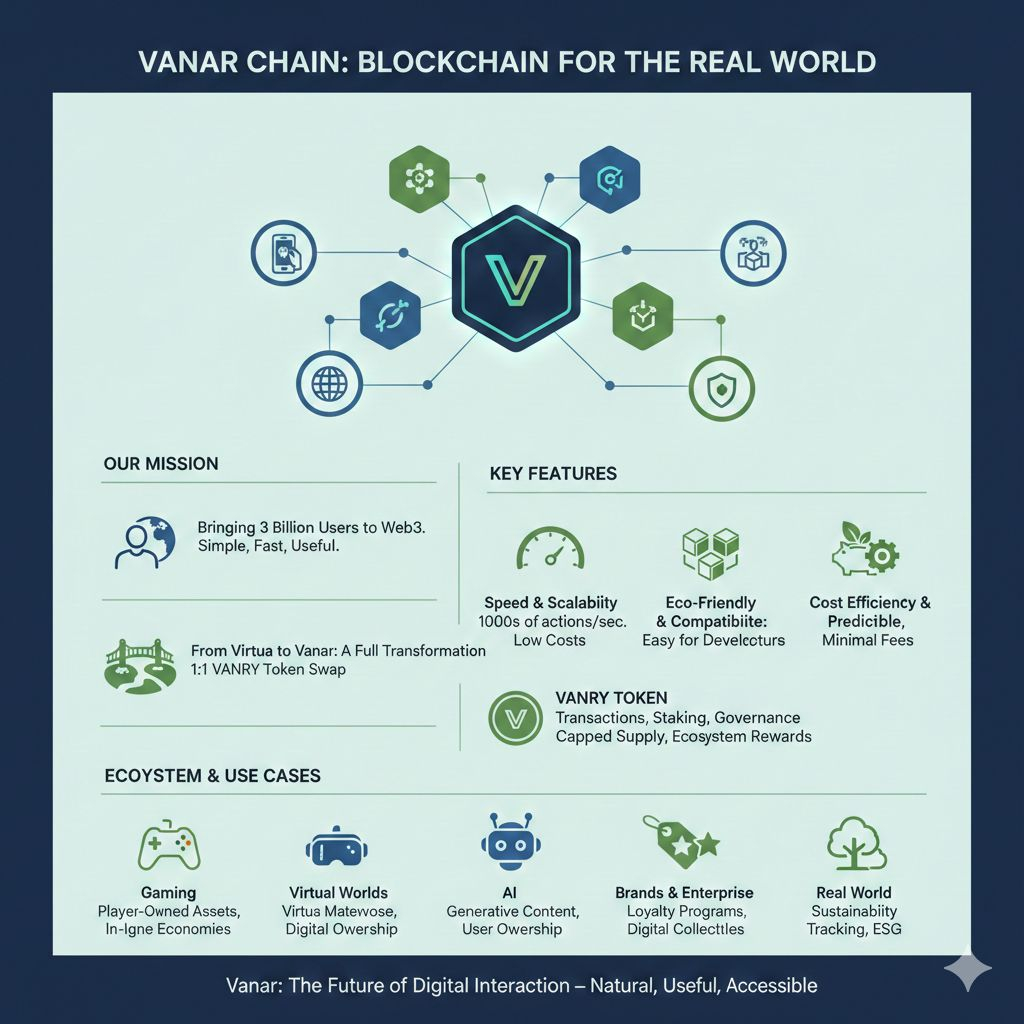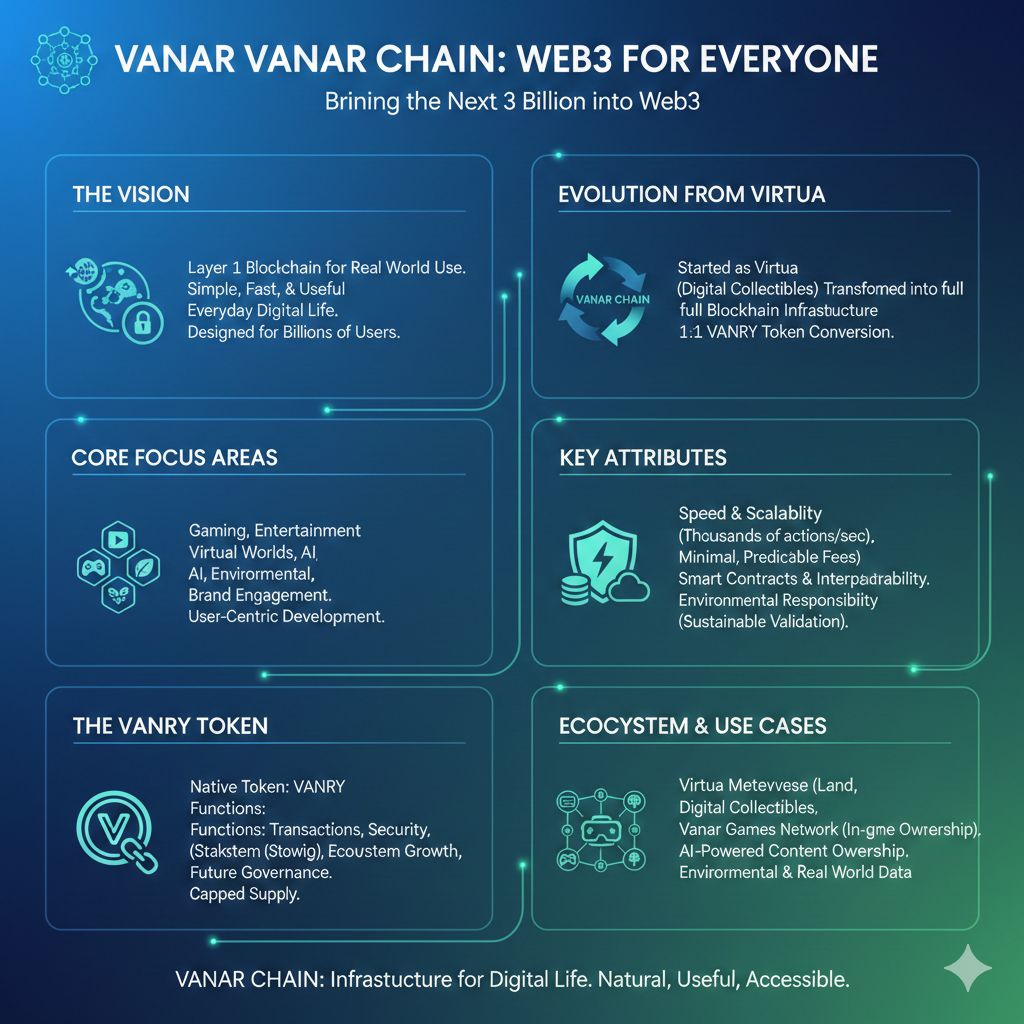
with one main idea in mind. Blockchain should work for real people in the real world. Most blockchains were designed for traders and developers who already understand wallets and gas fees. Vanar was designed for everyone else. Its mission is to help bring the next three billion people into by making blockchain simple, fast, and useful in everyday digital life.
Vanar focuses on industries that already reach billions of users. These include gaming, entertainment, virtual worlds, artificial intelligence, environmental systems, and brand engagement. Instead of building technology first and then searching for users, Vanar starts with users and builds the technology around them. The is powered by its native token called $VANRY , which supports transactions, security, and growth across the ecosystem.
Vanar did not start from nothing. It evolved from an earlier project known as Virtua, which worked on digital collectibles and immersive online experiences. Over time, the team realized that their tools could serve more than just one platform. They decided to build their own blockchain to support many products and industries instead of only one application. This decision led to a full transformation into Vanar Chain.
As part of this transition, the original token was replaced with VANRY through a one to one conversion. This ensured that early supporters remained part of the ecosystem while allowing the project to move forward with a clearer vision. The change represented a shift from being only a platform to becoming full blockchain infrastructure.
The team behind Vanar comes from backgrounds in gaming, entertainment, enterprise software, and brand development. This experience shapes how the blockchain is designed. Their goal is not only technical performance but also user comfort. They aim to create systems that feel familiar to people who already use apps, games, and digital services every day.
Vanar was built with speed and scalability in mind. Games and virtual environments require thousands of actions every second. Players trade items, earn rewards, move through worlds, and interact with others constantly. A slow or expensive blockchain would make these experiences frustrating. Vanar aims to handle these activities smoothly with low costs and fast confirmations.
The network also supports smart contracts so developers can build applications easily. It is designed to be compatible with common blockchain tools so developers do not have to start from scratch. This lowers the barrier for new projects and encourages more builders to experiment on the network.
Another important part of Vanar is cost efficiency. For mass adoption, transactions must be cheap enough that users do not even notice them. Small in game actions or brand interactions should not feel like financial decisions. Vanar is structured to keep fees predictable and minimal so applications can run naturally.
Environmental responsibility is also part of Vanar’s design. Instead of relying on energy intensive systems, the network uses more efficient validation methods and supports sustainable infrastructure. This makes it more appealing to companies and brands that care about climate impact.
The VANRY token plays several roles inside the ecosystem. It is used to pay for transactions and network operations. It is also used for staking, which helps secure the blockchain. Validators lock up VANRY to participate in block production and earn rewards. Over time, VANRY is also expected to play a role in governance, allowing the community to influence the direction of the network.
The supply of $VANRY is capped and most of the tokens are reserved for ecosystem rewards and long term development. This means they are intended to support growth rather than short term speculation. Instead of existing mainly for trading, $VANRY is meant to circulate inside games, virtual worlds, and applications as a functional currency.Vanar is not just a blockchain but an ecosystem of connected products. One of the most well known is the Virtua metaverse. Virtua is a digital world where users can own land, collect digital items, and participate in interactive experiences. It demonstrates how blockchain can support ownership and trade inside a virtual environment.
Another major component is the Vanar Games Network. This is a framework that allows game developers to integrate blockchain features into their games. Players can own their in game items, trade them freely, and move them between supported games. This creates player driven economies and gives users more control over their digital assets.Artificial intelligence is another area Vanar aims to support. AI can be used to generate characters, environments, and content inside games and virtual spaces. When combined with blockchain, this allows users to own the results of AI generated work and control how it is used. This opens the door to personalized digital experiences that are both automated and owned by users.
Vanar also focuses heavily on brand and enterprise use cases. Companies can use the blockchain to create digital collectibles, loyalty programs, access passes, and fan engagement systems. The goal is to hide technical complexity from users so that interacting with blockchain feels as simple as using any normal app.Environmental and real world integration is another part of Vanar’s vision. Blockchain can be used to track sustainability data, verify environmental claims, and manage carbon related systems. This links digital records to physical world accountability and brings more transparency to industries that need it.
Vanar is designed to connect with other blockchains rather than exist alone. Through bridges and interoperability tools, assets and data can move between networks. This allows Vanar to participate in the wider blockchain economy instead of remaining isolated.The idea of bringing in the next three billion users is based on real world trends. Billions of people already use smartphones, play games, and interact with digital brands. They buy digital items, subscribe to services, and build online identities. Vanar aims to integrate blockchain into these familiar behaviors instead of forcing people to learn complex crypto systems.
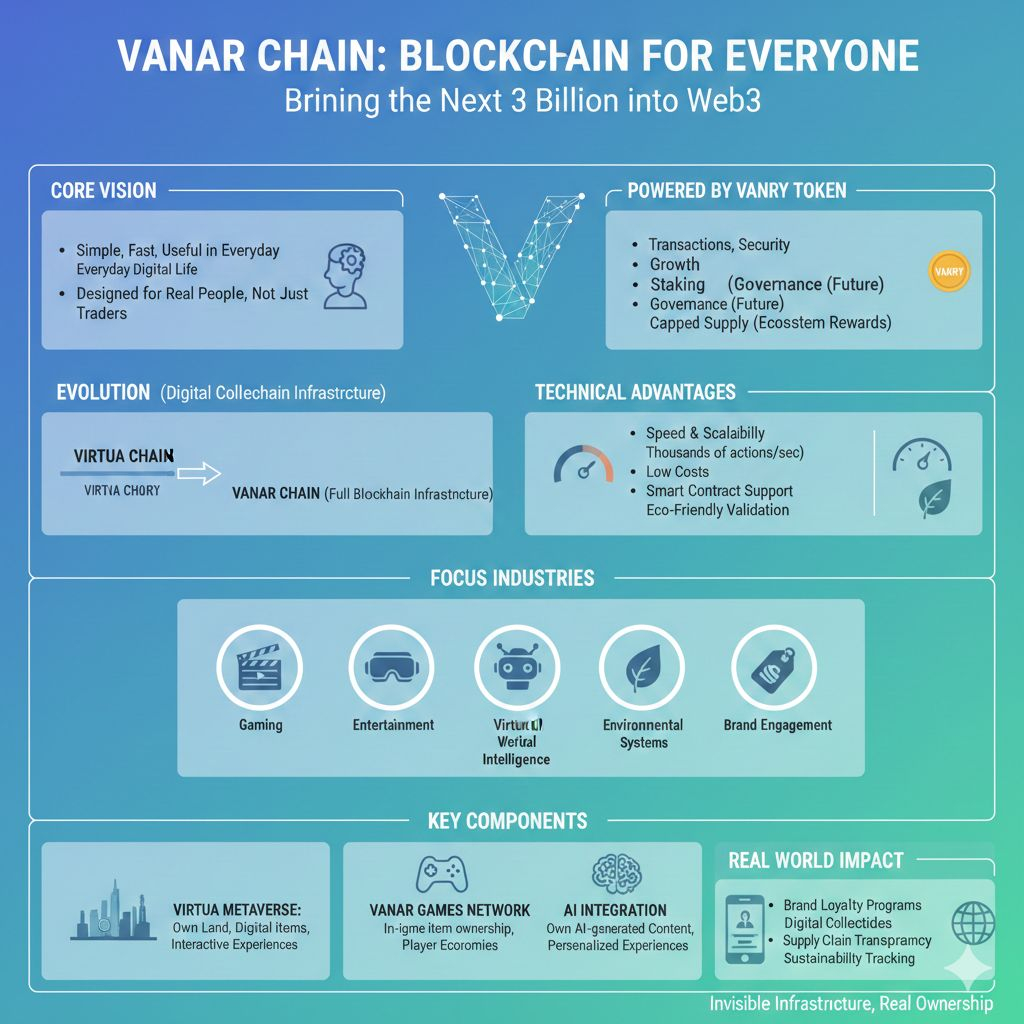
In this model, blockchain becomes invisible infrastructure. Users may not even realize they are using it. They simply experience faster systems, true ownership of digital items, and open marketplaces.Vanar operates in a competitive space alongside other blockchains focused on gaming and virtual worlds. What sets it apart is its unified focus on consumer experiences, environmental awareness, and brand readiness. Its success will depend on whether developers choose to build on it and whether users enjoy the products built on top of it.
There are still challenges ahead. The project must attract users, support developers, and adapt to changing regulations. Like all blockchain networks, it must also handle market volatility and technical risks. These challenges are not unique to Vanar but are part of the broader landscape.Looking forward, the future of Vanar depends on real usage. If games attract players, if brands launch meaningful campaigns, and if tools remain easy to use, the could become a backbone for digital interaction. Its long term value will come not from hype but from daily activity.
Vanar Chain represents a shift away from purely financial blockchain systems toward platforms built for human experience. It is designed for play, creativity, ownership, and interaction. Powered by the VANRY token, it aims to become infrastructure for digital life rather than just another trading . it reaches its goal of mass adoption will depend on execution and time. But its direction is clear. It wants blockchain to feel natural, useful, and accessible to ordinary people around the world.#vanar @Vanarchain