
Artificial intelligence is no longer confined to chat interfaces and analytics dashboards. A new wave of AI agents is emerging systems capable of making decisions executing tasks interacting with applications and adapting over time with minimal human input. These agents are shifting from being simple tools to becoming autonomous digital actors. As this evolution accelerates the infrastructure that supports them becomes just as important as the intelligence that powers them.
Blockchain networks were originally designed to record transactions securely and transparently. Their architecture prioritizes consensus immutability and decentralized validation. While these qualities are essential for financial settlement and asset ownership they do not automatically translate into environments optimized for autonomous reasoning systems. The requirements of AI agents extend far beyond transferring tokens from one address to another. They require context memory structured information and predictable execution environments.
This is where a new generation of blockchain infrastructure begins to matter. Vanar Chain approaches the rise of AI agents from a different starting point. Rather than retrofitting intelligence onto a transaction first architecture it positions itself as a network built to support intelligent systems operating directly within the blockchain environment.
The Shift From Transactions to Intelligence
Traditional blockchain design focuses on transactional efficiency. Networks compete on throughput block times and gas optimization. While these metrics are important they largely serve human driven interactions trading minting staking or transferring assets. AI agents introduce a fundamentally different dynamic.
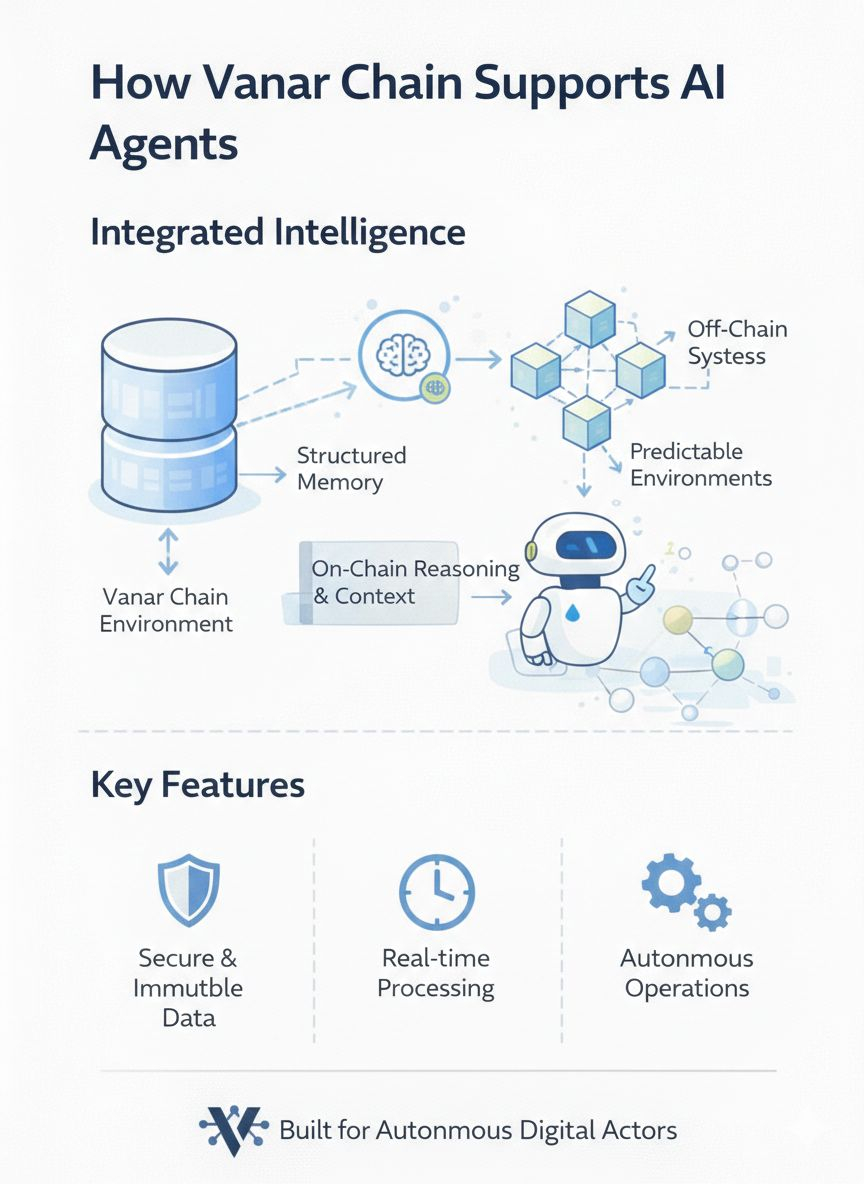
An AI agent does not simply initiate a transaction and wait. It observes states interprets data evaluates conditions and then executes actions based on logic. It may need to reference historical interactions adapt to new inputs and operate continuously without manual oversight. In such a model blockchain becomes not just a settlement layer but a cognitive environment where data and logic coexist.
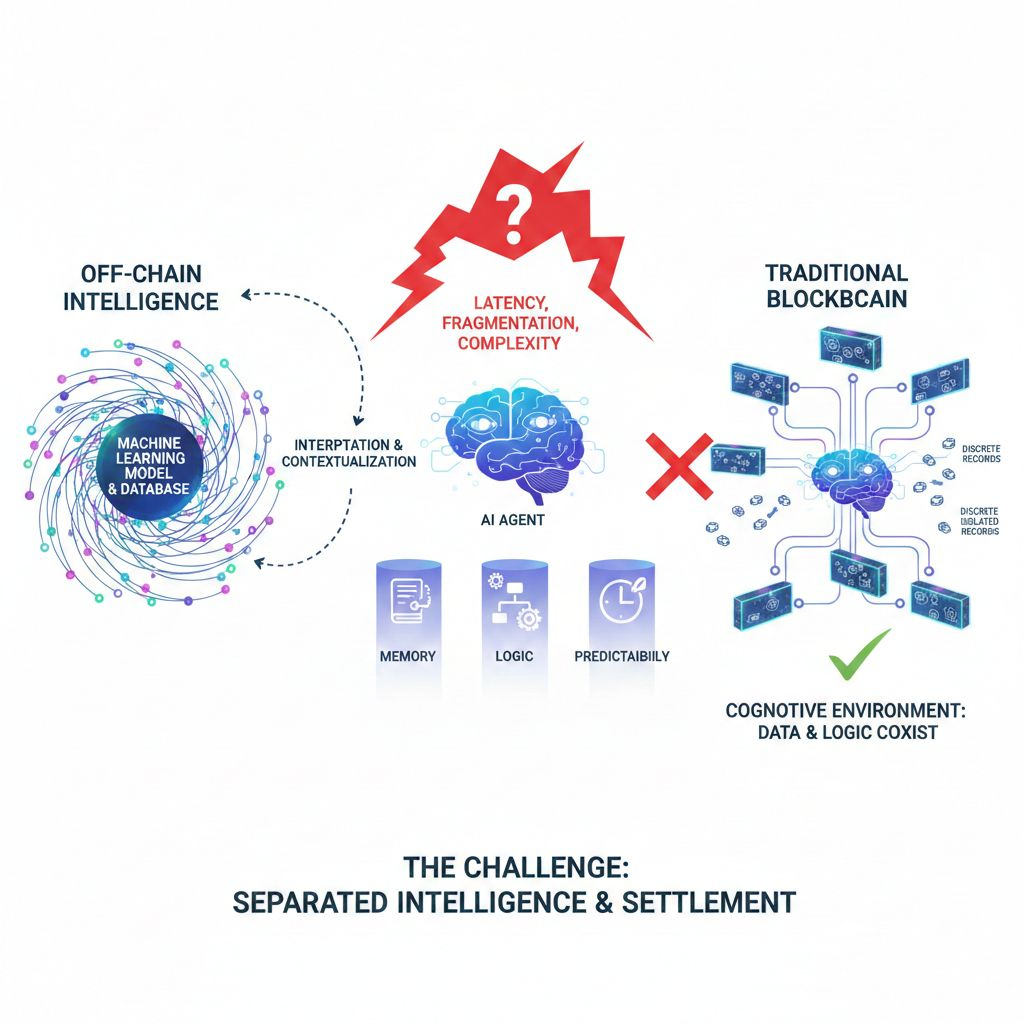
Most conventional chains were not architected with this paradigm in mind. Data on many networks is stored as discrete isolated records. While this design ensures integrity and traceability it does not inherently provide semantic meaning. AI systems therefore rely heavily on off chain infrastructure to interpret and contextualize on chain information. This separation between intelligence and settlement introduces latency fragmentation and complexity.
When reasoning happens off chain and execution happens on chain agents operate across divided environments. Each bridge between systems increases dependency and reduces cohesion. For AI agents to function seamlessly the infrastructure itself must evolve.
Why Traditional Chains Struggle With AI Agents
To understand the challenge it is helpful to examine the operational needs of autonomous systems. AI agents depend on three core pillars memory logic and predictability.
Memory is not simply storage. It is structured contextual awareness of past states and interactions. Logic refers to the reliable execution of decision making processes. Predictability ensures that actions occur under stable consistent conditions.
On many blockchains raw data is accessible but not inherently interpretable. An AI agent attempting to analyze prior states must reconstruct meaning by pulling multiple pieces of information and assembling them externally. This reconstruction process often occurs off chain where machine learning models and databases handle interpretation.
While this approach works in limited scenarios it creates fragmentation. Intelligence is detached from settlement. The blockchain becomes a passive ledger rather than an active environment for reasoning. As AI agents scale in complexity and frequency of interaction this separation becomes increasingly inefficient.
Additionally unpredictable network behavior can disrupt autonomous systems. Highly volatile transaction fees fluctuating throughput and inconsistent performance introduce uncertainty. For human users occasional delays or cost spikes may be tolerable. For AI agents operating continuously such variability can interfere with decision loops and automated workflows.
The Need for Structured Memory
AI agents rely heavily on context. Context allows them to understand relationships between data points recognize patterns and make informed decisions. Without structured memory an agent is forced to treat each interaction as isolated limiting its ability to reason effectively.
Vanar Chain emphasizes structured interpretable data at the protocol level. Instead of treating storage as a collection of unrelated entries it enables semantic organization that supports machine reasoning. This approach provides a foundation where AI agents can reference prior states and relationships without rebuilding context from scratch.
Structured memory changes how agents interact with on chain environments. Rather than extracting data processing it externally and then returning with a transaction agents can operate within a coherent system. Data becomes more than a record it becomes part of a navigable knowledge layer.
This design reduces dependency on external infrastructure. It narrows the gap between observation and action. For AI agents this cohesion enhances efficiency and reliability.
Logic Integrated Into Infrastructure
Beyond memory autonomous systems require dependable logic execution. Decision making models may be complex but their execution must be consistent. If reasoning occurs externally and only final actions are submitted on chain there remains a disconnect between intelligence and enforcement.
Vanar Chain integrates reasoning capabilities directly into its stack. By aligning data logic and execution within a unified environment it reduces latency between analysis and action. This integration allows agents to evaluate conditions and respond without unnecessary cross system friction.
Such architecture supports use cases that extend beyond simple automation. AI agents could participate in governance processes manage digital assets optimize decentralized applications or coordinate workflows. In each scenario the ability to reason and execute within the same environment strengthens reliability.
Latency becomes particularly important in machine driven systems. Micro delays that are negligible for human users can accumulate in automated loops. An infrastructure that minimizes these delays improves the feasibility of continuous intelligent interaction.
Predictability for Autonomous Systems
Autonomous agents operate best in stable environments. If transaction costs fluctuate dramatically or network conditions vary unpredictably agents must constantly adapt to external instability. This adaptation introduces complexity and can undermine performance.
Vanar Chain’s emphasis on coherent architecture and controlled system behavior addresses this challenge. By prioritizing predictability the network creates conditions suitable for sustained machine interaction. Agents can operate with clearer assumptions about execution costs and performance parameters.
Predictability is not merely about cost. It also relates to consistency of execution and system response. For AI agents managing assets engaging with decentralized applications or executing automated strategies stable conditions are essential.
In an ecosystem designed primarily for speculative activity variability may be an accepted trade off. In an ecosystem designed for autonomous systems coherence becomes a necessity.
The Role of VANRY in Agent Participation
As AI agents interact with applications and governance layers economic coordination remains essential. The native token functions as the operational medium that enables participation across the network.
When agents initiate transactions access data layers or engage with decentralized services token utility becomes aligned with automated activity. Instead of being driven solely by human traders and users network activity may increasingly reflect machine driven interactions.
This shift represents a broader evolution in blockchain economics. As AI agents become more integrated into decentralized systems token utility expands beyond manual transactions. It becomes intertwined with autonomous workflows and intelligent processes.
Such alignment between infrastructure and economic participation strengthens the ecosystem’s long term coherence. Agents contribute to network activity and the token facilitates that interaction within a predictable framework.
Toward Autonomous Application Ecosystems
The emergence of AI agents marks a turning point in digital infrastructure. Applications are no longer limited to static interfaces awaiting human input. They can become dynamic environments where autonomous systems collaborate optimize and evolve.
Vanar Chain positions itself as infrastructure capable of supporting this transformation. By focusing on structured memory integrated logic and predictable execution it aims to create conditions where intelligent systems can operate natively on chain.
This approach moves beyond viewing blockchain solely as a financial settlement layer. It reframes it as an environment for machine cognition and interaction. As AI agents grow more capable networks designed around coherence and reasoning may prove better equipped to sustain them.
The broader blockchain landscape is still adapting to this shift. Many networks continue to optimize for speed and cost without reconsidering architectural assumptions. Yet as AI agents become more prevalent the limitations of transaction centric design may become more visible.
Infrastructure that aligns with the needs of autonomous systems could shape the next phase of decentralized technology. Memory must be structured logic must be reliable and execution must be predictable. When these elements converge blockchain can evolve from a ledger of transactions into a substrate for intelligent activity.
The rise of AI agents is not a distant possibility. It is unfolding in real time. As developers explore new applications the question becomes not whether agents will interact with blockchain systems but which networks are prepared to support them effectively.
Vanar Chain represents one approach to answering that question. By designing around the operational realities of autonomous systems it seeks to bridge the gap between intelligence and decentralized infrastructure. In doing so it contributes to a broader conversation about what blockchain technology can become in an era defined by machine driven interaction.
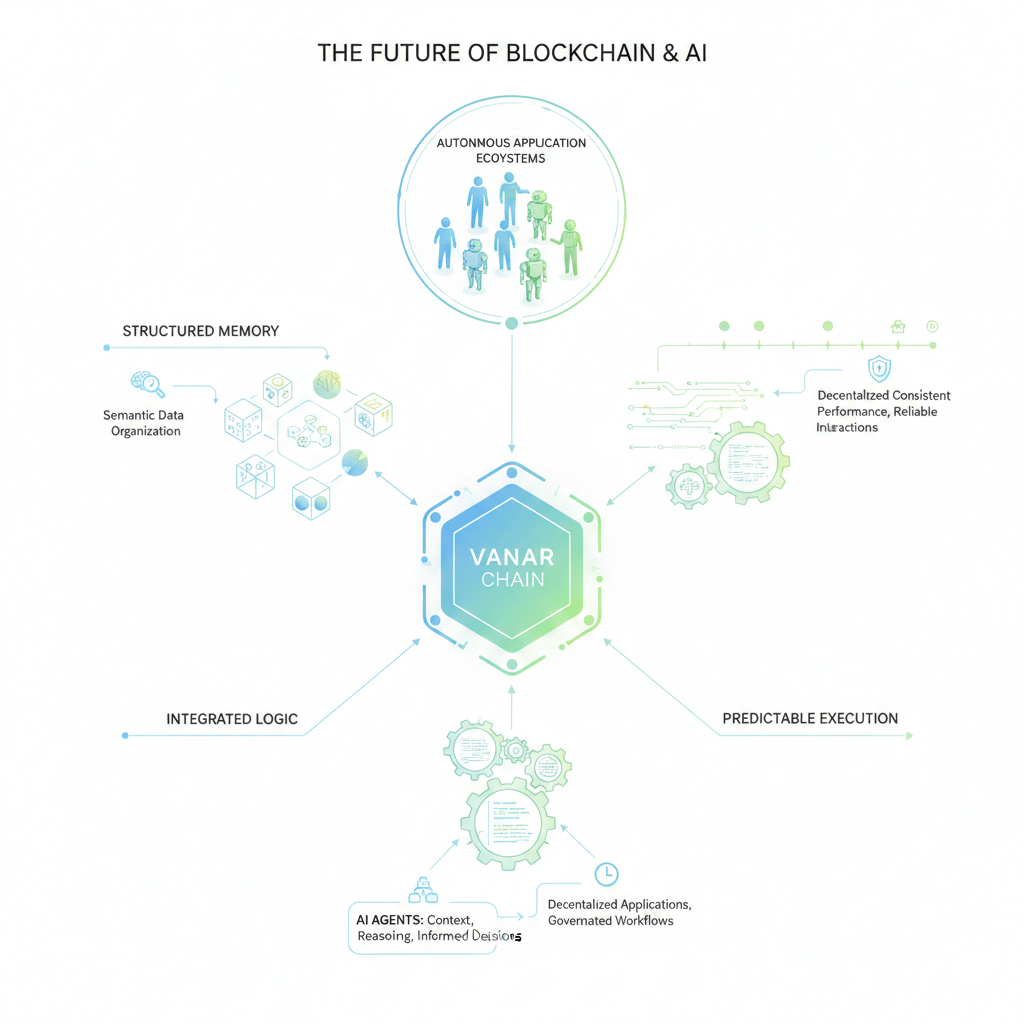
As digital ecosystems grow more complex the synergy between AI and blockchain will likely deepen. Networks that recognize this convergence early may play a defining role in shaping how autonomous agents participate in decentralized environments. The evolution is not simply about faster transactions or lower fees. It is about creating infrastructure where intelligent systems can think act and coordinate directly within the fabric of the network.
In this emerging landscape coherence may matter more than raw speed. Structured memory may matter more than storage capacity. Integrated logic may matter more than isolated execution. And predictability may matter more than volatility.
The future of blockchain may not belong solely to human users. It may increasingly belong to the intelligent agents operating alongside them.
