
The trajectory of decentralized finance has been marked by dramatic growth cycles followed by painful contractions, each revealing both the sector’s transformative potential and its infrastructural shortcomings. Plasma Network entered this dynamic landscape with a thesis that existing blockchain platforms, despite their innovations, remained fundamentally constrained by architectural decisions made when DeFi was barely a concept. The project emerged from recognizing that financial applications possess unique performance, security, and economic requirements that general-purpose blockchains cannot adequately serve without compromise. Rather than accepting these limitations as inevitable tradeoffs, Plasma set out to engineer infrastructure specifically optimized for the demands of decentralized finance at scale.
The problems Plasma addresses aren’t abstract technical concerns but practical barriers preventing DeFi from achieving its democratizing potential. Users attempting to participate in yield farming, provide liquidity, or execute trading strategies encounter transaction fees that make smaller positions economically unviable. During market volatility when DeFi activity peaks, network congestion creates unpredictable delays affecting trade execution and liquidation timing. Cross-chain opportunities remain frustratingly difficult to access because moving assets between networks requires navigating complex bridge protocols and accepting security risks that have cost users billions collectively. These friction points aren’t minor annoyances but fundamental obstacles preventing DeFi expansion beyond crypto-native users willing to tolerate significant complexity and cost.
The vision driving Plasma’s development centers on creating financial infrastructure where blockchain technology enhances rather than constrains the user experience. This means transaction finality fast enough that users don’t notice confirmation delays. It means fee structures where transaction costs become economically invisible rather than meaningful factors in strategy viability. It means cross-chain interactions that happen seamlessly without users manually managing assets across multiple networks. Achieving this vision required rethinking blockchain architecture from foundational principles rather than incrementally improving existing designs.
Performance Engineering for Financial Applications
Plasma’s technical architecture reflects deep understanding of what financial applications actually require to function competitively. The consensus mechanism achieves transaction finality in approximately two seconds through optimized proof-of-stake validation. This performance characteristic directly addresses timing-critical operations where delays measured in seconds can determine profitability. Arbitrage opportunities exist in fleeting windows as price discrepancies equilibrate across markets. Automated trading strategies depend on rapid execution to capture intended price points. Lending protocol liquidations must execute promptly during adverse price movements to protect lenders from losses. Plasma engineered consensus speeds meeting these demanding requirements without sacrificing decentralization or security.
Network throughput reaches thousands of transactions per second through innovations in data availability and execution optimization. Financial markets naturally generate sustained high-volume activity as participants continuously adjust positions, market makers update pricing, and automated protocols rebalance portfolios. Traditional blockchains frequently experience severe congestion during volatility spikes when transaction demand peaks precisely when users most desperately need reliable execution. Plasma’s architecture maintains consistent performance through market stress that would paralyze less capable infrastructure, ensuring that network capacity doesn’t become the limiting factor during critical periods.
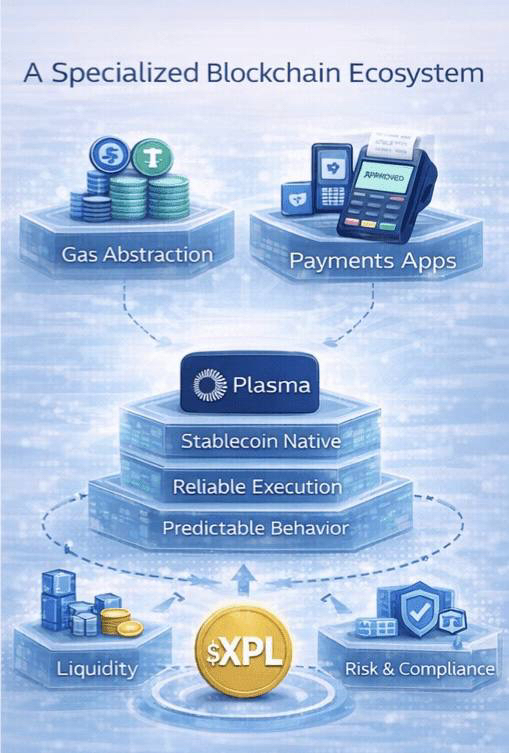
Transaction cost economics operate at scales enabling entirely new categories of financial strategies. Fees measured in cents or fractions of cents make frequent position adjustments economically rational and allow micro-strategies that would be impossible when each transaction costs multiple dollars. Financial applications inherently involve numerous operations as users enter positions, adjust exposure, claim yields, and exit positions. When individual transaction costs become economically significant, only large-capital participants can engage profitably. Plasma’s fee structure democratizes access by making sophisticated approaches viable regardless of portfolio size.
The modular architecture allows different system components to evolve independently while maintaining overall coherence and compatibility. Execution layers can upgrade without disrupting settlement or requiring applications to rewrite core logic. New financial primitives can integrate without requiring changes to base protocols. This flexibility matters enormously for long-term sustainability because DeFi innovation continues rapidly. Monolithic designs tightly coupling all functionality struggle to evolve without coordination challenges that slow development and create governance conflicts. Plasma’s modularity enables continuous improvement at the pace innovation demands.
Cross-Chain Infrastructure Solving Fragmentation
Plasma recognized that liquidity fragmentation across blockchain networks creates systematic inefficiencies harming users and limiting DeFi’s potential. Identical assets trade at different prices on different chains. Yield opportunities exist on networks where users don’t maintain positions. Capital sits idle on one chain while opportunities exist elsewhere. Traditional approaches to cross-chain interaction through bridge protocols have proven both cumbersome for users and vulnerable to exploits that have cost billions. Plasma’s cross-chain infrastructure addresses these challenges through architectural innovations maintaining security while enabling seamless interoperability.
The technical implementation employs cryptographic verification and specialized validation specifically designed for cross-chain operations. Rather than trusting bridge protocols secured by small validator sets vulnerable to compromise, Plasma’s cross-chain security model inherits from the broader network’s decentralization and economic security. This approach reflects hard-learned lessons from bridge exploits demonstrating that cross-chain infrastructure requires security architecture matching the value it handles. When substantial capital flows across networks continuously, security cannot be compromised for speed or convenience.
Liquidity aggregation represents another dimension beyond simple asset transfers. Users shouldn’t need to manually track opportunities across multiple networks or maintain positions on different chains to access optimal yields or trading prices. Plasma enables applications to access liquidity wherever it exists, abstracting cross-chain complexity from end users. Traders execute swaps receiving best available pricing regardless of which underlying networks provide liquidity. Yield optimizers deploy capital that automatically allocates across chains based on current opportunities. This unified experience transforms fragmented multi-chain reality into coherent financial infrastructure from the user perspective.
Financial Primitives Enabling Protocol Innovation
Plasma provides foundational capabilities enabling sophisticated financial applications while maintaining the composability that makes DeFi uniquely powerful. Decentralized exchanges benefit from performance characteristics supporting order book models alongside automated market maker designs. Order books offer advantages including superior price discovery and reduced slippage for larger trades, but require infrastructure handling high message rates from continuous order placement, cancellation, and matching. Plasma’s throughput and latency make order book exchanges viable on decentralized infrastructure at scales approaching centralized platforms.
Lending protocols gain enhanced capabilities from Plasma’s infrastructure foundation. Deterministic settlement enables sophisticated liquidation mechanisms protecting lenders while maximizing borrower flexibility. Cross-chain collateral acceptance becomes practical when infrastructure handles multi-chain operations securely without requiring manual bridging or centralized custody. Interest rates can adjust dynamically responding to real-time supply and demand without concerns that frequent updates generate prohibitive transaction costs. These capabilities enable lending markets serving both capital providers and borrowers more effectively than current alternatives constrained by infrastructure limitations.
Derivatives protocols require particularly robust infrastructure because leveraged positions demand reliable price feeds, instant liquidations during adverse movements, and capital efficiency minimizing collateral requirements. Plasma provides foundation where complex derivatives operate with reliability approaching centralized exchanges while maintaining decentralization benefits including transparency and elimination of counterparty risk. The platform enables derivatives markets previously impractical on decentralized infrastructure due to performance or reliability constraints that made them unsafe or economically unviable.
Token Economics and Network Sustainability
The XPL token coordinates economic incentives across ecosystem participants toward network health and sustainable growth. Validators stake XPL to participate in consensus, earning rewards for securing the network while facing penalties for malicious behavior or poor performance. This creates strong economic commitment to honest operation because validators risk substantial capital. The economic security model ensures attacking the network becomes economically irrational even for well-resourced adversaries who would need to acquire and risk enormous capital for uncertain potential gains.
Transaction fees paid in XPL generate utilization-driven demand correlating with network activity. Unlike tokens where utility remains theoretical, Plasma’s fee mechanism creates genuine economic consumption as protocols process transactions. DeFi applications handling significant volume generate substantial aggregate fee demand even though individual transaction costs remain minimal. This connection between usage and token demand creates fundamentally different dynamics than governance-only tokens. As DeFi adoption grows and more value flows through Plasma, fee demand scales proportionally with actual utility rather than speculation.
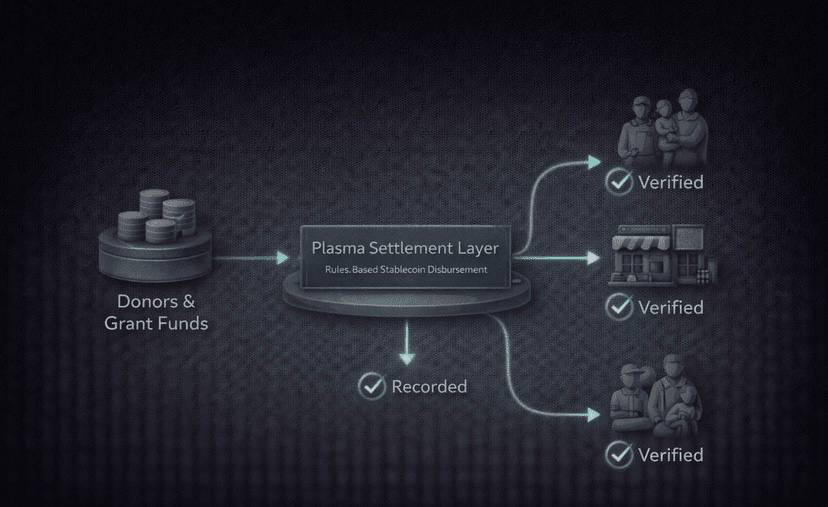
Governance enables community participation in protocol evolution and parameter optimization. Token holders vote on upgrades, parameter adjustments affecting economic variables, and ecosystem funding supporting public goods and development. For DeFi platforms, governance becomes particularly consequential because parameters directly impact strategy economics. Liquidation thresholds, fee structures, and protocol integrations all flow from governance decisions. This creates ongoing engagement beyond passive holding as participants actively shape the platform’s evolution based on their understanding of what serves the ecosystem best.
Security Foundation and Risk Management
Security represents paramount concern for financial infrastructure where vulnerabilities translate to immediate user losses. Plasma invested comprehensively in formal verification, rigorous auditing, and continuous monitoring. The architecture employs layered security where multiple defensive mechanisms protect against different attack vectors. No single vulnerability should compromise the entire system even if individual components face successful attacks. This defense-in-depth approach reflects understanding that security cannot assume perfection but must limit potential damage when breaches occur.
Validator network decentralization provides security through economic incentives and distributed trust rather than relying on trusted parties. Geographic and organizational diversity prevents concentration enabling coordinated attacks or censorship. Plasma cultivates participation across regions and entity types ensuring no single jurisdiction or interest group controls consensus. This decentralization creates resilience against both technical attacks and political pressure that might target centralized control points.
Smart contract security receives particular emphasis given DeFi’s history of costly exploits. Plasma provides security tooling helping developers avoid common vulnerability patterns. Automated scanning identifies potential issues during development before production deployment. Formal verification options allow mathematical proof of critical properties for high-value protocols. Security-focused frameworks guide developers toward secure patterns by default. They’re building ecosystem where security represents the path of least resistance rather than requiring extraordinary effort.
The Path Toward Financial Infrastructure Maturity
Looking forward, Plasma’s success depends on how effectively DeFi infrastructure enables seamless financial experiences without demanding user attention to underlying technology. The goal isn’t users constantly aware of blockchain but financial services working transparently while providing security and accessibility centralized alternatives cannot match. Plasma aims to become invisible foundation supporting these experiences without requiring technical understanding from participants.
If traditional financial institutions begin incorporating DeFi protocols, infrastructure like Plasma provides necessary bridges. Banks and asset managers require reliability and performance matching existing systems. Plasma’s optimization for financial applications positions it serving both crypto-native protocols and traditional finance exploring blockchain integration. This positioning could accelerate mainstream adoption as traditional finance discovers DeFi meeting institutional standards.
The journey from vision to mature infrastructure spans years navigating technical and market challenges. Competitors will emerge with alternative approaches. Market conditions will create opportunities and obstacles. Through these dynamics, Plasma’s clarity about problems they’re solving provides strategic direction. They’re building infrastructure making decentralized finance genuinely competitive with centralized alternatives through superior technology serving user needs rather than ideological positioning alone. Whether this succeeds at envisioned scale depends on execution and market acceptance, but the approach reflects deep understanding of what DeFi requires to achieve transformative potential beyond crypto-native communities. The future being built is one where powerful financial tools become accessible to anyone regardless of geography or wealth, enabled by infrastructure robust enough to support that vision globally.

