I want you to imagine the exact moment a normal person first touches Web3. They are curious, maybe even excited, but the feeling changes fast when the screen starts throwing strange words at them and every tap feels risky. One wrong move, one confusing fee, one slow confirmation, and the emotion shifts from curiosity to stress. That is the problem Vanar is trying to solve. Vanar is a Layer 1 blockchain built around the idea that real world adoption is not won by being clever, it is won by being comfortable. It is built to support the kinds of experiences people already love, games, entertainment, digital worlds, and brand experiences, where the user does not want to study how the system works. They just want it to work. Vanar’s own materials keep repeating this mindset in different ways: speed, predictable costs, and smoother onboarding, because those are the things that stop fear from taking over.
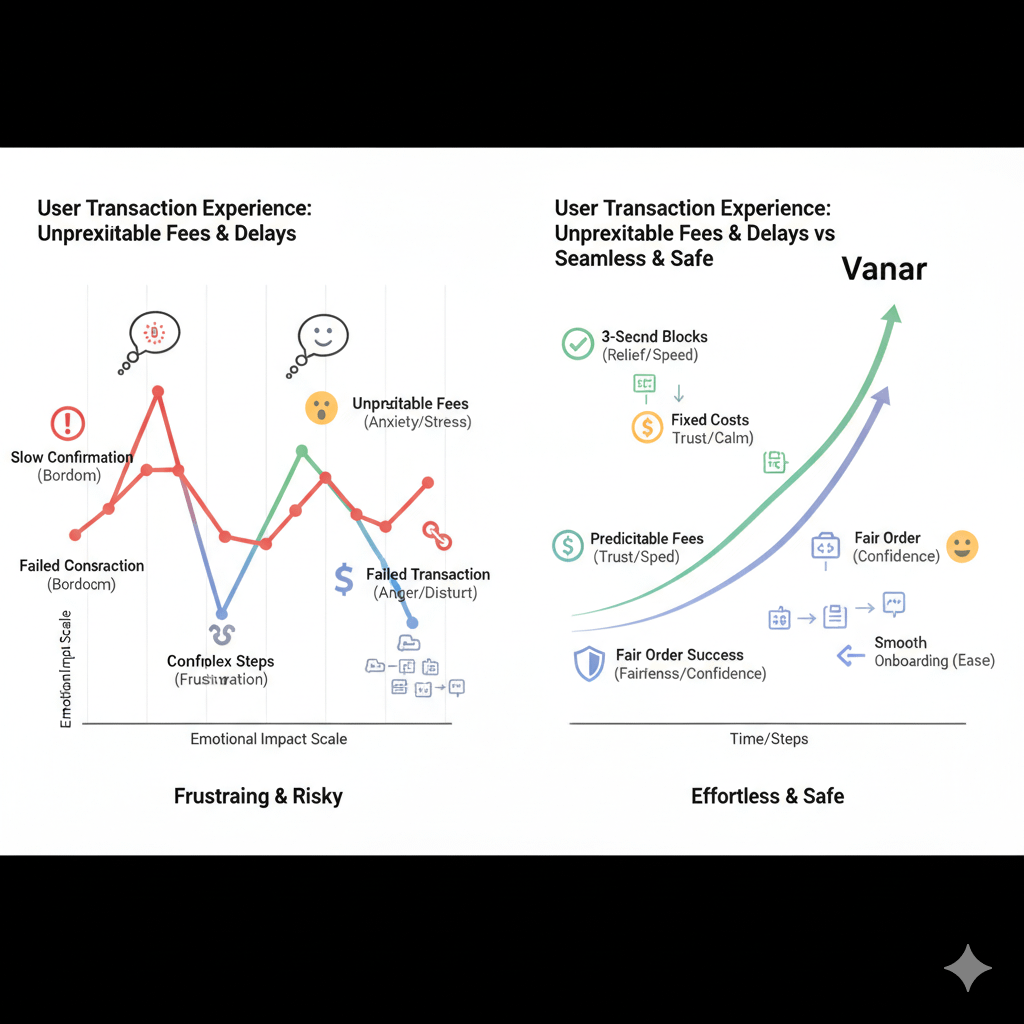
When I read their technical choices, I see a chain designed to protect a user’s mood. That sounds funny, but it is real. In consumer products, mood is everything. If the app feels slow, people feel bored. If the cost feels random, people feel nervous. If the system feels unfair, people feel angry. Vanar is built to avoid those feelings. Their whitepaper describes a fast network rhythm, with blocks capped at about 3 seconds, and they also describe a large capacity target per block, which is their way of saying they want the chain to stay responsive even when activity spikes. If a big game event happens or a popular drop draws a crowd, the chain is built to handle it without turning the experience into a mess.
Now let me explain how Vanar works in simple words, the way I would explain it to a friend. A blockchain is like a shared record book that many computers keep in sync. When something happens, like a user earning a reward, buying an item, or moving a digital collectible, the network writes it down in a way that can be checked later. The part that matters is how quickly and predictably the network can agree on what happened. Vanar’s design goal is to make that agreement happen fast enough that it feels like a normal app, not like a slow system you have to babysit. That 3 second timing is not just a number. It is the difference between a moment that feels smooth and a moment that feels broken.
The biggest emotional win they are aiming for is predictability. Vanar’s documentation and whitepaper describe a fixed fee approach, where the cost of common actions is meant to stay stable in dollar value terms, even though users pay the fee using the network token. This matters because surprise costs are one of the fastest ways to destroy trust. A new user might accept a tiny fee if it is clear and consistent. But if the fee jumps unpredictably, the user feels trapped, like they cannot control what will happen when they tap the button. Vanar is built to reduce that fear by keeping fees low and predictable, and they present this fixed fee idea as one of the main reasons their chain can work for mainstream apps and big projects.
There is also a fairness angle that might sound technical, but it is actually emotional. Vanar describes handling transactions in the order they arrive, rather than letting someone pay extra to cut the line. In real life, fairness is not optional. In a game, in a limited event, in a popular release, people want to feel like they had a real chance. If the system is built so that rich users always jump ahead, the experience feels rigged and the community energy collapses. Vanar’s approach is built to make the queue feel fair, because a fair system keeps people coming back.
Behind the scenes, a network needs trusted participants to keep it running, validate actions, and keep the record book honest. Vanar describes a model where people can support the network by staking the VANRY token, and where rewards flow to those who help secure the chain. Here is the simple meaning: instead of just watching from the outside, holders can take part in supporting the network’s safety, and the network pays them rewards for that support. This is important because it ties the token to real network function. It is not just something you hold and hope for. It is something you use to power activity and something you can stake to back the system and earn rewards.
Now let’s talk about the ecosystem in a way that feels real. Vanar talks about reaching the next billions through products that already attract mainstream attention, especially gaming, entertainment, and brand experiences. Two names that are often connected to the Vanar ecosystem are Virtua Metaverse and the VGN games network. The reason this matters is simple: people adopt technology when it gives them a feeling they want. Fun, belonging, creativity, status, access, ownership, identity. Most people will never adopt a chain because it is a chain. They adopt because the experience gives them something meaningful. Vanar is trying to be the chain that supports those experiences without making users feel like they are stepping into a complicated world.
Vanar also positions itself as more than a basic transaction network. On their official site, they describe a broader stack that includes a base chain plus additional layers designed to handle data and logic in a more integrated way, with components like Neutron and Kayon. I am not going to drown you in buzzwords. The simple promise they are trying to reach is this: apps should not feel scattered across too many separate systems. It is built to keep more of the app experience inside one consistent framework, so developers can build richer products and users get fewer confusing breaks in the flow. If this happens the way they intend, it can make Web3 apps feel more like modern apps, fast, guided, and helpful, instead of feeling like a set of disconnected steps. 
Let me explain VANRY in plain terms, because token utility is where many projects become vague, and that is where users get skeptical. VANRY is the fuel token used to pay network fees. So whenever an app runs an action on Vanar, the fee is paid in VANRY. That is the basic utility. On top of that, VANRY can be staked to support the network and earn rewards, which gives holders a way to participate in network security and benefit from it. Vanar also connects staking to participation in network direction, meaning staking is not only about rewards, it is also about having a voice in the system’s future. If a network is serious about long term adoption, these incentives matter, because they shape how people behave. They shape whether people build, support, and stay.
Vanar’s whitepaper also lays out a long term supply plan and reward approach, including a maximum supply cap and an emissions schedule for network rewards. I think this part matters for one emotional reason: stability. In Web3, people have been burned by sudden changes, unclear rules, and short term thinking. A long term plan is not a guarantee, but it is a signal that the project is trying to think in years, not in days. When communities feel that long term intention, they are more likely to build with patience instead of chasing quick exits.
So what does adoption look like if Vanar succeeds? It looks like this: a person joins a game or a digital world, and they do not feel afraid. They claim something and it arrives quickly. They pay a fee and it feels tiny and predictable. They do not feel like the system is designed to trick them. They do not feel like only insiders can win. And that is the moment Web3 stops feeling like a niche and starts feeling like normal life. This is why Vanar’s focus on speed, predictable costs, and fairness is not just technical. It is human. It is built to protect trust at the exact moment trust is hardest to earn.
When you ask what comes next, I see a clear test in front of them. The promise is big, and the world is not forgiving. They have to keep the network fast when usage grows. They have to keep fees predictable even when markets swing. They have to keep the experience fair when demand spikes. They have to keep developer building simple so the ecosystem stays alive with real apps and real users. And they have to prove that the broader stack vision they describe becomes something developers can use without complexity creeping back in. If this happens, Vanar can become more than another chain in a long list. It can become an example of what Web3 looks like when it finally chooses the user first.
I will end with the part that feels most important to me. The future of Web3 will not be decided by who sounds the loudest. It will be decided by who makes people feel safe enough to stay. That is the real fight. Vanar is important because it is trying to remove the emotional pain that stops adoption: fear of unpredictable fees, frustration from slow confirmations, confusion from complex onboarding, anger from unfair systems. If Vanar keeps building around those human realities, it helps push Web3 toward a future where ownership is normal, digital value feels real, and the technology disappears into the background the way great technology always does. That is how you reach the next billions, not by demanding that people change, but by building something that fits the way people already live.