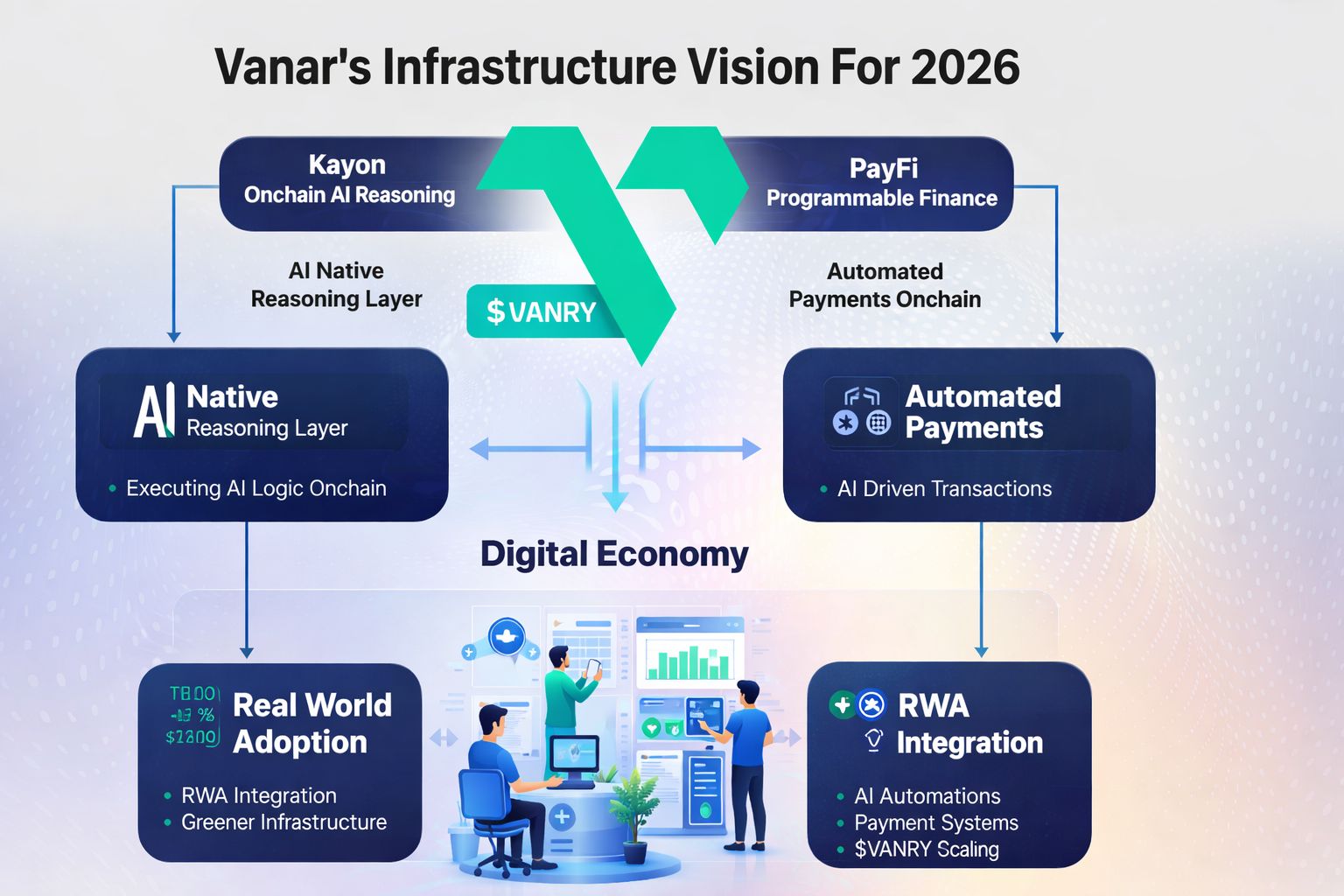
In crypto, most people watch price.
Smart builders watch infrastructure.
And in 2026, one of the most interesting infrastructure plays I’m personally watching is @vanar and its evolving ecosystem around $VANRY. Not because of hype. Not because of short term speculation. But because of what is quietly being built underneath.
Vanar is not trying to win headlines. It is trying to build foundations.
That difference matters.
The Shift From Narrative To Execution
A lot of L1 chains launched with big promises. Faster. Cheaper. More scalable. But over time, the real question became simple.
What are you actually enabling?
Vanar’s direction feels different. Instead of chasing trends, it is focusing on three core pillars that actually make sense long term.
AI native infrastructure
PayFi integration
Real world digital asset frameworks
This is not a meme cycle strategy. This is infrastructure positioning.
And if you are a builder, that is where attention should go.
Kayon And Onchain Reasoning
One of the most overlooked upgrades inside Vanar is its onchain AI reasoning layer, Kayon.
Most chains talk about AI. Few integrate it at protocol level.
Kayon allows AI agents to execute reasoning directly onchain. That reduces external dependency layers and makes decision logic verifiable inside the network itself. For builders, this changes the design space completely.
Instead of building apps that depend entirely on offchain AI APIs, you can integrate onchain logic that interacts with value settlement in the same environment.
AI that can think and settle in one flow.
That is a serious structural advantage if executed correctly.
PayFi Is Not Just A Buzzword
Payments in crypto have always been fragmented. High volatility. Gas complexity. UX friction.
Vanar’s PayFi direction is focused on simplifying value transfer and agent based payment execution. The goal is not just faster transactions. It is programmable financial interaction.
Imagine AI agents handling subscription flows, settlements, microtransactions and service logic automatically.
That is where PayFi connects with AI infrastructure.
This is why I see Vanar less as a typical L1 and more as a coordination layer between intelligence and payments.
Sustainable Token Utility Model
Another thing that stands out to me is the shift toward subscription based utility models within the ecosystem.
Instead of relying purely on speculative trading activity, the idea is to tie $VANRY demand to ongoing usage of AI services and infrastructure tools.
Builders need predictable cost structures. They need models that scale with usage, not just hype cycles.
If Vanar continues pushing toward real utility demand rather than transactional noise, that creates a more stable long term foundation.
And stability attracts serious builders.
Environmental And Enterprise Angle
Vanar has also positioned itself around greener infrastructure and enterprise alignment.
In a regulatory environment that is tightening globally, compliance friendly and energy conscious networks will have an edge.
Builders who want longevity will naturally prefer ecosystems that can integrate with real world frameworks instead of fighting against them.
This matters more in 2026 than it did in 2021.
Why 2026 Is Important
The market is maturing.
Speculation cycles are shorter. Users are more aware. Institutions are more cautious.
In this phase, infrastructure that supports AI automation, programmable finance and real world integration becomes extremely valuable.
Vanar seems to understand that the next wave is not about louder marketing.
It is about smarter design.
And as someone who watches structural shifts more than short term volatility, I find that interesting.
My Honest Take
Vanar is still early. Execution will decide everything. Roadmaps are easy. Adoption is hard.
But the direction makes sense.
AI native logic
Payment focused architecture
Utility driven token economics
Builder oriented positioning
If you are a developer thinking long term, ignoring infrastructure plays like @Vanarchain could mean missing where the next real build cycle forms.
I am not watching Vanar for noise.
I am watching it for architecture.
And in crypto, architecture always outlives hype.