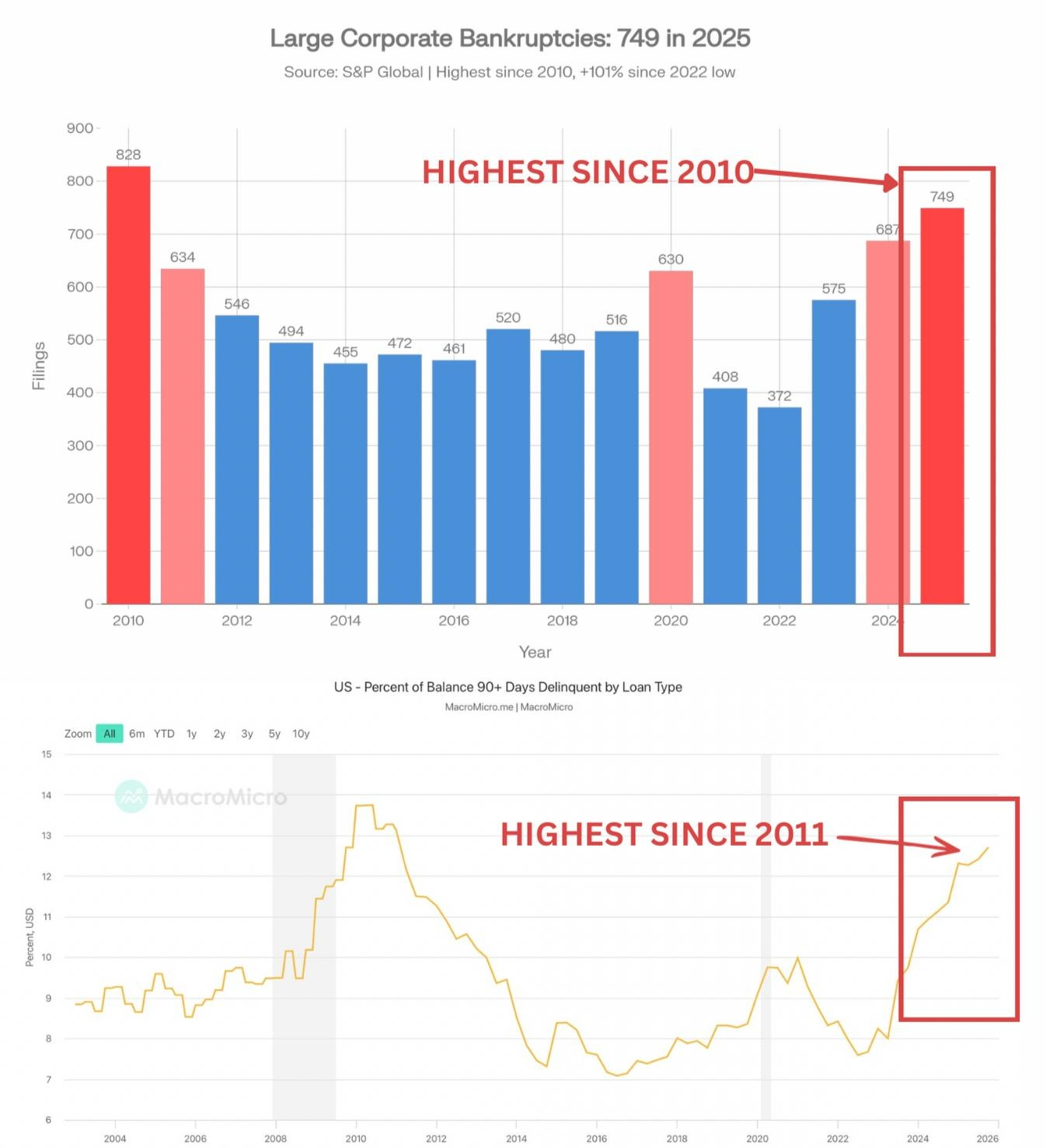
BREAKING: U.S. corporate failures and consumer stress just hit crisis levels, the worst since 2008.
In just the last 3 weeks, 18 large companies each with $50M+ in liabilities have filed for bankruptcy. Last week alone, 9 large U.S. companies went bankrupt.
That pushed the 3-week average to 6, the fastest pace of large bankruptcies since the 2020 pandemic. To put that in perspective, the worst stretch this century was during the 2009 financial crisis, when the 3 week average peaked at 9.
So we’re at crisis peak levels.
Now look at consumers: the stress is even clearer.
Serious credit card delinquencies rose to 12.7% in Q4 2025, the highest since 2011, when the economy was still dealing with the aftermath of 2008.
Since Q3 2022, serious delinquencies have jumped +5.1 percentage points, a bigger rise than what was seen during the 2008-2009 period.
That means people falling behind on payments is accelerating, not stabilizing.
Late stage stress is rising too.
Credit card balances moving into 90+ days delinquent climbed to 7.1%, now the 3rd highest level since 2011.
Younger consumers are under the most pressure:
Ages 18-29 are seeing serious delinquency transitions around 9.5%, and ages 30–39 around 8.6%, both much higher than older groups.
Younger households drive a big share of discretionary spending, so this is serious.
U.S. household debt just hit a new record of $18.8 trillion, rising +$191 billion in Q4 2025 alone. Since January 2020, household debt has increased by $4.6 trillion.
Every major category is now at record highs:
Mortgage debt is at $13.2T, credit card debt at $1.3T, auto loans at $1.7T, and student loans also at $1.7T.
So, Here's what happening all at same time:
- Companies are going bankrupt faster.
- Consumers are missing payments more.
- Delinquencies are rising sharply.
- Debt balances are already at records.
This combination usually shows up late in the cycle, when growth is slowing but debt is still high.
If bankruptcies keep rising and consumers keep falling behind, it puts pressure on jobs, spending, and credit markets next.
That’s when policymakers typically step in.
The Federal Reserve’s main tools are rate cuts, liquidity support, and eventually balance sheet expansion if stress spreads into the financial system.
In simple terms: cheaper borrowing, easier credit, and more money flowing into the system to stabilize growth.
But policy response usually comes after the damage starts showing clearly in the data.
Right now, the signal from bankruptcies, delinquencies, and debt is pointing in one direction:
Financial stress is rising fast and the window for policy support is getting closer.
#USNFPBlowout #CZAMAonBinanceSquare #TrumpCanadaTariffsOverturned #USTechFundFlows #USRetailSalesMissForecast