


My friend Marcus texted me at 2am last week saying he just gave notice at his Web2 job.
I thought he’d finally lost it. Guy has a wife, a mortgage, two kids. You don’t just quit stable employment in this economy.
Then he sent me a screenshot of what he’d been building secretly for three months on Vanar.
He Built Something I Didn’t Think Was Possible
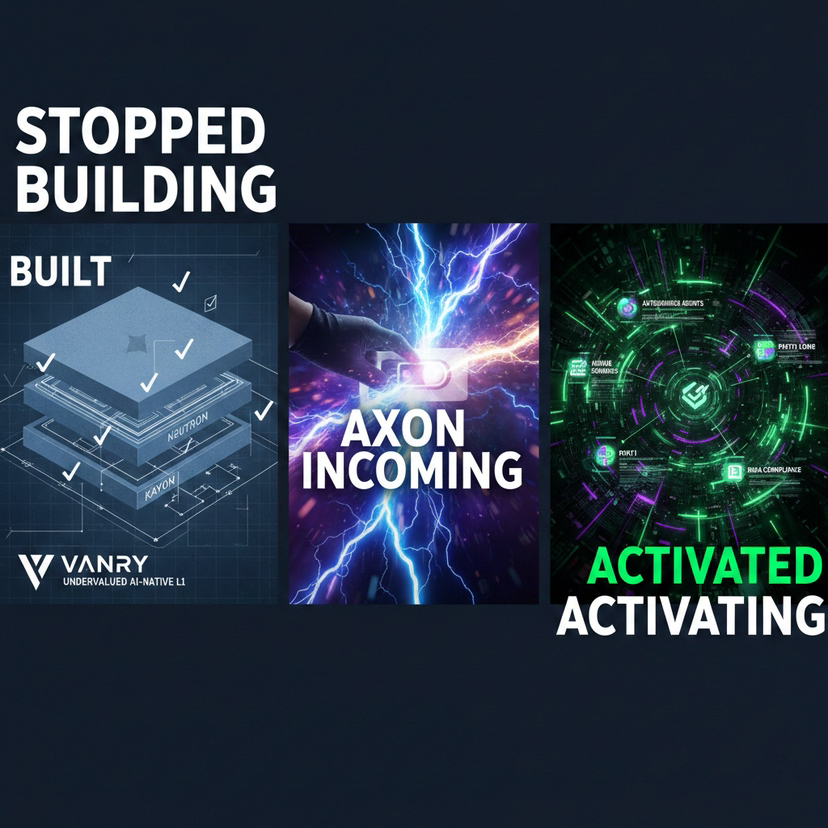
An AI agent that actually remembers every interaction it has with users. Not through some janky database he maintains. Through Neutron’s memory layer built into the chain itself.
The agent learns customer preferences, adapts its responses over time, and gets smarter without Marcus touching the code after deployment.
He showed me a demo. Same user asking similar questions six weeks apart. The agent referenced the previous conversation naturally. Suggested things based on patterns it noticed. Like talking to someone who actually knows you.
I asked him how much custom infrastructure he built to make that work. He laughed.
“That’s the point. I didn’t build any of it. Neutron just handles memory persistence. Kayon handles the reasoning logic. I just wrote the application layer.”
Then He Told Me About Axon
Then he told me why he’s quitting now instead of waiting.
Axon is launching soon. It’s the automation layer that sits on top of everything Vanar already shipped.
Marcus explained it like this. Right now he can build agents that remember and reason. With Axon, those agents can actually do things autonomously based on what they learn.
Execute transactions. Modify their own behavior. Coordinate with other agents. Without him writing manual triggers for every possible scenario.
He’s Betting His Family’s Income on This
“I can build in three weeks what would take six months on any other chain. And the result actually works like AI is supposed to work, not like a chatbot stapled to a smart contract.”
That’s when I realized he wasn’t being reckless. He’d done the math.
VANRY is trading at what he called embarrassingly low levels for what the infrastructure can already do. Before Axon even launches.
He thinks the market hasn’t figured out yet that Vanar stopped being a concept and became a working product nobody’s using because nobody knows it exists yet.
His Plan Is Simple
Build three applications before anyone else realizes what’s possible. Get users. Generate revenue. Prove the stack works at scale.
By the time everyone else figures out you can build autonomous intelligent applications that actually function, he’ll already have users and revenue.
Not token speculation. Actual SaaS revenue from apps that happen to run on Vanar.
I Asked Him About the Risk
I asked him what happens if this doesn’t work. If Axon launches broken or adoption doesn’t come.
He shrugged. “Then I get another Web2 job in six months and I learned how to build AI native apps before anyone else did. Worst case I’m more valuable than before.”
Why This Conversation Changed My View
I’d been watching Vanar from a distance thinking it was just another AI blockchain doing what everyone else claims to do.
But Marcus is the most risk-averse developer I know. The fact that he’s betting his family’s financial stability on this stack working tells me something fundamental shifted.
Vanar isn’t in the promise phase anymore. They’re in the “developers are building real businesses on it” phase.
That’s completely different. And way more interesting than any roadmap announcement.
The Activation Phase Makes Sense Now
When people say Vanar entered the activation phase I thought that was just marketing language.
After talking to Marcus I get it. The foundation is completely done. Neutron and Kayon are live and working.
Axon is the piece that turns “this infrastructure works” into “you can build actual businesses with this infrastructure.”
That’s activation. Not hype. Not promises. Developers quietly quitting their jobs to build because the math finally works.
I’m Watching What He Builds
I’m not buying VANRY because Marcus quit his job. That would be stupid.
But I am watching extremely closely what he builds over the next three months.
Because if he’s right and the infrastructure can actually deliver what he thinks it can, he won’t be the only developer making this calculation.
And when developers start building real revenue-generating businesses instead of speculative dApps, that’s when chains stop being experiments and become infrastructure.
Marcus might be early. Or he might be insane. Time will tell.
But he’s betting his mortgage payment that Vanar’s 2026 isn’t about announcements. It’s about proving the stack works by actually using it.
That’s the kind of conviction you can’t fake. And it’s way more interesting than any whitepaper.
