

Why Payments Complete AI-First Infrastructure — and Why @Vanarchain Builds From That Premise
The most common misunderstanding about AI agents is that they are a software problem. That if you make a model smarter, give it better reasoning, hook it up to more tools, the rest follows. But there is a hard floor that has nothing to do with model capability. It has to do with money.
AI agents are everywhere — answering questions, summarizing documents, and assisting with tasks. But today's agents hit a wall when they need to actually do something that requires money. That is not a model problem. That is an infrastructure problem. And it is the gap that everything interesting happening right now in AI payments — and in #vanar Chain's design specifically — is trying to close.
The Agent Problem Nobody Is Talking About
When most people imagine AI agents, they imagine something like a very capable assistant. Ask it to book a flight. Ask it to research a market. Ask it to draft a contract. The agent does the cognitive work. The human approves and clicks.

That model is already becoming obsolete. The next wave of agents doesn't ask for approval. It executes. It negotiates with other agents. It pays for compute on demand. It settles invoices at 3am when a condition is triggered. It runs in the background of a supply chain, purchasing logistics slots in real time based on demand signals. It manages a treasury.
The problem is that AI agents cannot open traditional bank accounts. These digital entities are not recognized as legal persons, meaning banks will not open accounts for them. That is not a minor inconvenience. It is a structural wall. An agent operating at machine speed, making thousands of micro-decisions per day, cannot wait for a human to approve each transaction. It cannot route through a system designed for the assumption that a human is sitting at a keyboard, clicking confirm, carrying legal liability.
While today's payment systems generally assume a human is directly clicking "buy" on a trusted surface, the rise of autonomous agents and their ability to initiate a payment breaks this fundamental assumption. Every layer of traditional financial infrastructure — fraud detection, KYC, chargebacks, authorization flows — was built around the human-as-actor model. Agents break that model completely.
[████████████████████] ~95% of payment rails globally designed for human-authorized transactions
[████████] Estimated <5% of current infrastructure natively supports agent-initiated autonomous settlement
[████████████] AI agent market cap tokens surged to tens of billions in 2025 — demand is real
Why Traditional Wallet UX Is the Wrong Frame
The response from most of the industry has been to give agents wallets. Coinbase rolled out "Agentic Wallets," enabling AI agents to independently hold funds, send payments, trade tokens, earn yield, and transact on-chain, with built-in security guardrails. This is progress. But a wallet is not infrastructure. A wallet is an interface.
The deeper question is what sits beneath the wallet. What handles settlement finality? What ensures the agent's memory of the transaction persists? What allows the agent to query what it has already paid for, to whom, under what conditions, in a format it can reason over? What handles the compliance layer when the agent is operating across jurisdictions? What happens when the agent needs to trigger a smart contract conditional on data it compressed and stored from a prior session?
Traditional wallets don't answer any of those questions. They answer one question: can this key sign a transaction? That is table stakes. An AI agent with a wallet but no policy controls is like a teenager with a credit card and no spending limit. The payment capability exists. The infrastructure around it — memory, compliance, context, execution logic — does not.
This is where most chains fail agents. They were not designed for agents. They were designed for humans who want to self-custody assets or interact with DeFi protocols. The agent use case is a completely different set of requirements bolted onto infrastructure that was never meant to support it.
What Agents Actually Need: Settlement as a Primitive
If you take a look at traditional payment systems, they weren't built for autonomous agents; they're slow, permissioned and oftentimes geographically restricted. The average bank needs business days for cross-border wires. Such a system doesn't work in a world where AI agents operate globally, making decisions in milliseconds, needing to pay for resources or services on demand.
For agents, settlement cannot be an add-on. It has to be a primitive — meaning it needs to be as reliable, low-latency, and programmable as any other core function in the stack. An agent that can reason but cannot settle is incomplete, in the same way that a function that can compute but cannot return a value is broken.
The specific requirements are concrete. Sub-cent transaction fees — because agents make enormous numbers of small payments and even a $0.10 fee destroys the unit economics of micro-transactions. Finality in seconds — because agents operate on decision loops measured in milliseconds, not banking days. Programmable conditions — because agent payments aren't just transfers, they're contracts. Pay this address when this condition is true. Release this escrow when the oracle confirms delivery. Split this revenue based on this logic. And persistent memory — because an agent that cannot remember what it paid for, or recall the context of a prior negotiation, cannot operate reliably in any real-world environment.
The division of labor is clear: AI agents make policy-constrained, context-aware decisions as the decision layer; blockchains execute those decisions and record them immutably as the execution and data layer. The result is auditable autonomy, not unconstrained automation.
[████████████████████] x402 protocol — Coinbase's open agent payments standard — processed 50M transactions since launch
[████████████████] Average traditional cross-border wire: 2–5 days, 3–7% fee. Agent-native rails: seconds, <$0.001
[████████████] PayPal, Visa, Mastercard, Google all announced agent payment protocols in 2025 — the race is real
Where Compliance and Global Rails Actually Matter
There is a version of the agent payments story that stops at "programmable money on-chain." That version misses something important: the vast majority of economic value that agents will eventually interact with lives inside regulated systems — payroll, invoices, insurance settlements, tokenized real-world assets, cross-border trade.
Getting agents into those systems requires compliance rails. Not as an afterthought. Not as something you add at the end when a regulator asks. As part of the base infrastructure.
The US Congress passed the GENIUS Act in 2025, giving stablecoins regulatory clarity for the first time. That is the starting gun. With regulatory clarity comes institutional engagement, which means the next wave of agent applications will be expected to operate within legal frameworks, with auditable trails, verifiable identity for the entity that authorized the agent, and conformance to the jurisdictions they operate in.
One of the biggest challenges is ensuring that AI agent transactions remain compliant with regulatory frameworks. Know Your Agent (KYA) — analogous to traditional Know Your Customer processes — is designed to verify the beneficiary behind an AI agent, ensuring all transactions are conducted transparently and within legal frameworks.
A chain that cannot support compliance is a chain that cannot support the enterprise agents that will eventually move the most value. That is not a theoretical concern. It is a near-term market reality.
Vanar Chain: Infrastructure That Was Built for This
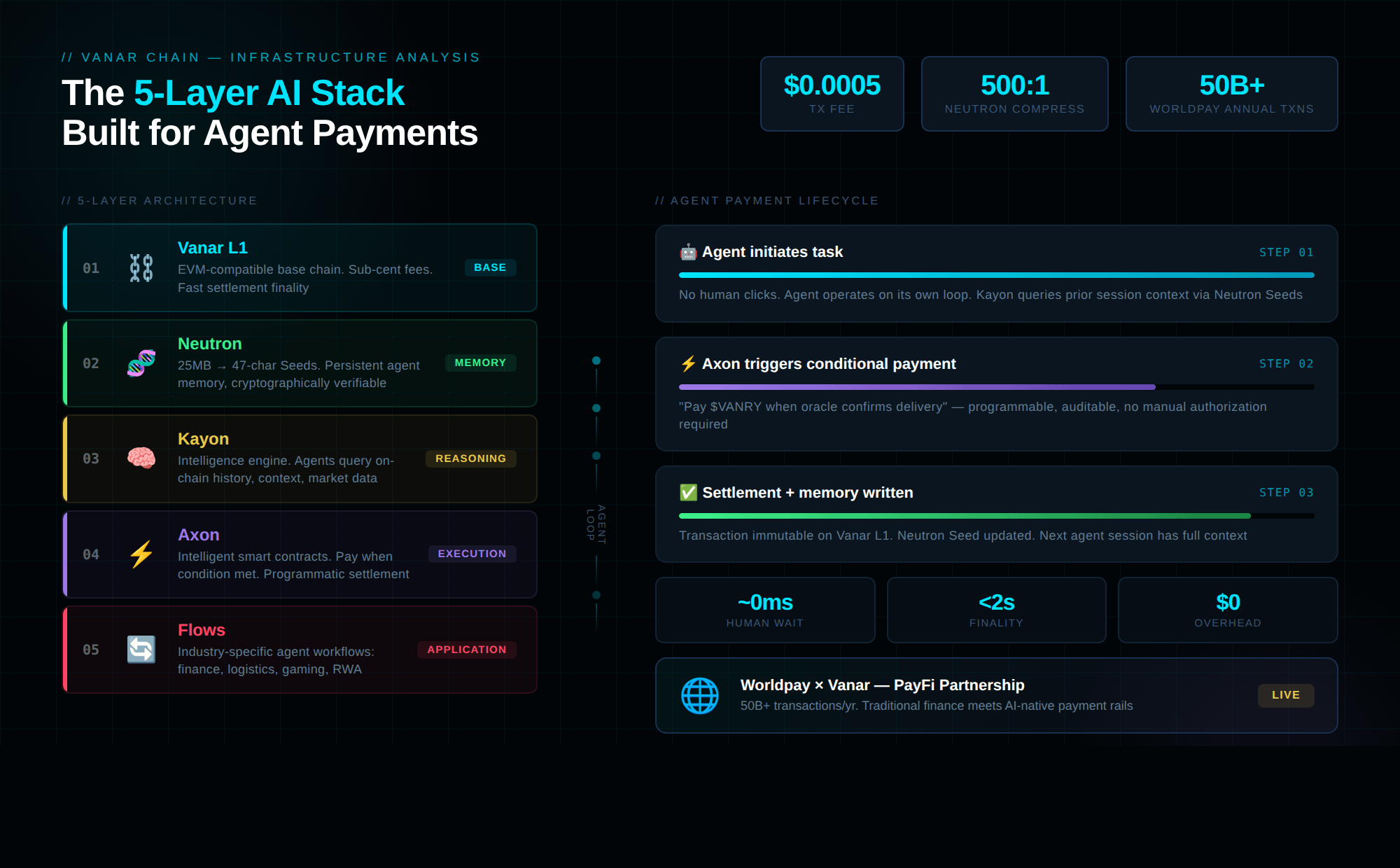
Vanar Chain is the first blockchain infrastructure stack purpose-built for AI workloads. Its 5-layer architecture enables every Web3 application to be intelligent by default. That is not marketing language if you understand what the layers actually are. This is worth walking through carefully.
Layer one is the Vanar L1 itself — a modular, EVM-compatible base chain. The VANRY design supports scalability with a standard $0.0005 transaction fee, creating fast settlements and economical payment processes. That sub-cent fee is not an accident of market conditions. It is designed to make micro-transaction-heavy agent workflows viable at scale.
Layer two is Neutron — and this is where Vanar departs most sharply from every other chain. Neutron compresses 25MB into 50KB using semantic, heuristic, and algorithmic layers, turning raw files into ultra-light, cryptographically verifiable Neutron Seeds. The data doesn't just live here. It works here. Seeds can run apps, initiate smart contracts, or serve as input for autonomous agents. This is agent memory that is persistent, verifiable, and queryable. An agent can store the context of a prior negotiation as a Seed. A later agent session can query that Seed and pick up exactly where it left off. This is not possible with any chain that offloads storage to IPFS or AWS — and the April 2025 AWS outage that froze Binance, KuCoin, and MEXC for 23 minutes demonstrated precisely why "nothing points outside the chain" matters for infrastructure that needs to be relied upon.
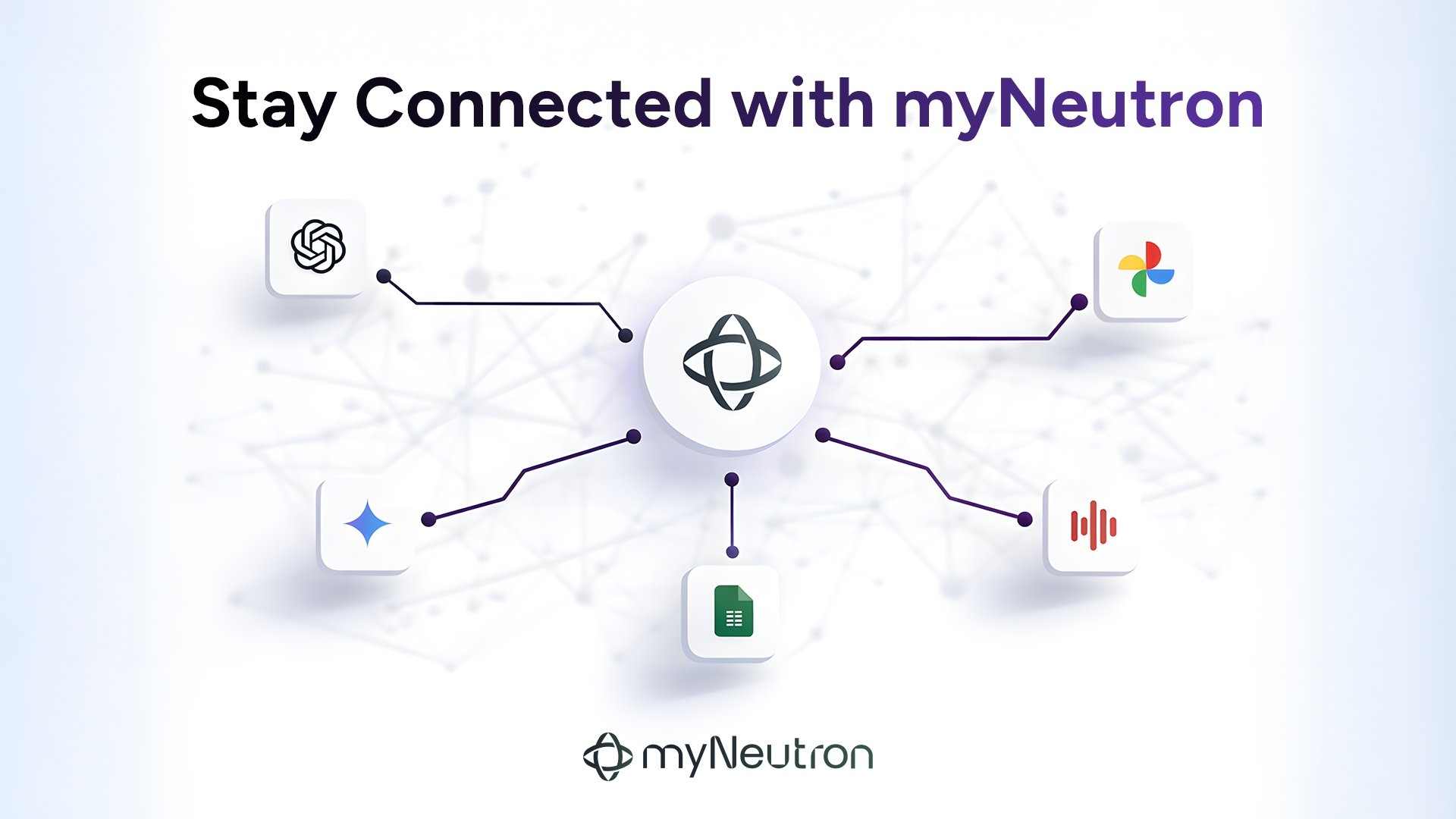
Layer three is Kayon — a decentralized intelligence engine that enables smart contracts to query and act on Neutron data. This allows AI agents to retain persistent memory and context, solving continuity issues in traditional AI tools. Kayon is what makes the data stored in Neutron useful for reasoning, not just retrieval. An agent can ask Kayon a question about its on-chain history, about a counterparty's behavior, about market conditions, and get an answer that is grounded in verifiable on-chain data rather than hallucinated from training weights.
Layer four is Axon — a system for intelligent, agent-ready smart contracts. This is where payment logic lives. Not just "transfer X to Y" but "transfer X to Y when Kayon confirms that condition Z is met." This is programmable settlement with embedded intelligence, not a wallet with a transfer function.
Layer five is Flows — industry-specific intelligent agents built on the full stack, the application layer where vertical-specific agent workflows get deployed: finance, logistics, gaming, real-world asset management.
[████████████████████] Neutron compression ratio: 500:1 — 25MB file → 47-character on-chain Seed
[████████████████] Vanar AI stack: 5 layers, all native, nothing offloaded to external infrastructure
[████████████] Worldpay — $2.3T annual transaction volume — partnered with Vanar for PayFi AI solutions
[████████] Google Cloud renewable nodes + NVIDIA CUDA stack integrated for enterprise-grade AI compute

The Worldpay Partnership Is the Clearest Signal
Worldpay handles over 50 billion transactions annually and facilitates card-to-crypto transactions for major crypto exchanges. The Vanar collaboration aims to enhance blockchain services through joint development of financial solutions that combine traditional finance and decentralized finance, creating AI-enabled financial solutions referred to as PayFi.
Worldpay does not partner with blockchain projects for marketing reasons. They partner when they see infrastructure that can move real transaction volume through compliance-ready, scalable rails. The fact that Vanar secured this partnership is not incidental — it signals that Vanar's stack is being evaluated as production-grade financial infrastructure, not as a demo.
The PayFi thesis at the core of this is straightforward: AI-native payments are not just about crypto-native users. They are about every enterprise workflow that involves settlement — procurement, payroll, licensing, cross-border invoicing — being made more intelligent and autonomous. Vanar is building the layer that makes that possible for developers who want to deploy agents into those workflows without rebuilding compliance and settlement infrastructure from scratch.
How VANRY Aligns With Real Economic Activity
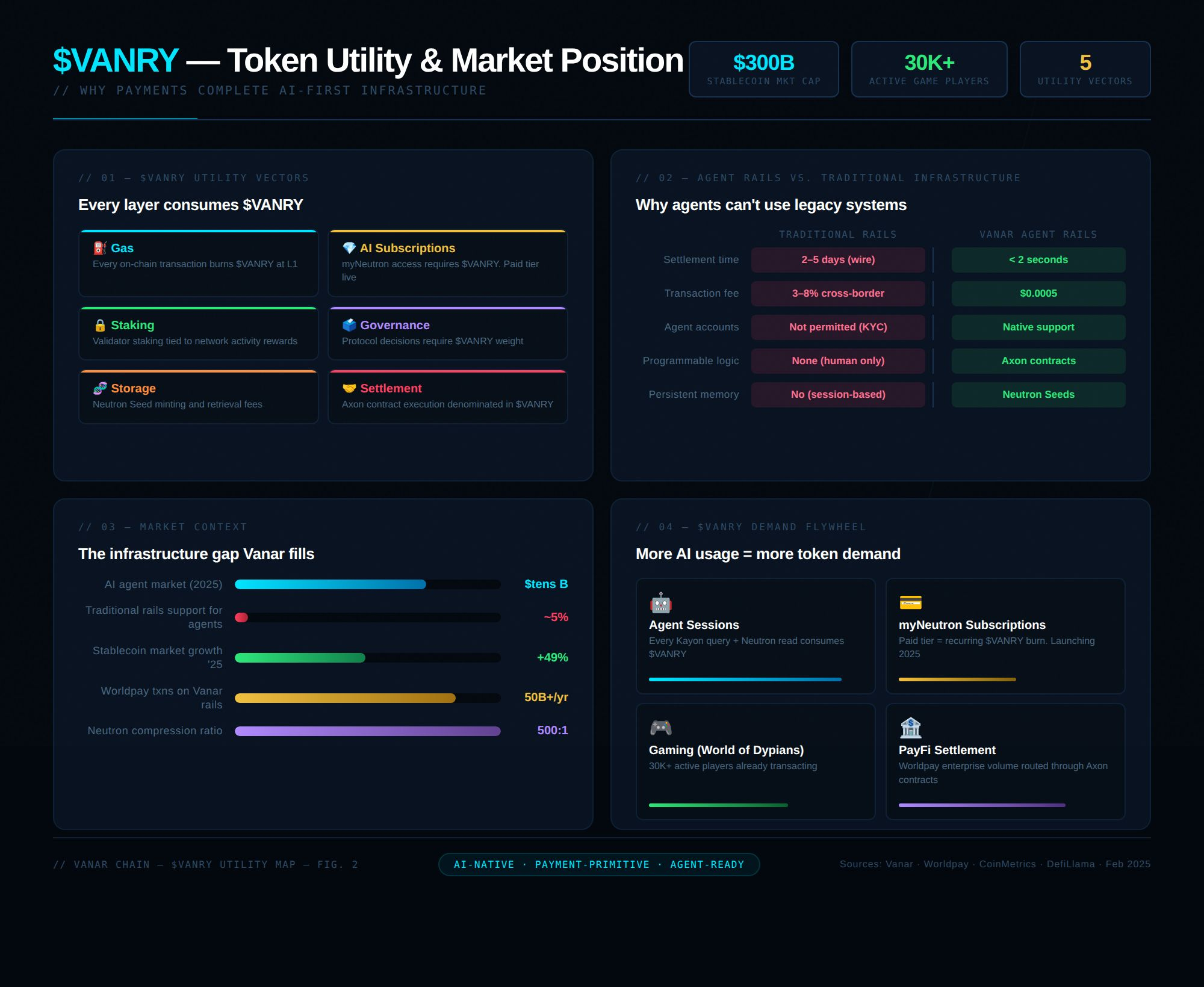
The token design is worth examining closely, because it is where abstract claims about "AI-native infrastructure" either become real or stay theoretical.
Every myNeutron user generating context, Seeds, or sessions contributes to on-chain economic activity, with Bundles reinforcing the VANRY market. Meaning: every time the AI stack is used — storing memory, running inference, settling a payment, minting a Seed — VANRY is consumed as gas. As the AI tool suite moves to a subscription model, advanced AI tool subscriptions require VANRY tokens, which also serve as gas, staking, and governance tokens, enhancing utility.
This is a different token model than most chains. Most chains have gas tokens that are consumed when transactions are submitted, full stop. Vanar's gas token is consumed not just by transfers but by every layer of the AI stack — storage, inference, contract execution, subscription access, governance. Every AI workflow that runs on Vanar converts directly into VANRY demand. That is the definition of a token that is tethered to real economic activity rather than speculative flow.
The burn and staking mechanics reinforce this. As usage grows, both the burn pressure and the staking rewards tied to network activity increase. The token is not a bet on future adoption — it is the fuel for infrastructure that is already running.
[████████████████████] VANRY utility vectors: gas + AI subscriptions + staking + governance + storage payments
[████████████████] myNeutron transitioning to paid subscription model — direct recurring VANRY demand
[████████] World of Dypians: 30,000+ active on-chain game players, already generating VANRY transactions
The Bigger Frame: What AI-First Actually Means
The industry has spent two years adding "AI features" to blockchains. Integrations, plugins, inference endpoints that hang off the side of chains designed for DeFi or NFTs. Unlike other blockchains that retrofit AI capabilities, Vanar Chain was designed specifically for AI workloads. Every component is optimized for the unique requirements of intelligent applications — native support for AI inference, optimized data structures for semantic operations, built-in vector storage and similarity search, AI-optimized consensus and validation.
The consequence of retrofitting is compounding friction. Every layer that was not designed for agents adds friction for agents. Storage that depends on IPFS fails silently when IPFS links rot. Memory that lives outside the chain cannot be queried by smart contracts. Compliance infrastructure that was bolted on after the fact cannot be trusted by enterprises with regulatory obligations.
Vanar's answer is architectural: build the memory layer, the reasoning layer, the execution layer, and the payment layer as a single coherent stack, with VANRY running through all of them as the economic unit. The result is infrastructure where an agent can store context, reason over it, trigger a payment, and settle — all on-chain, all verifiable, all without routing through external services that can fail at 3am.

That is what payments completing AI-first infrastructure actually means. Not a payments feature added to an AI chain. A chain where payments, memory, reasoning, and execution are the same stack — and where the economic model is designed around the reality that AI agents are about to become the primary actors in a substantial portion of global financial settlement.
