
At some point in the life of any blockchain, the technology ceases to be the bottleneck and adoption is when the test is truly put. Vanar Chain is perhaps on that point. There is the five-layer architecture. Neutron is file compressing on mainnet. Kayon is processing queries. However, the uncomfortable question that most project cheerleaders would avoid answering is this: what exactly must be the case, all at once, in order that any of this would be converted into permanent traction?
That is the purpose of an analysis of adoptions flywheel. Not hype, not hope. And all it takes is a bloody eyeglass map of what dominoes must fall, and when.
A Quick Refresher on What Vanar Does
To anyone who is a latecomer, @Vanarchain is an EVM-compatible Layer 1 blockchain that markets itself as AI-native. That is, AI is not an add-on to the protocol, it is embroiled in the protocol over five layers. The base chain does transactions on a fixed charge of about 0.0005. Neutron compresses files up to 500:1 and stores them directly to the chain as a form of Seed. Kayon is an on-chain reasoning engine that enables smart contracts to actually interpret the data they are storing, and not simply to refer to the data stored elsewhere.
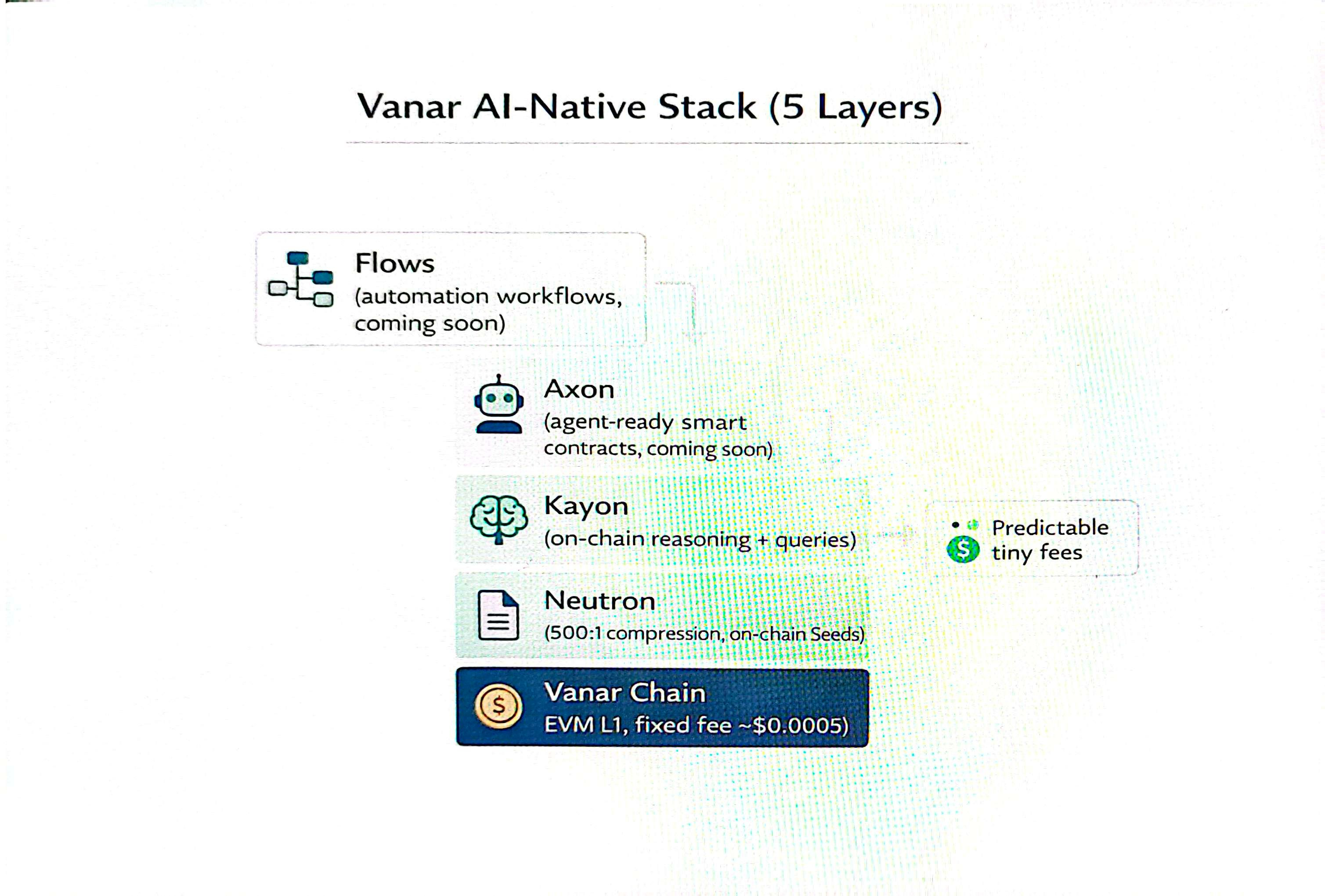
The pitch is compelling. Pitches do not bring out flywheels. Usage does.
The Flywheel, Mapped Out
Self-reinforcing loop- An adoption flywheel. To Vanar, the simplified version would appear as follows:
Necessary support tools Builders build apps Useful builders arrive On-chain activity increases Token utility increases More builders notice Better tools are built Repeat
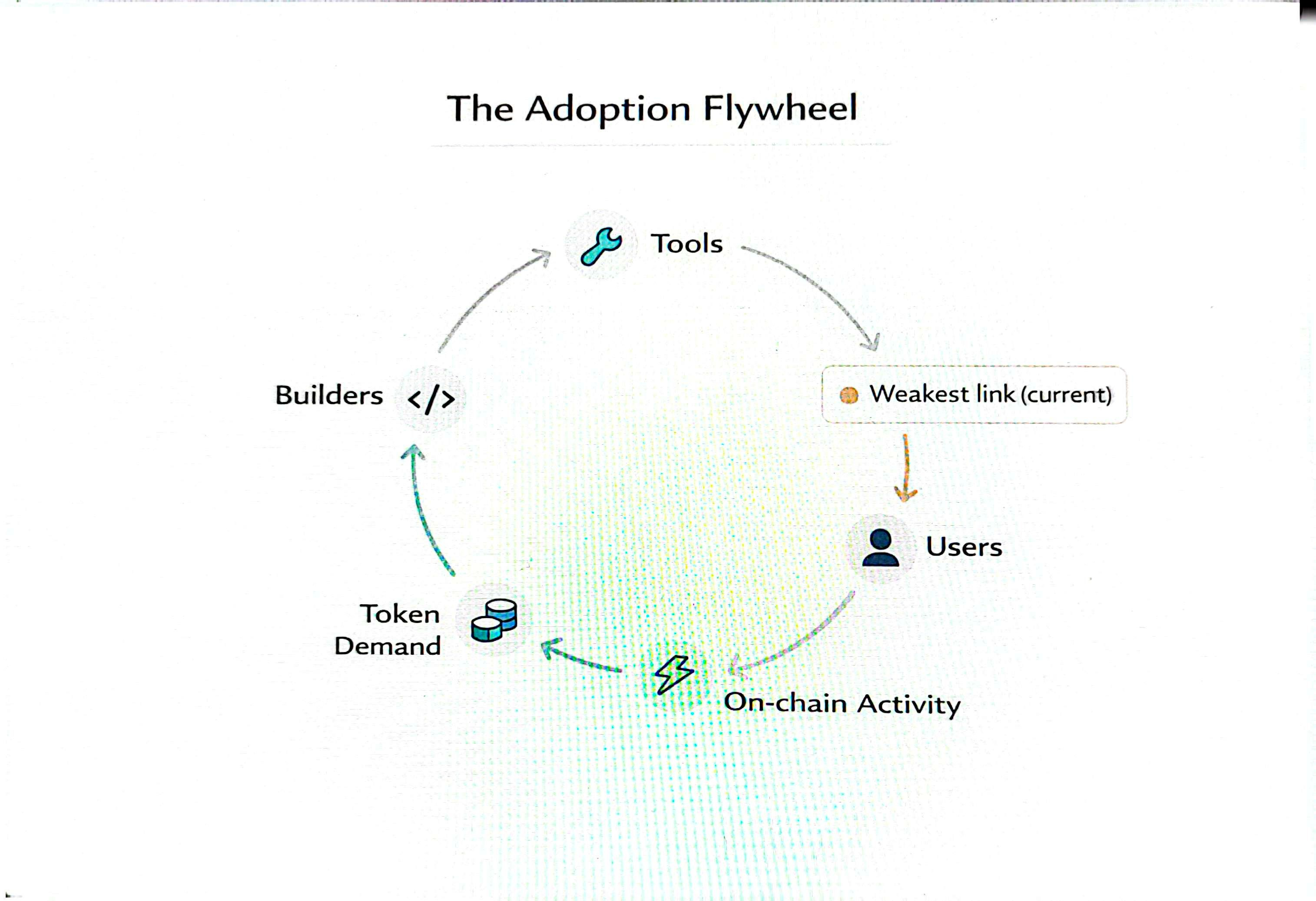
Simple on paper. Brutally hard in practice. We can deconstruct each of the chains and what will reinforce or break.
Connection 1: Does the Core Tools Solve an Existing Problem?
Here the TOKEN2049 Neutron demo would come in handy. During the Vision conference of Vanar in Dubai, the team encoded a 25-megabyte 4K video as a Neutron Seed (a 47 character identifier) and stored it in a live mainnet transaction and reassembled the video in less than thirty seconds. That is an interesting demonstration of concept and the type of one that infrastructure engineers take note of.
However, here is the query between a good demo and actual adoption, who needs this day-to-day? The solution might be substantial. Consider a project that hosted an NFT collection, and the whole collection is no longer available due to a cloud hostage provider a failure, which did indeed occur to CloneX NFTs in April 2025 due to an apparent Cloudflare problem. When your media is on-chain as a Neutron Seed, then that mode of failure does not exist. Or consider in-the-real-world, tokenization of assets, where a deed to a property or a document of compliance must be permanently, irrevocably fixed to the token itself, not hanging off an IPFS link which could become dark.
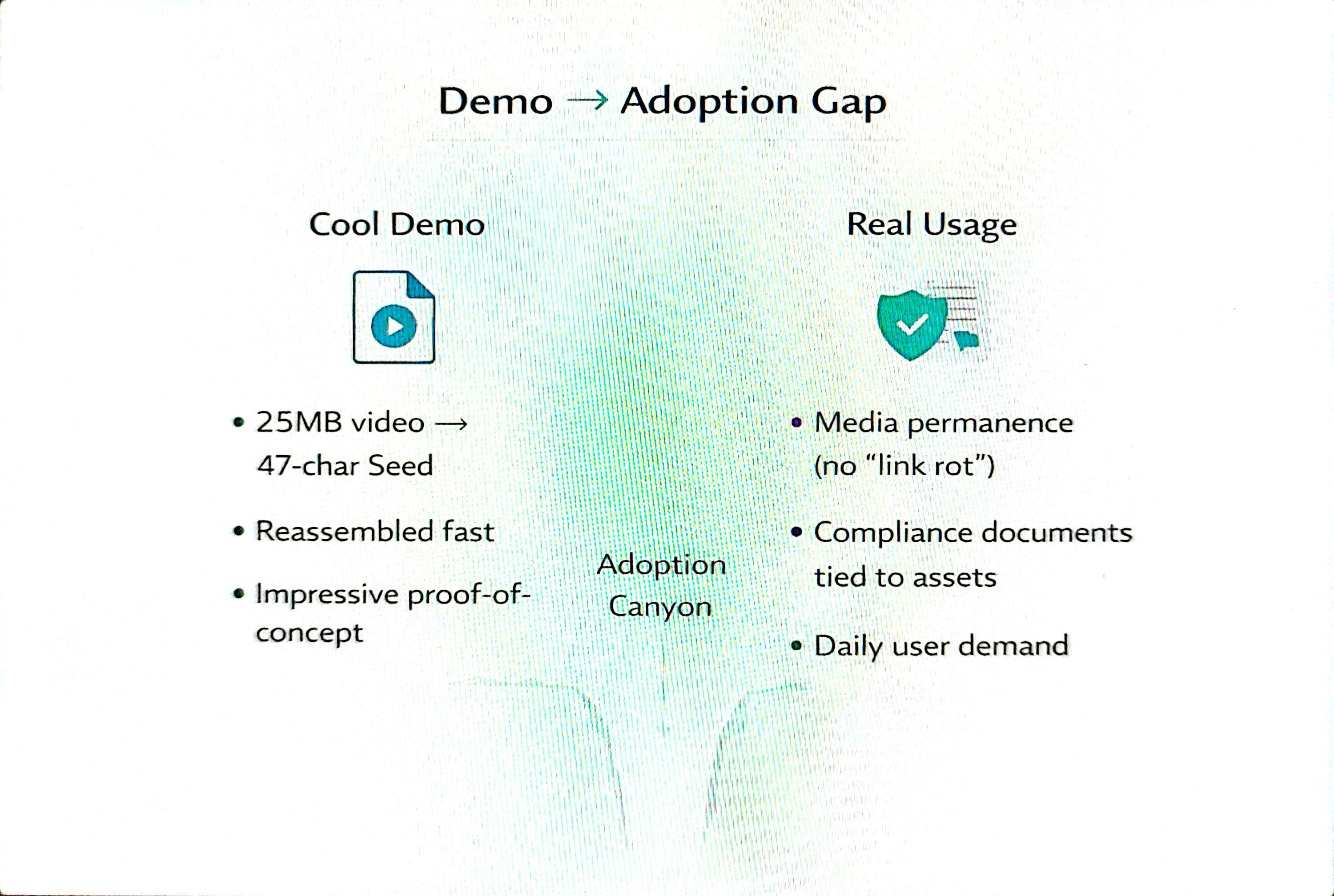
These are real use cases. But would come in handy, and is in use, stand on different sides of a canyon. The flywheel actually begins to spin when builders actually launch applications that require Neutron to do something that their customers are interested in.
Link 2: Builders Are They Coming?
Vanar is compatible with EVM (therefore Solidity developers can use existing code), has JavaScript, Python, and Rust SDKs, and an academy that contains educational content. They have declared integrations with infrastructure vendors such as Google Cloud, the CUDA stack by NVIDIA as well as Supra oracle price feeds. World of Dypians is given as a gaming application that is said to be played on the chain.
That is not an unreasonable basis. However, the middle level observers would want to know: what is the ratio between announced partnerships and shipped products, which are working? This ratio is usually humiliatingly skewed in crypto. The value that counts is not the number of logos on the ecosystem page, but the number of autonomous teams operating to construct things that create recurring on-chain transactions. Now that is one figure to watch with interest, since it is the only sure predictor of the presence or absence of momentum in this flywheel; whether it has had its first actual impulse or is still awaiting its initial actual impulse.
Connection 3: Does Token Utility Have a Pull, and not a Drain?
VANRY charges gas fees, staking, that voting and access to AI tools under subscriptions, such as myNeutron. There is a tension there to that utility structure which is worth knowing.
Consider it by analogy: a theme park will have an entrance fee, ride tickets and annual passes. When the rides are spectacular, all three sources of revenue support one another, people purchase passes as the rides are worth it, and revenue is used to improve the rides. However, when the park is of beautiful architecture and there are just two rides running in it, pass sales will fail regardless of the fancy of pricing model used.
The same is true of the token economics used by Vanar. The utility design is excellent in paper. Gas charges provide some minimum demand. Staking locks supply. The subscription fees on AI-tools would create a continuous purchasing demand. However, all of those mechanisms merely need adequate real action on the chain in order to matter. MyNeutron subscription fee is nothing without a sufficient number of users who are finding it essential. Staking yields are ample until the staked item becomes worthless as no one is investing on the network.
That is not a criticism, it is just the structural fact of any early-stage L1. The idea is to observe the proper indicators.
The Honest Paragraph: Where I Still Fall Short.
The architecture of Vanar is more differentiated than most of the chains that I reviewed in this category. The state of having on-chain storage and having AI reasoning and fixed-fee economics is a design space that is truly new. However, protocol-level differentiation does not necessarily translate into gravity of the ecosystem. Etherium did not triumph since it possessed the finest virtual machine in 2016; it triumphed since plenty of developers put in early and created such things that gathered users which gained more developers. Vanar must have its version of that compounding cycle and the straightforward fact is that we still are still in the promising infrastructure, limited applications stage. That could change very fast, assuming Axon and Flows ship in 2026 and unlock new meaningful automation categories on the chain. Otherwise, the narrative relevance window becomes even more difficult to maintain. Such ambiguity is worth lingering on than quick-fixing.
Risks Worth Monitoring
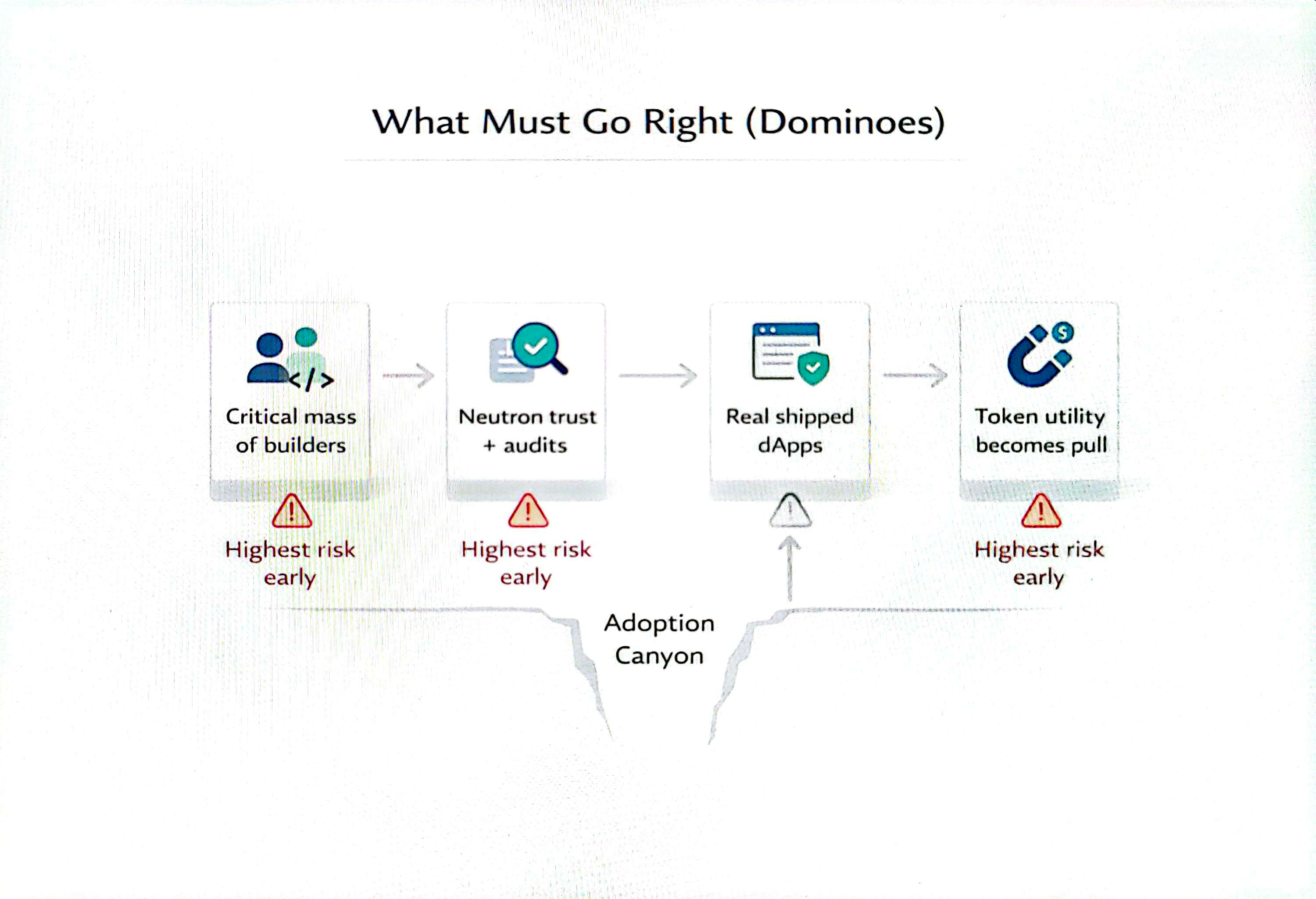
Cold-start problem. Even such a great tool cannot work without an initial critical mass of builders. Partnership announcements are not the only type of activity to watch, as developer grant programs, hackathon outcomes, and active work on the related GitHub can also be viewed as organic.
Compression trust gap. It is an impressive achievement of neutron that they have 500:1 compression claims, but the wider implementation needs to be audited and peer reviewed. Some builders will remain skeptical until scale has been confirmed as safe and honest by third parties.
Liquidity thinness. Order books of VANRY are shallow with a market cap of less than tens of millions. The spikes in interest, or selloffs, can cause price movements which are not based on fundamentals. It is one of the facts of the existing market structure and not a remark about the tech.
Narrative crowding. Each chain is now described as being AI-native. The denser the label, the less Vanar can be economically differentiated without actually verified on-chain usage, the kind of real usage other than claims.
Execution dependency. Axon (agent-ready smart contracts), Flows (workflows that are automated on-chain) are listed as coming soon. They will deliver quality products and on time and this will significantly influence the existence of second and third gears in the flywheel.
Practical Takeaways
Graph the flywheel of any of the chains you are considering: tools builders users activity token utility more builders. Next question, where the weakest link. In the case of Vanar, it is probably the builder-to-user handoff at the moment.
Focus more on shipped products that make transactions as opposed to partnership logos. A single operational dApp and daily active users speak more than ten integration announcements.
In case you are thinking of exposure to the #VANAR ecosystem, consider it as early-stage. The implications of that are smaller position sizes, longer time horizons and readiness to revise your thesis when evidence is provided in either way.
Multimedia recommendation: A flywheel diagram of the five links mentioned above (tools -> builders -> users -> activity -> token demand) with annotations indicating where Vanar is at the moment in the cycle and where there are still critical gaps. Apply publicly available qualitative measurements as opposed to artificial measures.
The question, on which I would be delighted to receive your reply, is this: what particular kind of application, gaming, PayFi, AI agents, RWA tokenization, would you say is most likely to provide Vanar flywheel with its first serious impulse, and why that one in preference of the others?
The article is informational and educational and does not form a part of financial advice. Never make the decisions concerning digital assets without doing your own research.
