

$VANRY
The blockchain space is evolving at an unprecedented pace, with new projects constantly pushing the boundaries of decentralized finance, gaming, and digital ownership.
Among these emerging players, @Vanarchain has started attracting attention due to its ambitious ecosystem integrations and strategic partnerships. While still in its early stages, Vanar aims to become a versatile blockchain project that bridges the gap between DeFi, NFTs, and cross-chain interoperability.
In this article, we’ll explore what Vanar is, its positioning in the blockchain space, and the ecosystem partnerships it’s putting in place to grow adoption.
What Is Vanar?
Vanar is a blockchain-based platform designed to support a wide range of decentralized applications (dApps), including financial services, NFT marketplaces, and gaming ecosystems. Unlike some projects that focus solely on one niche, Vanar positions itself as a multi-functional ecosystem that can interact across different sectors.
Key features of Vanar include:
Decentralized Finance (DeFi) support: Offering staking, liquidity pools, and yield farming.
NFT marketplace integration: Enabling creators to mint, trade, and showcase digital assets.
Cross-chain functionality: Bridging assets across multiple blockchains to increase liquidity and accessibility.
The project emphasizes scalability, low transaction fees, and interoperability, which are critical factors for attracting both developers and users.
Why Ecosystem Partnerships Matter
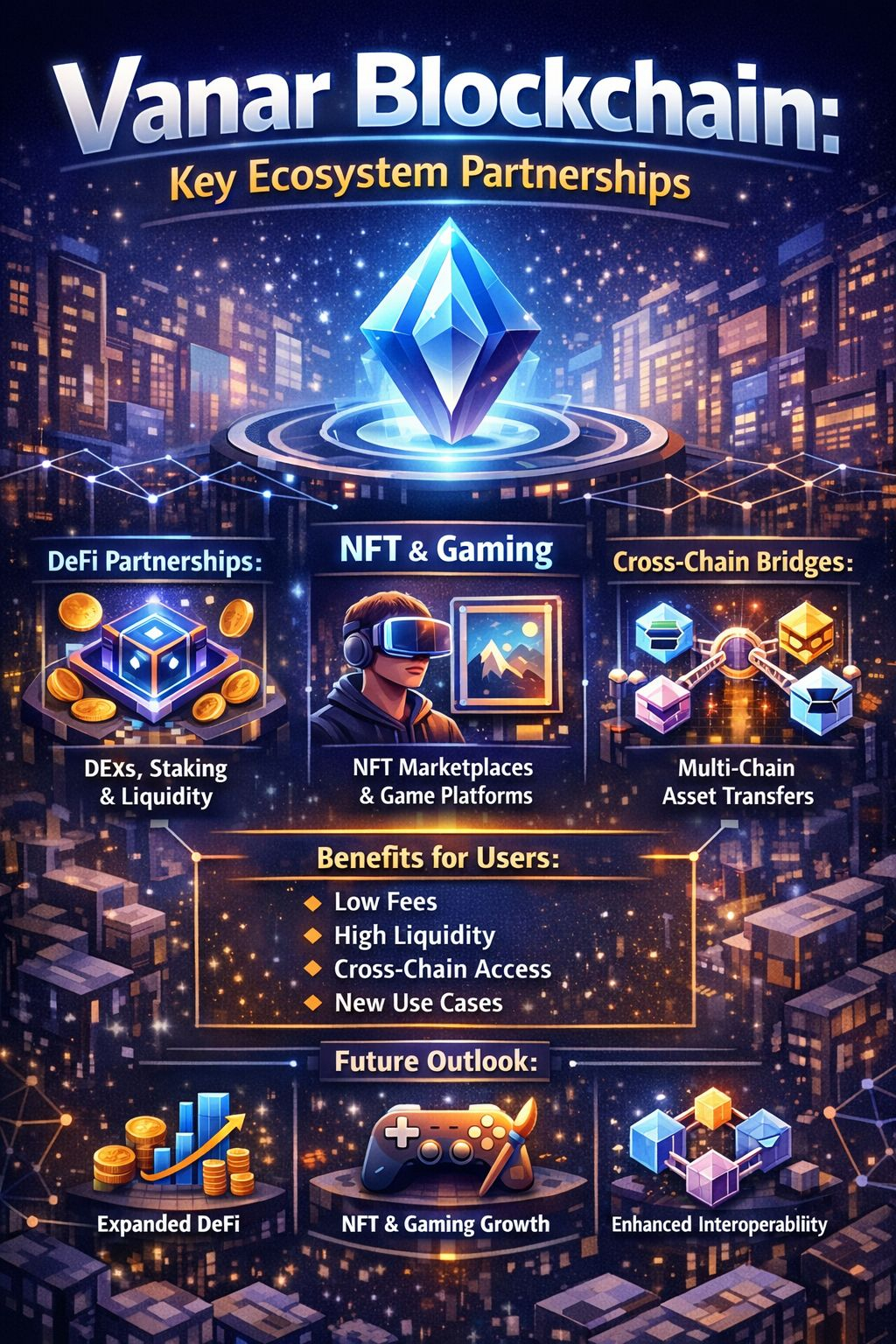
For any blockchain project, partnerships are essential. They provide credibility, access to new users, and technical support for growth. In Vanar’s case, ecosystem partnerships are focused on three main areas: DeFi integrations, NFT collaborations, and cross-chain bridges.
DeFi Partnerships
DeFi partnerships are aimed at increasing Vanar’s liquidity and trading volume. By collaborating with decentralized exchanges (DEXs) and yield farming platforms, Vanar ensures that its token can be traded efficiently and that users have opportunities to earn rewards. These partnerships are vital for long-term sustainability because liquidity and active trading are the lifeblood of any blockchain economy.NFT and Gaming Collaborations
NFTs are one of the fastest-growing sectors in blockchain, with applications ranging from digital art to gaming assets. Vanar is exploring partnerships with NFT marketplaces and gaming platforms to allow creators and players to mint and trade assets natively on its blockchain. This integration enhances adoption and attracts a community of digital creators and gamers who are looking for low-fee, scalable platforms.Cross-Chain Bridges
Interoperability is increasingly critical in the blockchain space. Vanar’s cross-chain partnerships aim to enable seamless asset transfers between different blockchains, such as Ethereum, Binance Smart Chain, and Solana. This reduces friction for users who want to move assets across ecosystems and opens opportunities for more complex dApps that rely on multiple blockchains.
Notable Ecosystem Partnerships
While Vanar is still growing, several partnerships and collaborations have been publicly mentioned:
Decentralized Exchanges (DEXs):
@Vanarchain has partnered with multiple DEXs to facilitate token trading and liquidity pools. These integrations allow users to swap Vanar tokens directly and participate in staking programs.NFT Marketplaces:
Vanar is working with select NFT marketplaces to bring digital art, collectibles, and gaming assets to its chain. Creators can mint assets at lower fees compared to high-traffic blockchains, making Vanar appealing to indie artists and small studios.Cross-Chain Bridges:
Several projects are exploring integration with Vanar to provide cross-chain asset movement. This feature is crucial for decentralized finance protocols and NFT platforms that operate on multiple blockchains, ensuring Vanar is not isolated in its ecosystem.Gaming Platforms:
Although details are still emerging, Vanar is pursuing partnerships with blockchain gaming platforms. The goal is to allow in-game assets to be tokenized, traded, and moved across chains, adding real value to the gaming economy.
Potential Benefits for Users
The partnerships Vanar is building can directly benefit users in multiple ways:
Lower Transaction Fees:
By leveraging efficient blockchain infrastructure and strategic partnerships, Vanar reduces the cost of minting NFTs or performing DeFi transactions.Access to New Markets:
Cross-chain integration allows users to interact with multiple blockchain ecosystems without leaving Vanar’s platform, expanding opportunities for trading and collaboration.Enhanced Liquidity:
DeFi partnerships increase liquidity, making it easier for users to buy, sell, and stake tokens.More Use Cases:
Collaborations with NFT marketplaces and gaming platforms introduce new ways to utilize Vanar tokens beyond basic transactions. This increases demand and strengthens the ecosystem.
Challenges and Considerations
Like any emerging blockchain project, Vanar faces challenges:
Competition: Many blockchains are targeting DeFi, NFTs, and gaming simultaneously. Vanar will need to differentiate itself through performance, partnerships, and community engagement.
Regulatory Uncertainty: Changes in cryptocurrency regulations could affect how partnerships operate, especially in DeFi and NFT sectors.
Adoption: Ecosystem partnerships are only valuable if they attract users. Vanar must focus on marketing and developer engagement to grow adoption.
Despite these challenges, Vanar’s strategic approach to partnerships positions it well for growth. By targeting key sectors and focusing on interoperability, the project addresses both technical and community needs.
What the Future Holds for Vanar
Vanar’s future largely depends on how successfully it can expand its ecosystem partnerships. Key areas to watch include:
Expansion of DeFi Integrations:
Adding more decentralized finance platforms can increase token utility and market liquidity.Broader NFT Collaboration:
Partnering with popular NFT platforms and gaming studios can establish Vanar as a go-to blockchain for creators and gamers.Cross-Chain Growth:
Implementing robust bridges will make Vanar a viable choice for users who need to move assets across chains efficiently.Community Development:
A strong, engaged community can drive adoption faster than technology alone. Vanar will need active social media, developer programs, and incentives for early adopters.
If these areas succeed, Vanar could become a versatile player in the blockchain ecosystem, bridging gaps between finance, digital ownership, and cross-chain interoperability.
Conclusion
Vanar is a blockchain project aiming to integrate DeFi, NFTs, and cross-chain functionality through strategic ecosystem partnerships. While still early in development, these partnerships indicate a clear roadmap for adoption, liquidity, and interoperability.
For users and developers, Vanar represents an opportunity to engage with a growing ecosystem that balances innovation, efficiency, and multi-chain connectivity. Its focus on collaborations with DEXs, NFT marketplaces, gaming platforms, and cross-chain bridges positions it as a project to watch in the evolving blockchain landscape.
With careful execution, Vanar has the potential to become a central hub for decentralized applications, digital assets, and cross-chain interactions, offering users a more seamless, low-cost, and versatile blockchain experience.
