

Binance has just completed a plan to purchase 1 billion USD worth of Bitcoin for the SAFU (Secure Asset Fund for Users). The latest transaction recorded the SAFU wallet buying an additional 4.545 BTC, valued at approximately 304.58 million USD, increasing the total holdings to 15,000 BTC, equivalent to over 1 billion USD at current price levels.
In the context of the market still being sensitive to institutional cash flows and macroeconomic fluctuations, many investors hope that this large-scale deal will provide a boost for Bitcoin prices. However, the reality shows that the market has hardly reacted significantly. Why is a billion-dollar deal not enough to drive prices up?
Overwhelming selling pressure from Wall Street.
The Bitcoin market is no longer primarily dominated by "pure crypto" flows like in previous cycles. Following the launch of spot Bitcoin ETFs in the US, the market structure has changed significantly. Total assets managed by these ETFs fluctuate around $85–100 billion, with daily trading volumes reaching billions of dollars.
Recent data shows that ETF flows are exhibiting strong divergence. There have been sessions with net inflows of hundreds of millions of USD, but also sessions with large-scale net outflows. For example, February 11th recorded a net outflow of over $276 million, and a few days prior, there were also sessions with negative outflows of over $400-500 million.
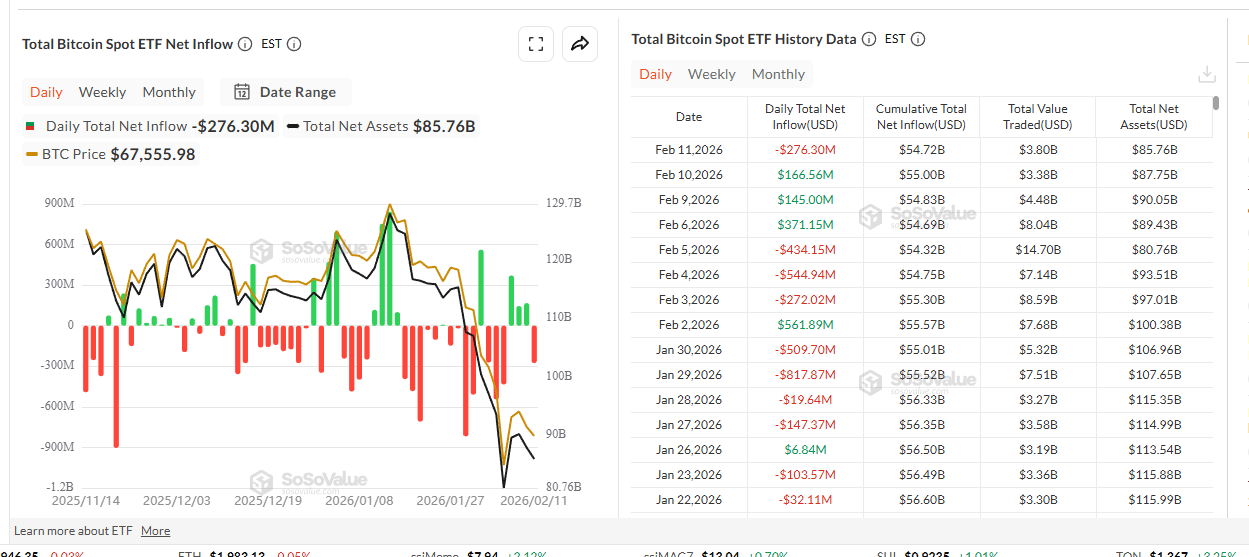
Given the enormous size of the ETF, a net outflow of several hundred million USD in a single session could easily neutralize buying pressure from a single institution, including Binance.
The first and most obvious reason is that selling pressure from ETFs absorbed most of Binance's buying. If Binance had bought $1 billion worth of Bitcoin over several sessions to optimize the price and avoid slippage, the actual demand distributed to the market each day might not have been so volatile. Meanwhile, just a few sessions of ETFs withdrawing between $300 million and $500 million were enough to create significant supply pressure.
In other words, the market is witnessing a "tug-of-war" between pure crypto capital flows (represented by Binance and industry institutions) and traditional capital flows from Wall Street. At the moment, the balance may not have clearly tipped to either side, causing prices to move sideways instead of breaking out.
Trading via OTC
Technically, the fact that Bitcoin is recorded as flowing into an on-chain wallet doesn't automatically equate to direct purchases on the order book. Binance manages a large amount of user assets and numerous different custodial wallets. Internal reallocation or transfer of assets between wallets can still generate on-chain cash flow without creating new demand.
The BTC that Binance transfers to on-chain wallets interacts with the exchange's hot wallets, which are the group of wallets Binance frequently uses to interact with users when withdrawing assets. This has led some investors to believe that the BTC in SAFU wallets may have been purchased by Binance through the OTC channel, so the price is not directly affected by this buying pressure.
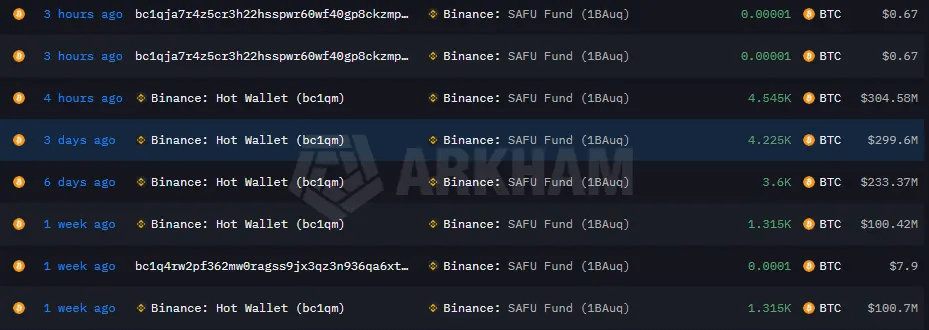
Another fundamental factor is that Bitcoin's scale and liquidity have grown significantly compared to previous cycles. Daily trading volumes in the spot and derivatives markets frequently reach tens of billions of dollars. In such a deeply liquid environment, a transaction of a few hundred million dollars, if broken down into smaller amounts, can be absorbed without causing significant volatility.
Furthermore, the increasing role of the derivatives market means that prices are influenced by long/short positions, funding rates, and hedging strategies of institutions. Therefore, positive news no longer automatically translates into an immediate price surge.
Binance's completion of its plan to hold 15,000 BTC for the SAFU fund remains strategically significant. This signals that the world's largest exchange places long-term faith in Bitcoin as a core reserve asset to protect users in emergency situations.
In a mature market driven by global capital flows, not every multi-billion dollar deal creates an immediate price shock. Instead, the impact may gradually manifest in the long-term supply and demand structure, as the amount of Bitcoin withdrawn from circulation and held in strategic wallets increases.
At this point, the question isn't just "how much has Binance bought," but also "which way are global institutional funds leaning?" And that's the variable that will determine Bitcoin's next trend.
#BTC #SAFU🙏
