
Subject: A Field Test of Vanar's Flagship App Using the Most Demanding Focus Group Imaginable: A 58-Year-Old Man Who Still Uses Internet Explorer
Last weekend, I committed an act of borderline technological terrorism. I sat my father down in front of my laptop and said, "Dad, I need you to test this app for me. It's called MyNeutron."
He looked at me the way he did when I tried to explain NFTs in 2021—that unique blend of confusion, mild concern, and the quiet realization that his child has joined a cult. But he humored me. What happened next was both completely unexpected and deeply informative about Vanar's consumer strategy.
The Setup: "So It's Like... A Squeegee for Files?"
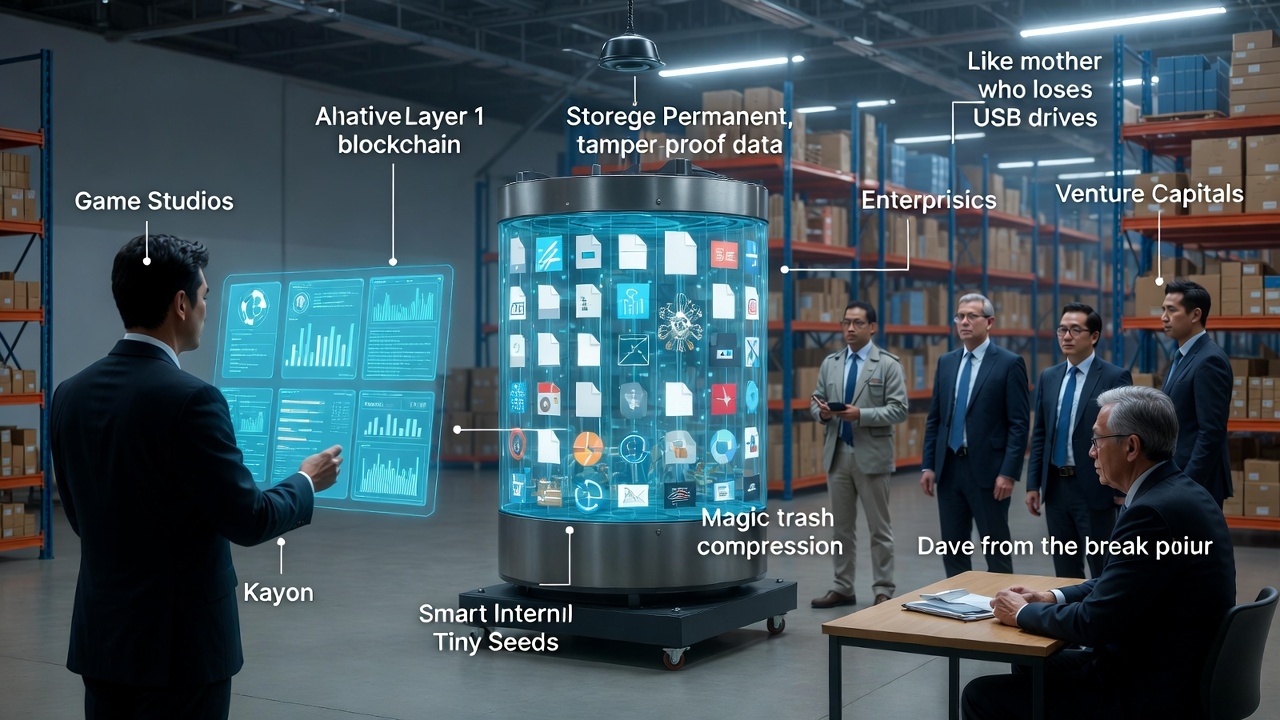
I gave him the pitch: "Dad, this app uses AI to compress files so small they can live on a blockchain forever. You can upload anything—old family videos, tax documents, that weird recipe for pickled eggs you like—and it stores a permanent, unchangeable version."
He squinted. "So it's like Dropbox, but with extra steps?"
"No, it's like... okay, imagine you have a giant inflatable pool toy. This app sucks all the air out, folds it into the size of a credit card, and then builds a permanent vault for it. When you want the toy again, it reinflates it perfectly."
"...So it's a squeegee for files?"
"Yes, Dad. It's a digital squeegee. Now please just try it."
The Experiment: Compression of the Household
He started small. A grocery list. Then his fishing license. Then a blurry photo of our dog from 2007.
"Huh," he said. "It made that picture tiny. And it says here it's... on the 'chain' now? Is that like a cloud?"
"Kind of. It's permanent. Nobody can delete it or change it. That photo of Rusty is now immortalized in the semantic memory layer of an AI-native Layer 1 blockchain."
He stared at me. He stared at the screen. He uploaded his entire tax folder from 2018.
Three hours later, I found him trying to compress a banana.
What I Learned About Vanar's Consumer Play
My father, a man who still prints directions from MapQuest, used MyNeutron for four straight hours. He didn't care about decentralization, consensus mechanisms, or the $VANRY token. He cared about one thing: the app did something useful, quickly, for free.
This is Vanar's secret weapon. While we're all doomscrolling Discord debating validator rewards, normal people are over here compressing banana photos because it actually works and solves a real problem.
The "Oh God, Now I Have to Explain Tokenomics to My Dad" Moment
Eventually, he asked the question I dreaded: "So how do they make money if it's free?"
I took a breath. "Well, Dad, there's this token called VANRY. For basic users, it's free. But power users—people who need to compress terabytes of data or use the AI to analyze their documents—will pay subscriptions. And part of that subscription fee burns the token, which creates scarcity and—"
"So it's like Costco," he interrupted. "Free samples to get you in the door, then you buy the membership."
I opened my mouth. I closed it. He was absolutely right.
The Verdict
My father now has a MyNeutron account. He's compressed 47 files. He asks me weekly if the "digital squeegee" has added any new features. He has absolutely no idea what a blockchain is and, at this point, I'm afraid to tell him.
Vanar's consumer strategy isn't about converting crypto skeptics into Web3 true believers overnight. It's about building something genuinely useful, putting it in people's hands, and letting the technology fade into the background. My dad doesn't care about semantic compression protocols—he cares that his 2007 dog photo is safe forever.
Maybe that's enough. Maybe that's the whole point.
Current status: I'm expecting a call any day now that he's tried to compress the actual, physical family television. Wish me luck.
