
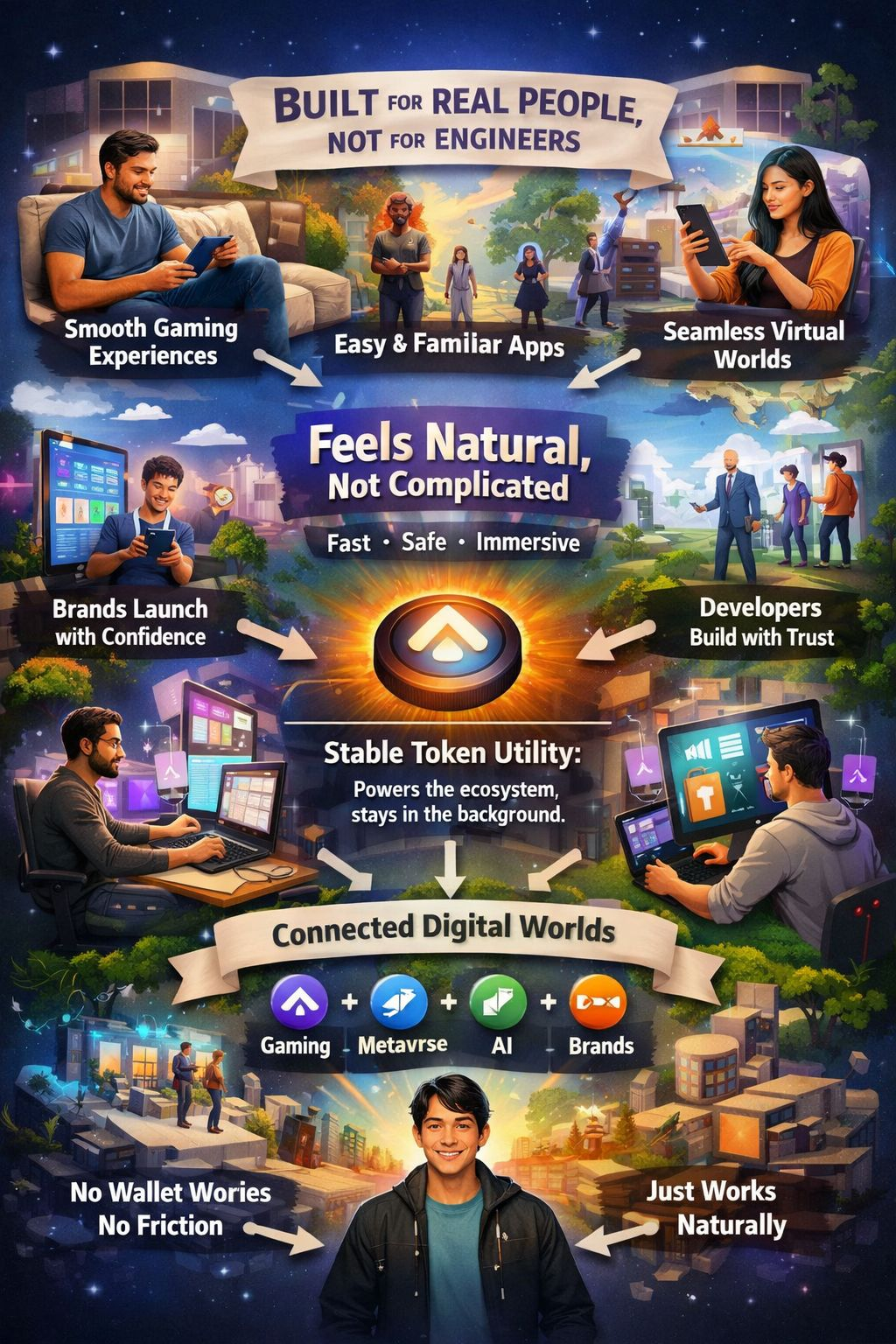
When I think about Vanar, I don’t picture charts or architecture diagrams first, I picture a normal person opening an app and expecting it to just work. That’s the lens I keep returning to. Most blockchains still feel like they were built to impress engineers, and then later someone tried to wrap a consumer experience around them. Vanar feels reversed. It feels like it started with the question of how entertainment, games, and digital spaces actually behave in real life, and then built the chain to support that behavior. The team’s roots in gaming and brands matter here because those industries are ruthless about user experience. If something is confusing, people close it. If something is slow, they don’t come back. That pressure forces simplicity, and I see Vanar as a response to that pressure more than a response to crypto trends.
I keep thinking about adoption as a feeling, not a metric. People don’t adopt technology because it’s advanced. They adopt it because it feels safe, fast, and familiar. Vanar’s focus on consumer ecosystems like Virtua and the VGN games network tells me the chain is trying to live inside environments where behavior is honest. Gamers don’t pretend to like friction. Casual users don’t tolerate wallet anxiety. Brands don’t gamble on unstable infrastructure. These spaces expose weaknesses immediately. If Vanar survives there, it means the system is learning how to behave like everyday software instead of experimental finance. That’s a huge psychological shift. We’re not talking about convincing people to believe in blockchain. We’re talking about letting them forget they’re using it.
There’s also something emotional in the way Vanar leans into richer application logic and AI-driven environments. I don’t read that as futuristic branding. I read it as an attempt to make digital spaces feel alive instead of mechanical. If digital ownership, identity, and interaction are going to become part of daily life, the infrastructure has to carry nuance. It has to react, adapt, and scale without breaking immersion. I imagine virtual worlds where assets persist, identities travel across experiences, and interactions feel continuous instead of fragmented. Vanar’s direction suggests a chain that wants to support that kind of continuity. If it becomes successful, users won’t say “this is advanced technology.” They’ll say “this feels natural,” and natural is the highest compliment consumer tech can earn.
The VANRY token, to me, only makes sense when it behaves like background electricity. It powers the environment, but it doesn’t demand attention every second. Consumer ecosystems collapse when the token becomes a stress point instead of a support structure. I’m always watching whether a chain can make its economic layer feel stable enough that users stop worrying about it. The history of the ecosystem and its evolution shows a project that’s still shaping its identity, which is normal for something trying to grow beyond a niche audience. What matters is whether the token ends up reinforcing participation without overshadowing the experience. The healthiest outcome is when users barely think about it, yet the community still feels connected through it.
The hardest reality Vanar faces is that consumer systems don’t get second chances easily. Infrastructure can fail quietly and recover. Consumer platforms fail loudly. If onboarding feels risky, people don’t retry. If transactions feel uncertain, trust evaporates. That means Vanar’s real mission isn’t to look impressive. It’s to feel dependable in small, repeated moments. I imagine success as something quiet: someone logs in, plays, trades, and leaves without ever worrying about what chain they’re on. Brands launch experiences without technical fear. Developers trust the environment enough to build long-term products instead of temporary experiments. When nobody is talking about the infrastructure anymore, that’s when it has finally done its job.
What I’m watching is whether Vanar can expand across gaming, metaverse, AI, and brand ecosystems without losing clarity. Breadth can become strength if the pieces reinforce each other. Shared identities, reusable assets, and connected economies could turn the ecosystem into something that feels like a persistent digital layer instead of separate islands. I’m thinking about a user moving between experiences and still feeling like the same person, carrying the same value and history. That continuity is where a consumer chain becomes a living environment instead of a toolkit.
If I explain Vanar to someone, I don’t start with technical specs. I start with a moment. I describe a non-crypto gamer entering a digital world and not feeling intimidated. I describe a brand running an experience that feels smooth instead of risky. I describe earning a virtual asset that actually feels owned. Those moments matter more than architecture. Vanar’s thesis is emotional at its core. It’s about reducing fear and increasing comfort until blockchain stops feeling like a leap and starts feeling like a routine action.
In the end, I measure a project like this by habits, not headlines. Do users come back tomorrow. Do apps feel stable under pressure. Do builders stay and ship real products. Adoption hides in repetition. If people return without hesitation, the system is working. If they pause, something still feels heavy. Vanar is trying to reach a point where digital experiences feel ordinary in the best way possible. If it gets there, people won’t call it revolutionary. They’ll call it normal. And normal is where real adoption lives.
