

A while back I watched a founder do something that felt… weirdly bullish in a way crypto rarely is. He wasn’t pitching. He wasn’t tweeting. He was quietly trying to make his pricing page make sense.
Not “tokenomics make sense.” Pricing page.
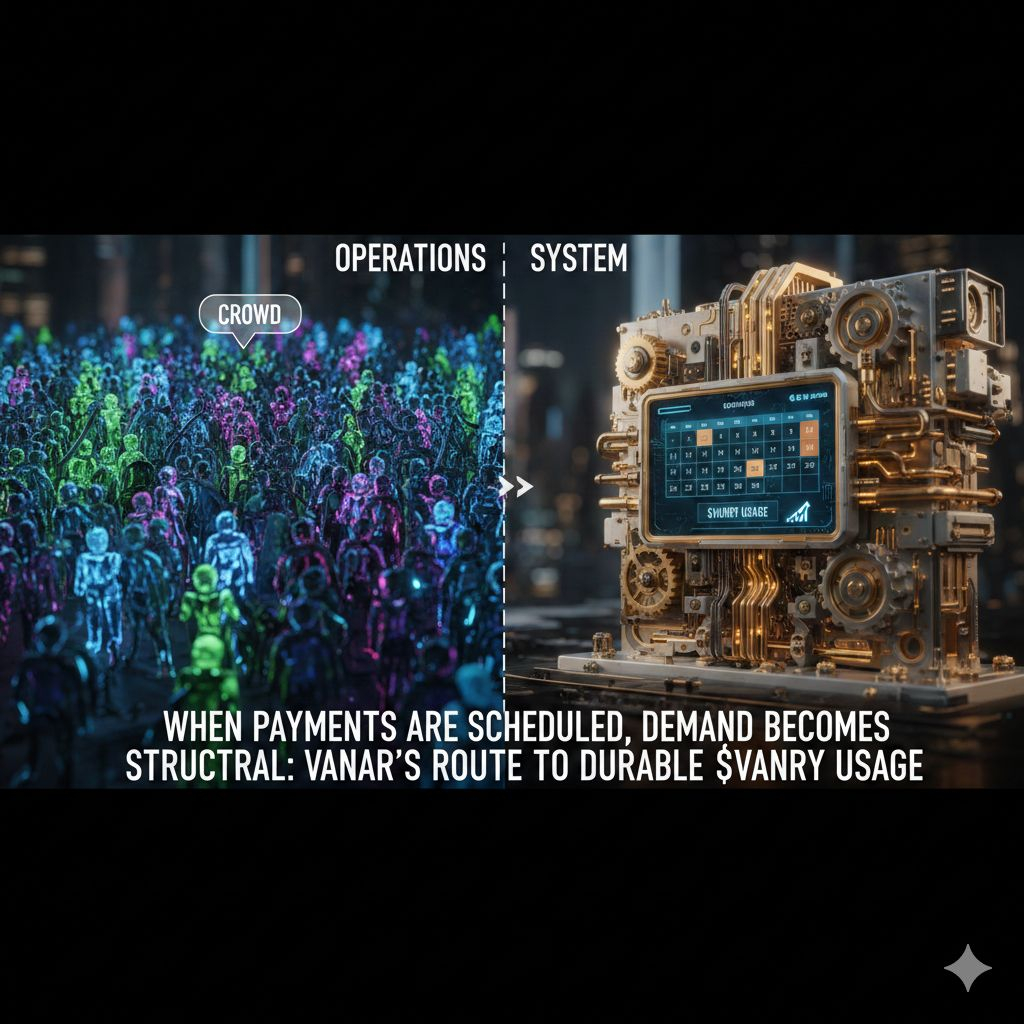
He kept circling the same problem: customers will pay us every month if we’re useful, but they won’t tolerate feeling like they’re funding an experiment just to keep their workflow alive. And I remember thinking: this is the moment most networks never reach. This is the moment where the conversation stops being about belief and starts being about operations.
Because when payments are scheduled, demand stops acting like a crowd. It starts acting like a system.
That’s the heart of what you’re pointing to with Vanar’s on-chain AI products. If builders are contracted into recurring payments—if subscription billing is baked into the product lifecycle—then $VANRY demand becomes less dependent on the daily emotional weather of trading. It doesn’t eliminate speculation, but it builds something sturdier beside it: a rhythm that keeps showing up.
Web2 has already taught us what “durable” looks like, and it’s almost never glamorous. Durable is a billing cycle. Durable is “renew” instead of “ape.” Durable is when the tool becomes part of the way a business breathes.
Think about what happens when a company adds a billing API, a CRM, or an analytics stack that actually gets used. The first month is curiosity. The second month is integration. The third month is dependence. After that, it’s not a tool anymore—it’s a habit wearing a contract. They keep paying because removing it creates pain. Not theoretical pain. Real pain: broken workflows, lost context, slower decisions, missed signals.
That’s why subscription systems are so dangerous—in the good way. They quietly convert value into routine.
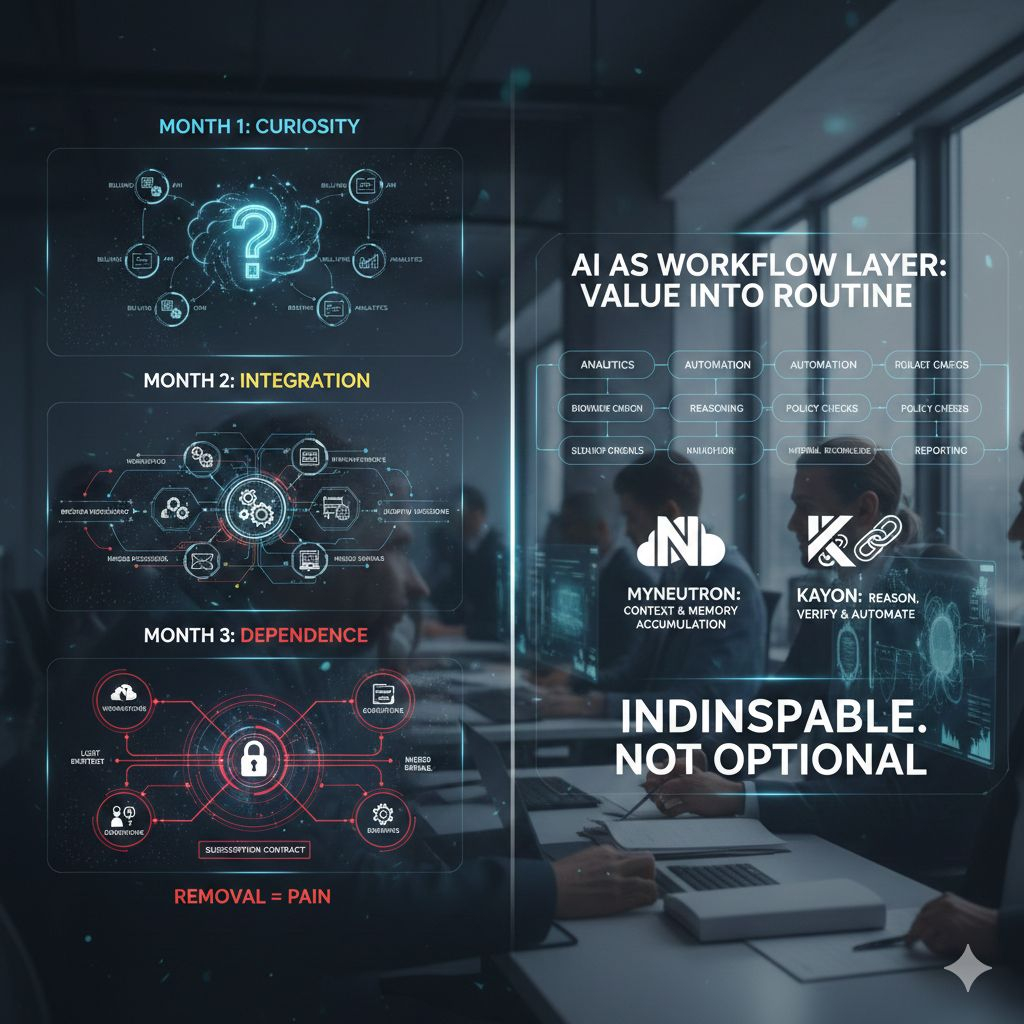
Now map that onto AI as a workflow layer. This is where the “on-chain AI” piece becomes more than a narrative. AI tools don’t live in the background. If they’re good, they sit right inside decision-making: analytics, automation, reasoning, policy checks, internal knowledge retrieval, reporting, and all the small “thinking chores” teams hate doing manually. If something like myNeutron becomes where a builder’s context and memory accumulates, or something like Kayon becomes the layer that helps teams reason, verify, and automate, then those tools stop being optional much faster than people expect.
And when they stop being optional, billing stops being a marketing decision. Billing becomes the natural shape of the product.
The interesting part is that this changes the type of demand a token can attract. Most tokens are addicted to attention-based demand: a single announcement, a listing, a partnership headline, a big “moment.” You get a spike, then you get silence. Even the best teams end up trapped in that cycle—always needing the next wave.
Subscriptions are the opposite. They’re boring on purpose. They don’t need drama. They need consistency.
Scheduled payments turn usage into a calendar event. They turn “I like this product” into “this product is now a monthly cost.” And once a cost becomes monthly, it becomes predictable, and once it becomes predictable, it becomes defensible internally. That’s where things get real.
This is the business angle most crypto conversations skip: controlled industries don’t just care about tech—they care about cost behavior. They care about whether expenses can be planned, audited, justified, and repeated without surprises.
Unpredictable gas costs are hard to sell to serious businesses. Even if they can afford it, they don’t like it. It’s not the amount that scares them—it’s the variance. Variance breaks planning. Variance breaks procurement logic. Variance creates internal friction: “Why did it cost this much this month?” “Why is this different today?” “How do we budget for something that changes because the market is emotional?”
Subscription billing neutralizes that argument. The cost is clear. The pattern is stable. The narrative becomes simple: we pay X in $VANRY for the capability that keeps our workflows moving. That’s the kind of sentence that survives a compliance review, a finance review, and a board-level conversation.
And this is where “token demand” becomes the wrong phrase. What you’re really describing is budgeted demand.
Budgeted demand isn’t romantic, but it’s powerful. It’s demand that gets written into operating expenses. Demand that returns on schedule. Demand that doesn’t need people to feel excited every day to keep existing.
It also creates something people underestimate: stickiness that compounds over time.
Because subscription products don’t just get “used.” They get installed into behavior. Teams train on them. Processes form around them. People build shortcuts and playbooks. The internal knowledge base grows. The automation becomes trusted. The reasoning layer becomes the default guardrail. And once those layers are set, switching isn’t just switching—it’s re-learning, re-building, and risking downtime.
That’s why the Web2 comparison feels so clean: you don’t keep paying because you love the tool. You keep paying because it’s woven into the way work happens.
So if Vanar’s on-chain AI products are priced and contracted in a subscription shape—especially if those payments are explicitly scheduled—then VANRY demand can shift from being a byproduct of attention to being a byproduct of continuity.
And there’s another piece here that matters more than people admit: this model can extend beyond a single chain.
If the value is in the intelligence layer—memory, reasoning, automation—then utility can travel wherever builders already live. The product becomes the anchor, not the network boundary. That’s what “Inter-Chain Utility Extension” really implies in practice: Vanar doesn’t need every user to relocate to prove usefulness. It needs the intelligence layer to stay essential, and for the settlement of that usefulness to remain consistent.
That’s how you get a token demand curve that isn’t waiting for the next sentiment wave. It’s tied to the one thing businesses don’t negotiate with: their own workflow.
I’ve learned to trust one signal more than hype, more than announcements, more than “community growth.” It’s when a builder stops talking like a trader and starts talking like an operator.
Because operators don’t ask, “Will the market like this?”
They ask, “Can we run this every day without friction?”
And if the answer becomes yes—if subscriptions become the default, if payments become scheduled, if VANRY becomes the ordinary way the system settles ongoing value—then the most important thing happens quietly.
The token stops needing people to believe in it loudly.
It just needs people to keep using what they already depend on.
And honestly, that’s the kind of demand I take seriously—because it doesn’t show up as noise.
It shows up as renewal.
