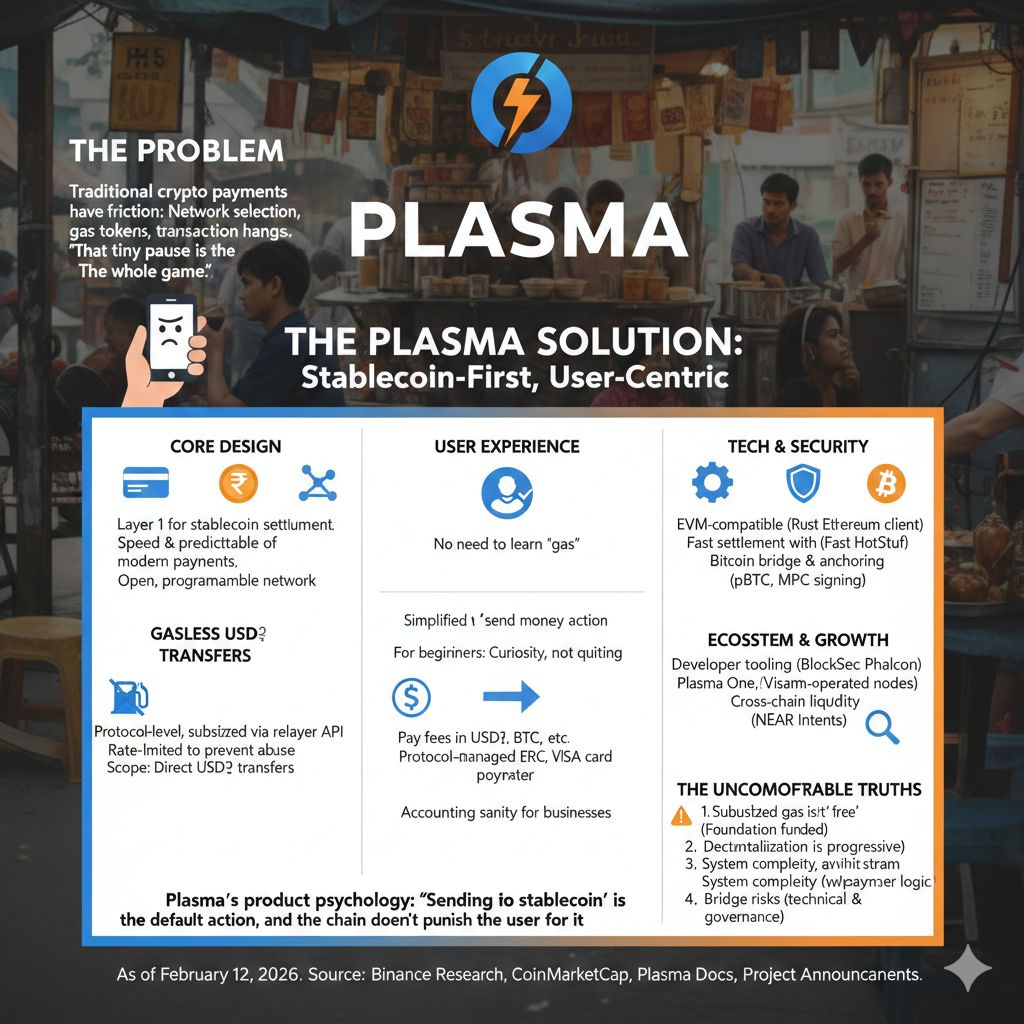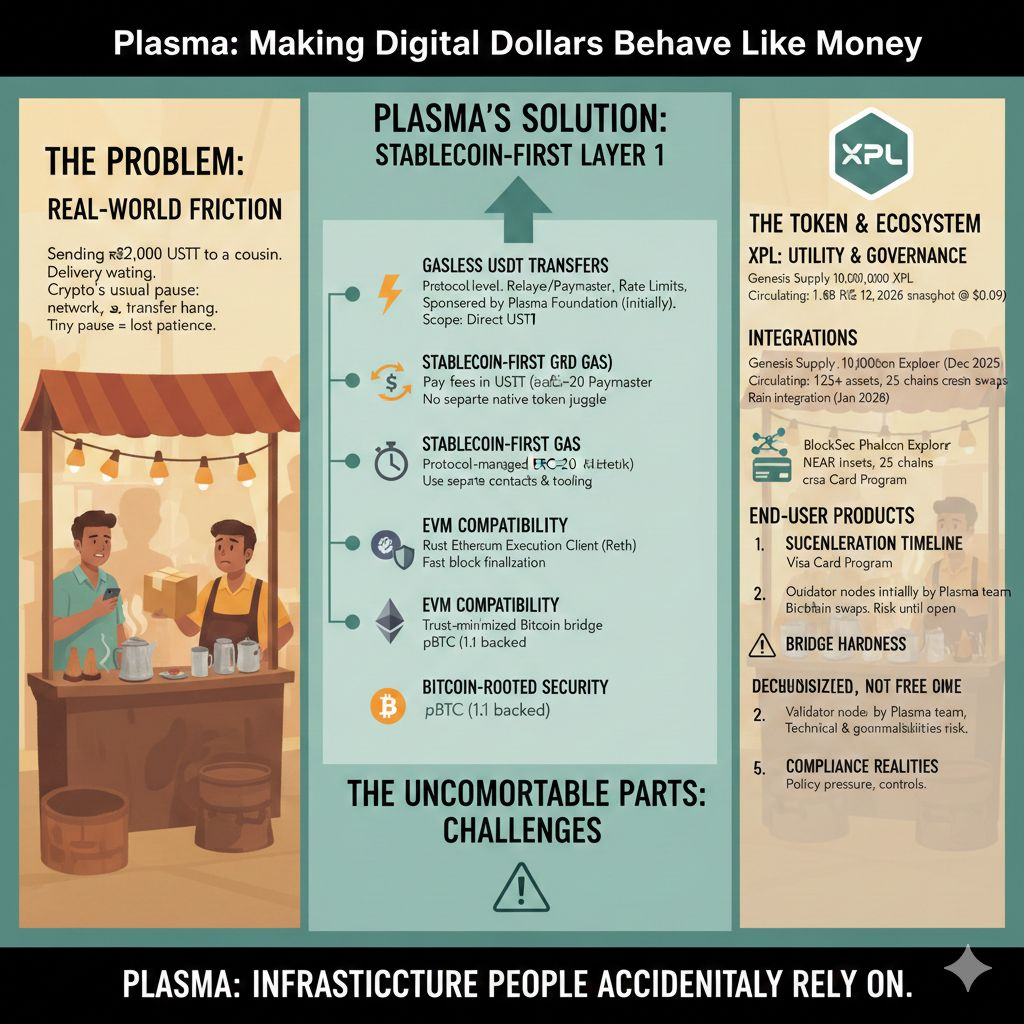
At a busy chai stall, the “payment problem” is never philosophical. Someone wants to send ₨2,000 worth of USDT to a cousin, right now, because the delivery guy is waiting and nobody wants to argue about exchange rates. The usual crypto friction shows up fast: pick the right network, keep a little gas token, hope fees don’t spike, hope the transfer doesn’t hang. In real life, that tiny pause is the whole game.Plasma is built around that pause. It’s a Layer 1 designed for stablecoin settlement first, not as a general-purpose chain that later also carries stablecoins. The practical promise is simple: stablecoins should move with the speed and predictability people expect from modern payments, while still living on an open, programmable network.The most noticeable design choice is also the most controversial: Plasma makes basic USD₮ transfers gasless, on purpose, at the protocol level. The way it does this isn’t magicit’s a relayer/paymaster setup managed through Plasma’s own relayer API, with controls and rate limits to prevent abuse. The sponsorship is tightly scoped to direct USD₮ transfers (not every possible contract call), and the docs are explicit that implementation details can evolve as they harden performance and security.That scope matters because it hints at Plasma’s worldview: a “send money” action should not feel like interacting with a blockchain at all. No extra token to buy. No “you’re short 0.0004 of something you’ve never heard of.” For beginners, that one missing step is the difference between curiosity and quitting.Here’s the blunt line: if a payment rail needs users to first learn what gas is, it’s not a payment rail.Plasma doesn’t pretend everything can be free forever, though. Their own FAQ makes the boundary clear: only simple USD₮ transfers are gasless; other transactions still pay fees, and those fees go to validators, maintaining incentives to secure the network.Then comes the second “real world” trick: stablecoin-first gas for everything else. Plasma allows fees to be paid in whitelisted assets like USD₮ (and BTC in some flows) so users and apps can stay inside the currency they already hold, instead of juggling a separate native token for every chain they touch. This is implemented through a protocol-managed ERC-20 paymaster—meaning developers don’t need to run their own gas abstraction layer just to give users a clean checkout experience.That’s not just nicer UX. It’s accounting sanity.If a fintech earns revenue in stablecoins and pays operational costs in stablecoins, “fees in stablecoins” stops being a feature and starts being basic compatibility with how businesses keep books. A builder trying to ship a remittance app does not want to explain why the app needs a volatile token balance sitting somewhere just to keep transfers alive.Under the hood, Plasma is still EVM-compatible. It uses a modern Rust Ethereum execution client (Reth) so Ethereum contracts and tooling can carry over without rewriting everything. That choice is less glamorous than new virtual machines, but it’s strategic: most stablecoin infrastructure already speaks EVM.The settlement speed side comes from PlasmaBFT, described in the official docs as a pipelined implementation of Fast HotStuffpart of the HotStuff family of BFT consensus protocols optimized for low-latency commits. In normal language: it’s designed to finalize blocks quickly and keep communication overhead under control when you want payment-like responsiveness.And then there’s the “anchoring” angle: Plasma’s architecture pairs that fast consensus and EVM execution with a Bitcoin bridge / Bitcoin-rooted security story. In their system overview, Plasma describes a modular stack that includes a trust-minimized Bitcoin bridge alongside the chain itself.The Bitcoin bridge is worth describing carefully because it’s where ideals meet engineering tradeoffs. Plasma’s docs present a design that introduces pBTC, meant to be backed 1:1 by real Bitcoin, using a verifier network and MPC-based signing for withdrawals, plus interoperability tooling (they mention a LayerZero OFT-based standard). That’s a lot of machineryand it’s exactly why bridges are always a risk surface in crypto, no matter how “trust-minimized” the intention is.So where does the token fit into all this?Plasma’s native token is XPL. On Binance Research’s project write-up, XPL is framed as the utility and governance token, used for gas at launch, staking post-decentralization, and as the base asset that still sits at the core even when users pay fees via custom gas tokens (through automated swap mechanics). They also list a genesis total supply of 10,000,000,000 XPL and a listed circulating supply figure of 1,800,000,000 (~18%) in that snapshot.Token markets are noisy, so it helps to anchor “latest” with a date. As of February 12, 2026, CoinMarketCap shows XPL trading around $0.09 with roughly $150M 24-hour trading volume and about 1.8B circulating supply (their figures update in real time).That price doesn’t tell you whether a chain works. It mostly tells you what attention looks like today. What matters more for Plasma’s long game is whether stablecoin activity becomes routine rather than incentive-driven.This is where ecosystem signals start to matter, not slogans.On the developer tooling side, Plasma has been picking up “boring but essential” integrations. For example, BlockSec announced Phalcon Explorer support for Plasma in late December 2025, positioning it as a way to analyze payment flows, trace transactions, and debug smart contracts on the network. This kind of integration is unsexy, but it’s what serious teams need when money is actually moving.On the product side, Plasma doesn’t only sell a chain. It also pushes an end-user surface: Plasma One, positioned as a stablecoin neobank-style app for saving, spending, sending, and earning, with a Visa card program structure described directly on their site (including the standard fintech disclaimers). Rewards and yields are explicitly “subject to change,” which is exactly the kind of sentence that feels real because it’s legally necessary.And yes, the sentence is a bit messy in practice.The bigger “bridge to real life” move lately is cards. Rain published an integration announcement on January 8, 2026, saying Rain partners building on Plasma can launch card programs that bring stablecoins into everyday spending, and that Rain supports large merchant acceptance through the Visa network. Plasma is trying to turn stablecoins from “something you hold” into “something you use without thinking.”
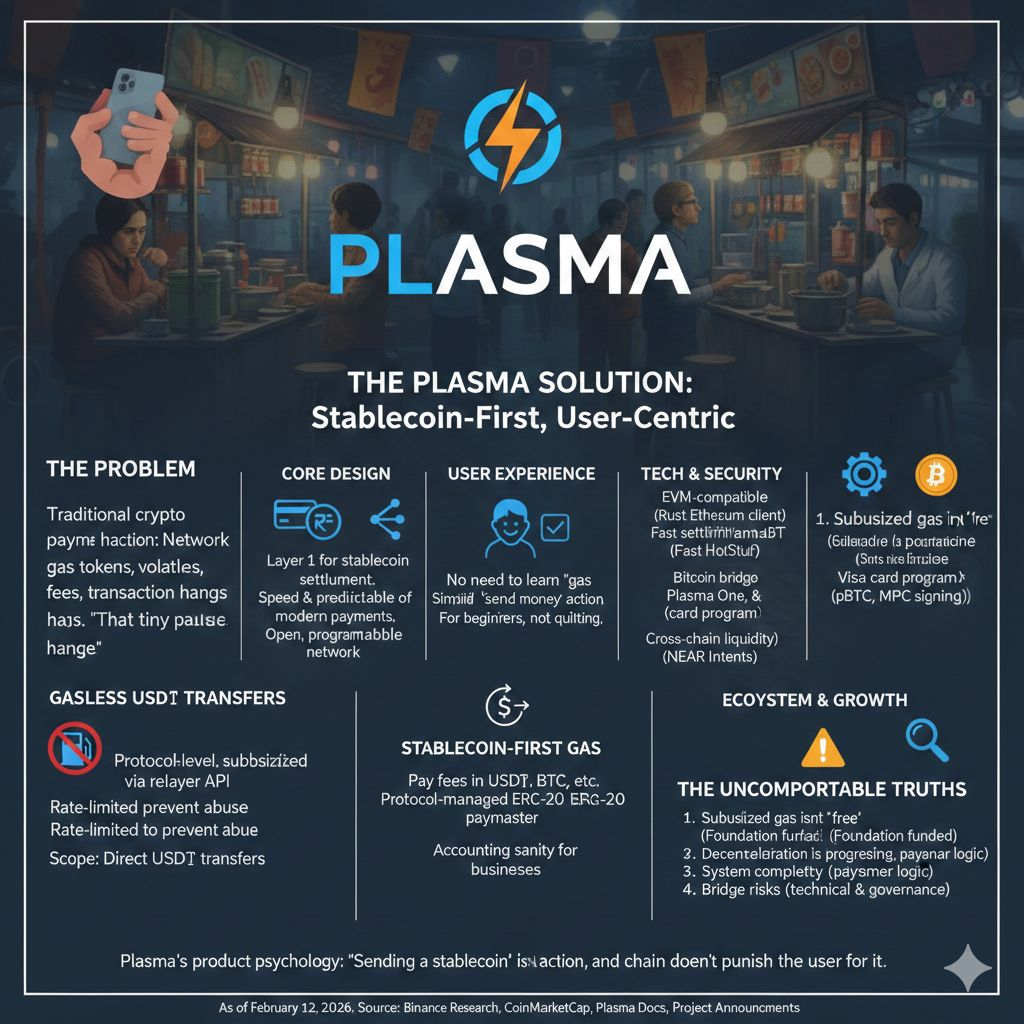
If you zoom out, this direction matches what the broader payments world is doing: stablecoin settlement rails are becoming mainstream infrastructure topics, not just crypto-native experiments. (Visa itself has expanded stablecoin settlement initiatives, for example.)But Plasma’s real constraint isn’t whether stablecoins are “the future.” The constraint is routing and liquidity.Stablecoins don’t win because the chain is fast. They win because the places people already useexchanges, wallets, on-ramps, off-ramps, merchantschoose that route by default.That’s why Plasma’s recent cross-chain and liquidity routing developments matter. NEAR Protocol’s official account posted that Plasma is live on NEAR Intents, enabling swaps across 125+ assets and 25+ chains to and from XPL. In plain terms: easier conversion and settlement paths, without forcing users through multi-step bridging rituals.For a stablecoin-focused chain, that kind of integration is not a side quest. If users can’t cheaply and reliably enter and exit, “payments” becomes a demo, not an economy.Now the uncomfortable partsbecause every payments chain has them.First, gasless transfers are not “free”; they are subsidized and managed. Plasma’s own documentation says the paymaster/relayer sponsorship is funded by the Plasma Foundation in the initial rollout, with identity-aware controls and rate limiting. That implies operational power: someone decides policies, thresholds, and abuse rules. In payments, policy is the product.Second, decentralization is a timeline, not a switch. Plasma’s FAQ states that validator nodes are currently operated by the Plasma team as part of “progressive decentralization,” while non-validator nodes can follow the chain and serve RPC without joining consensus. That may be a reasonable bootstrapping choice, but it’s still a centralization risk until the validator set opens up meaningfully.Third, stablecoin-first gas is great until pricing, whitelisting, and edge cases hit production. Whitelisted fee assets, automated swaps, and paymaster logic reduce UX pain, but they add system complexity. Complexity is where failures hideoutages, mispricing, wallet incompatibilities, and the classic “it worked yesterday” support nightmare. Plasma’s approach tries to keep it protocol-native so every app doesn’t reinvent the wheel, but the wheel still has to survive real traffic.Fourth, bridges stay hard. Plasma’s Bitcoin bridge design uses verifiers and MPC signing for withdrawals, and introduces pBTC as a 1:1 representation. Even when carefully designed, bridges are a concentration point for technical and governance risk: signer sets, verifier decentralization, monitoring, and attack response all matter.And then there’s the quiet, structural question Plasma can’t code away: stablecoin issuers and compliance realities exist. If Plasma succeeds at becoming a major settlement venue for stablecoins, it also becomes a place where policy pressure concentrates. Their docs already talk in “controls” language for gasless transfers. That’s not inherently bad; it’s just the reality of building payment rails that want to touch the mainstream.The most interesting part of Plasma isn’t that it’s fast, or that it’s EVM, or that it uses Bitcoin in the story. The interesting part is the product psychology: it treats “sending a stablecoin” as the default action, and it restructures the chain so that default doesn’t punish the user.If Plasma keeps shipping integrations that reduce frictioncards, better routing, better toolingand if it can widen decentralization while keeping the payment experience clean, then it stops feeling like “another chain” and starts feeling like infrastructure people accidentally rely on because it’s the easiest route.