
When I try to understand what Vanar is actually trying to be, I keep coming back to a comparison that has nothing to do with block sizes or throughput: it feels less like another “road” for transactions and more like a backstage control room that’s meant to quietly run the messy, real-world parts of digital products without forcing users to learn new rituals.
That matters because a lot of mainstream adoption problems are not “can I send value,” but rather “can I move information, permissions, proofs, and decisions through a workflow without everything turning into screenshots, spreadsheets, and human approvals,” and Vanar’s public positioning leans hard into that idea by describing a stack where the base chain is only one layer, and other layers handle structured storage and on-chain reasoning.
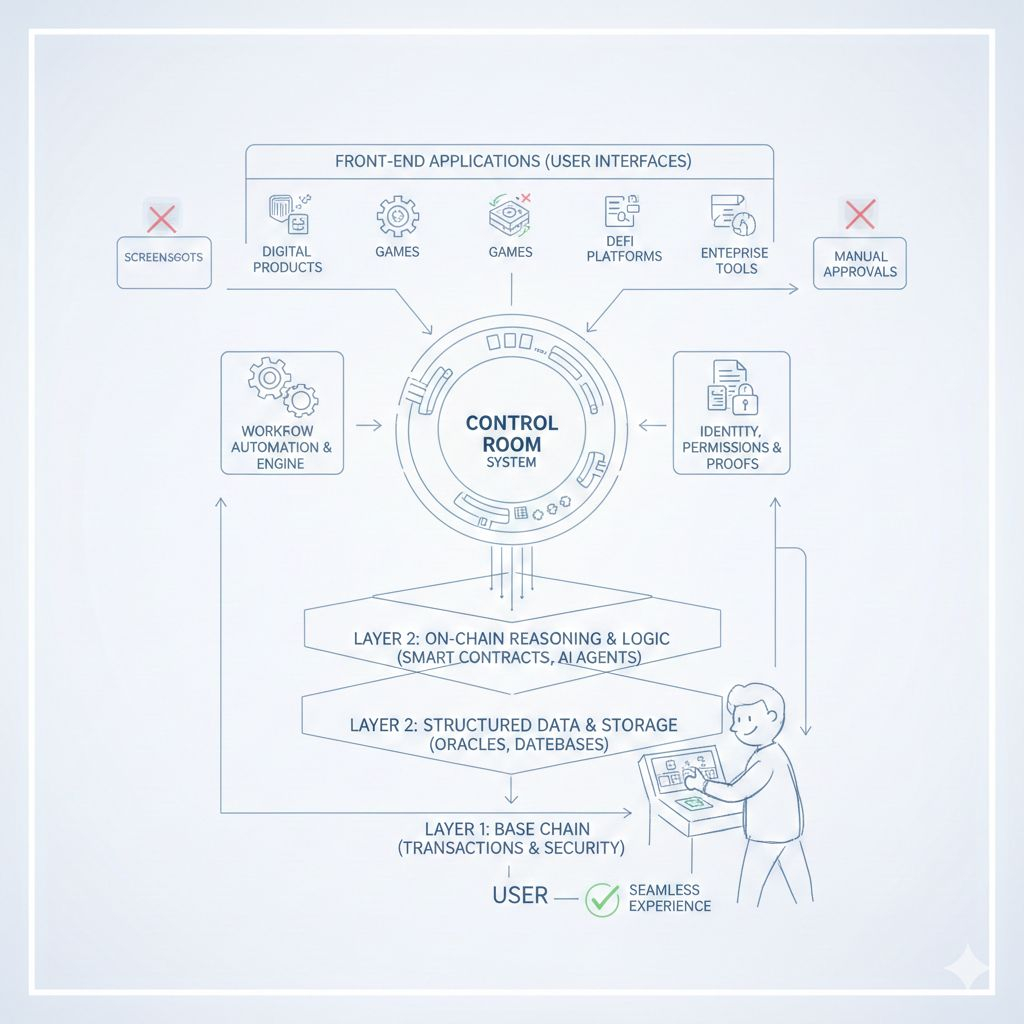
If you read that as marketing, it sounds like every other project trying to borrow the shine of “AI,” but if you read it as product architecture, it points to something more specific: Vanar seems to be arguing that the next wave of users won’t arrive because a wallet got prettier, but because the infrastructure starts behaving like a system that can remember, verify, and act in ways traditional chains usually push off-chain.
A detail I like to anchor on, simply because it is easy to verify and easy to build against, is that Vanar’s main network is presented with familiar developer rails like an EVM-compatible environment and a clear chain identifier (2040), alongside public endpoints and an explorer, which means the barrier to experimentation is closer to “plug in and deploy” than “relearn everything.”
Then there is the boring, unglamorous signal that I personally trust more than big narratives: the chain’s own explorer is currently showing roughly 193,823,272 total transactions and 28,634,064 wallet addresses, which, even allowing for the usual caveats about how addresses are counted and how activity can be distributed, suggests an ecosystem that has moved well beyond the “empty chain with a nice website” stage.
What I find more interesting than raw totals is what this implies about Vanar’s direction: if you are building for large consumer verticals, you eventually need infrastructure that tolerates high volumes of tiny actions while staying cheap and predictable, because mainstream apps tend to generate “lots of small events” rather than “a few huge financial moves,” and Vanar’s footprint on its explorer at least fits the shape of that world.
On the token side, the cleanest “latest” snapshot we can pull from public chain data is how VANRY behaves on Ethereum, where the token page currently shows 7,483 holders and 117 transfers in the last 24 hours, along with a displayed max total supply of 2,261,316,616 (as shown there).
I’m intentionally not turning that into a price story, because price talk is usually the fastest way to end up writing something that sounds like everyone else, but the holder/transfer relationship is still useful as a behavioral clue: thousands of holders paired with a low-hundreds daily transfer count often looks like an asset that people keep parked for access or exposure, while the day-to-day “work” of the ecosystem either happens somewhere else or happens in ways that don’t require constant ERC-20 motion.
In plain terms, Ethereum here feels more like a gateway layer than the place where the token’s utility gets fully expressed, which is consistent with the idea that the native chain is where the real usage narrative should be tested, especially if Vanar’s ambition is to power application workflows rather than just host a tradable asset.
One of the most quietly important design choices I’ve noticed in Vanar’s own technical documentation is the staking and validator structure, because it reveals who the network is optimized to satisfy: the documentation describes a delegated staking approach, and also states that validators are selected by the Vanar Foundation while the community delegates stake, which is a meaningful governance trade that tends to make networks more predictable for enterprise-style needs while also placing more weight on the transparency and evolution of the validator selection process over time.
That structure is not automatically a red flag or a green flag; it is more like a signpost that says, “this chain is comfortable with a bit more coordination if it improves reliability,” and if you genuinely believe the next big wave is real-world finance rails and tokenized assets that demand consistency, then that coordination bias can be interpreted as deliberate rather than accidental.
The “latest update” that feels most relevant to me is not a partnership headline, but the way Vanar’s own blog feed is continuing to lean into developer-facing themes around memory, structured data, and where builders already spend their time, with entries dated into late January 2026 and early February 2026 that keep circling back to the same central obsession: making the chain behave less like a dumb ledger and more like an environment where application intelligence has primitives it can rely on.
That repetition is useful, because it lets you evaluate Vanar with a sharper question than “is it fast”: if Vanar’s stack is genuinely about semantic storage and reasoning, then over time you should see more applications and contracts that treat the chain as a place to store compact representations of meaning and to run conditional logic on it, rather than only using it for transfers and generic state updates, and the moment those patterns show up in observable activity, the “AI-native” label stops being a vibe and starts being a measurable behavior.
If I were tracking Vanar like an independent researcher instead of writing a narrative, I would keep my attention on three “pressure tests” that tend to separate durable ecosystems from well-produced stories, and I would phrase them in a very unromantic way so they stay honest:
Does the chain’s visible activity increasingly reflect application logic and data workflows rather than just token motion, does the token’s usage feel like a metered cost of doing real work rather than simply an object of speculation, and does the network’s validator structure become more transparent and scalable as the ecosystem grows rather than more opaque and concentrated.
The reason I like this framing is that it doesn’t require me to take anyone’s word for anything; it asks Vanar to leave fingerprints in places that are hard to fake, like how the explorer evolves, how usage patterns look over time, and how token activity lines up with real ecosystem behavior instead of only lining up with attention.
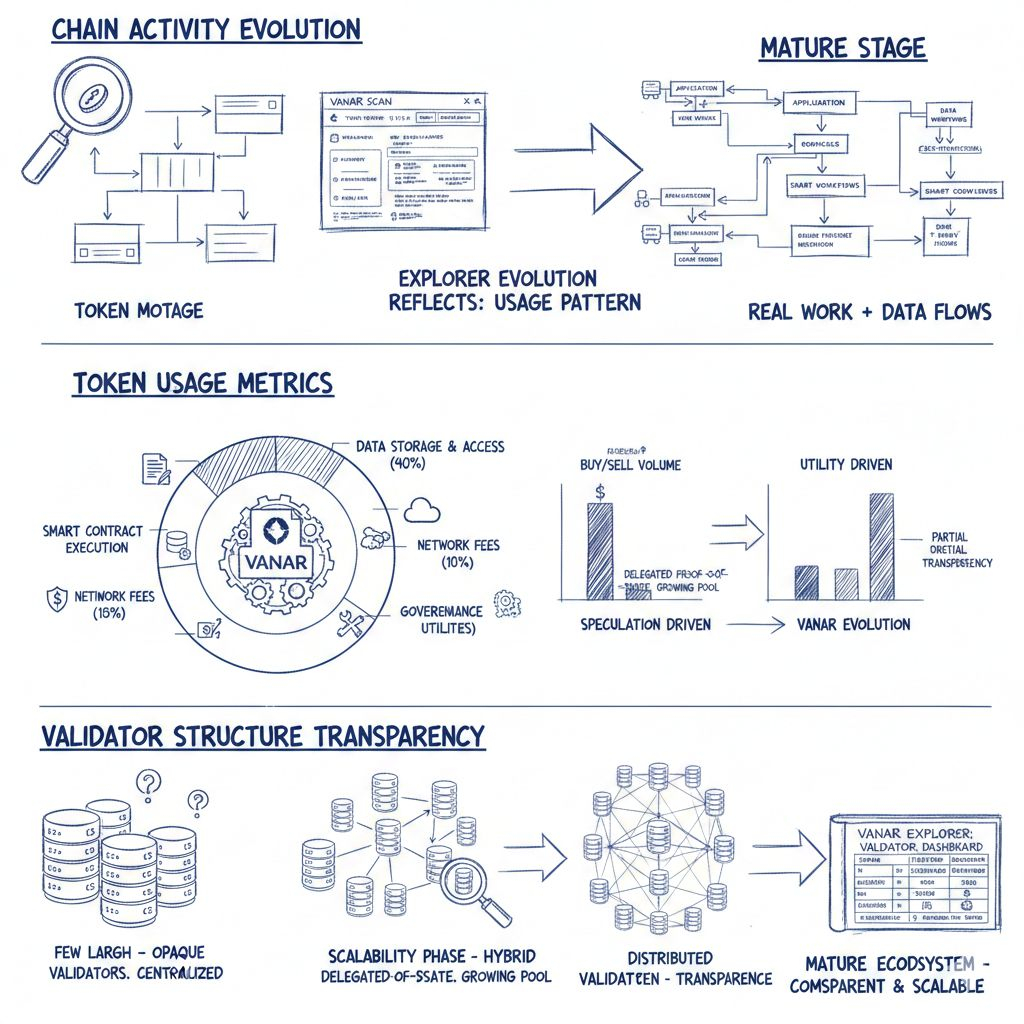
So my overall take, put as plainly as possible while staying fair, is that Vanar’s most distinctive bet is not that it will win the “best chain” contest, but that it can become the kind of infrastructure that consumer apps and real-world workflows can actually live on without constantly escaping off-chain for memory, logic, and verification, and the most convincing evidence for that bet will keep coming from what the chain visibly does and what builders demonstrably rely on, not from how confidently the story is told.
