
Ethereum, the second-largest cryptocurrency by market capitalization, has one of the most dramatic price journeys in modern finance. From trading for just a few cents in 2015 to reaching thousands of dollars, ETH has experienced extreme highs and painful crashes.
But beneath all the volatility lies a clear, repeating cycle, one shaped by innovation, speculation, liquidity, and now, powerful institutional investors. Understanding this cycle helps explain not only Ethereum’s past, but also where it may be headed next.
1) The ETH Cycle Pattern: Why Price Always Moves in Explosive Waves
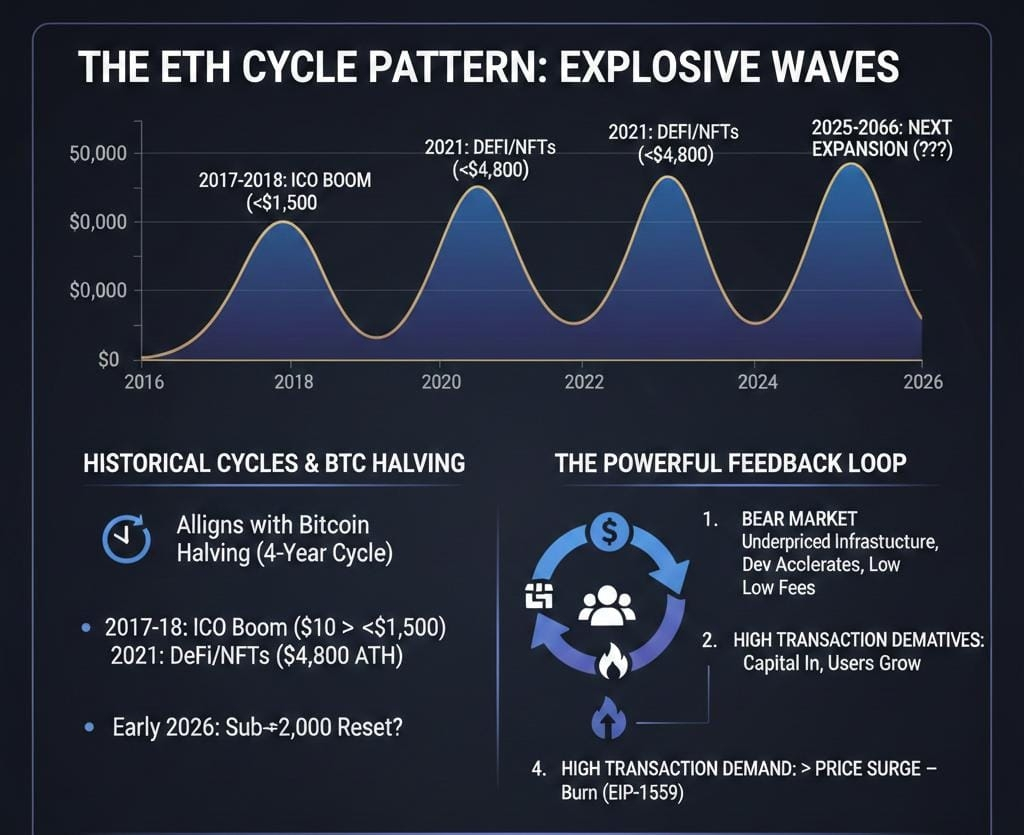
Ethereum does not grow in a straight line. Instead, it moves in powerful waves of accumulation, explosive rallies, and deep corrections.
Historically, ETH’s biggest moves have aligned closely with Bitcoin’s halving cycle, which occurs every four years and reduces new BTC supply often triggering broader crypto market enthusiasm.
2017–2018: The ICO boom pushed ETH from under $10 to nearly $1,500 as startups rushed to build on Ethereum.
2021: The rise of DeFi and NFTs sent ETH to an all-time high near $4,800.
During bear markets, Ethereum becomes undervalued infrastructure. Development accelerates, transaction fees drop, and experimentation thrives. Then, as adoption grows and narratives strengthen, capital floods back in. More users create higher transaction demand, which burns more ETH through EIP-1559, tightening supply and driving prices higher.
This creates a powerful feedback loop of demand, scarcity, and speculation.
By early 2026, ETH dipping below $2,000 once again reflects this reset phase, potentially laying the groundwork for the next expansion cycle.
Over time, volatility compresses and market maturity increases. For example, ETH holding above $1,800 during recent pullbacks stands in sharp contrast to the sub-$100 crash of 2018, signaling long-term structural strength.
2) Why ETH Explodes to New All-Time Highs
Ethereum’s rallies feel sudden, but they are fueled by several powerful forces working together.
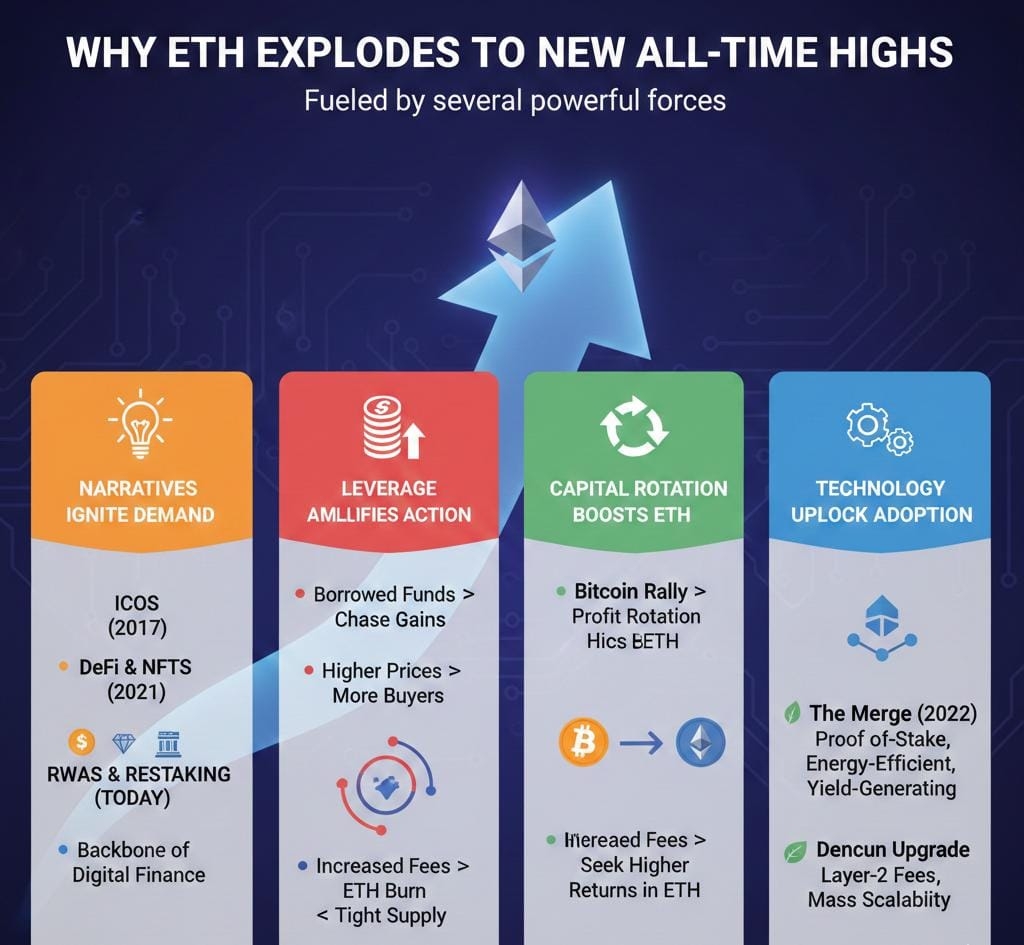
Narratives ignite demand.
Each cycle brings a new story that captures investor imagination. In 2017, it was ICOs. In 2021, DeFi and NFTs transformed Ethereum into a global financial engine. Today, real-world assets (RWAs), tokenized stocks, treasuries, and restaking protocols are positioning ETH as the backbone of digital finance.
Leverageamplifies price action.
As prices rise, traders use borrowed funds to chase gains, creating a reflexive loop higher prices attract more buyers, pushing fees higher, increasing ETH burn, and tightening supply even further.
Capital rotation boosts ETH.
After Bitcoin rallies, investors often rotate profits into Ethereum seeking higher returns, further accelerating price momentum.
Technology upgrades unlock adoption.
The Merge (2022) transitioned Ethereum to proof-of-stake, making it energy-efficient and yield-generating.
The Dencun upgrade (2024) dramatically reduced layer-2 fees, unlocking mass scalability and adoption.
Together, these forces turn Ethereum rallies into explosive, vertical price movements.
3) Why ETH Crashes So Hard After Each Peak
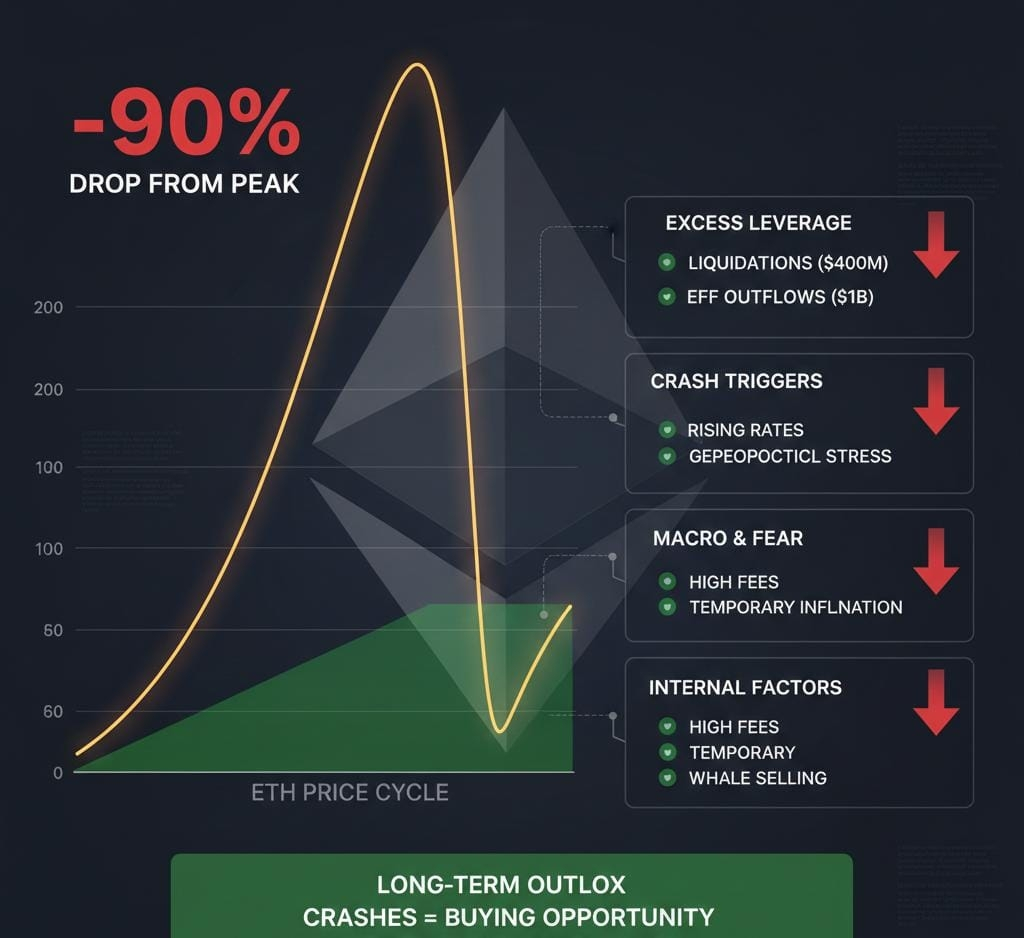
Just as Ethereum’s rallies are euphoric, its crashes are brutal often wiping out 70–90% from cycle highs.
The main driver is excess leverage. When prices begin to fall, leveraged positions are liquidated, triggering forced selling that rapidly accelerates declines.
Fear compounds the problem. Optimistic narratives quickly flip into panic, and macroeconomic pressures such as rising interest rates, tightening liquidity, or geopolitical stress push institutions into risk-off mode.
In early 2026, a sharp market drop liquidated over $400 million in ETH long positions within a day, worsened by more than $1 billion in ETF outflows.
Even internal factors can intensify sell-offs. High transaction fees, temporary inflation following upgrades, and occasional whale selling add pressure during peaks.
Yet historically, these crashes often signal long-term buying zones, setting the stage for the next accumulation phase.
4) The Institutional Takeover: How Big Money Now Shapes ETH Cycles
Ethereum’s early cycles were driven mostly by retail speculation. That has changed dramatically.
Since the approval of spot Ethereum ETFs in 2024, institutions including hedge funds, asset managers, banks, and pension funds have become major market participants.
ETH is now viewed as:
Digital financial infrastructure
A yield-bearing asset
A portfolio diversification tool
This shift has tied Ethereum closely to global liquidity cycles. When financial conditions ease, ETH rallies. When liquidity tightens, ETH corrects.
Institutions bring deeper liquidity and stability, but also stronger reactions to macroeconomic changes making Ethereum increasingly connected to global financial markets.
5) How to Position Smartly for the Next ETH Cycle
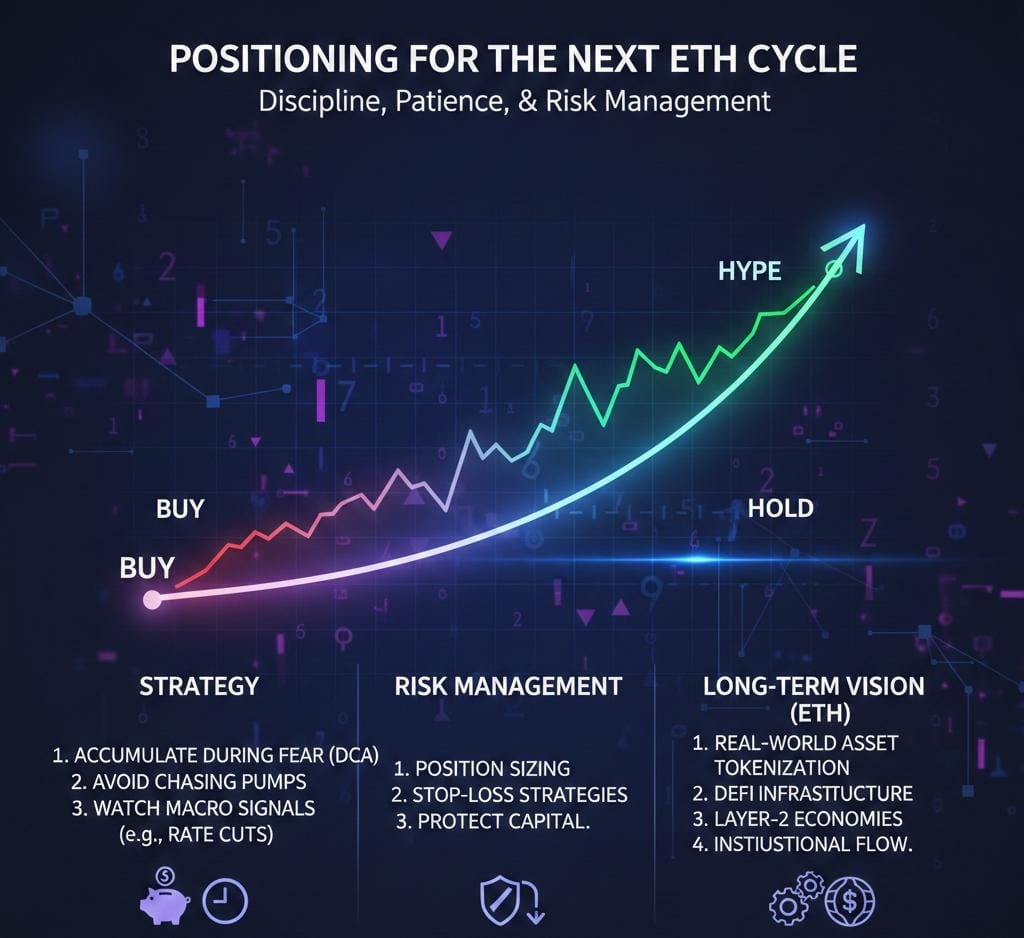
Success in Ethereum cycles isn’t about perfect timing it’s about discipline, patience, and risk management.
Accumulateduring fear, not hype.
Use dollar-cost averaging instead of chasing pumps.
Watch macro signals,interest rate cuts and liquidity expansion often ignite crypto rallies.
Protect capital using proper position sizing and stop-loss strategies.
Long-term, Ethereum’s expanding role in real-world asset tokenization, DeFi infrastructure, and layer-2 economies positions it as a core pillar of the digital financial system.
Institutions are accumulating quietly. Smart investors aim to align with that flow not fight it.
Conclusion
Ethereum’s price history may seem chaotic, but it follows a clear and predictable rhythm: build, explode, crash, and rebuild. Each cycle strengthens the network, expands adoption, and brings new players from retail traders to large institutions into the market.
Understanding these patterns isn’t about guessing tops or bottoms; it’s about staying informed, managing risk, and positioning for the next wave. By recognizing the signals, watching macro trends, and focusing on Ethereum’s growing utility in real-world assets and layer-2 ecosystems, investors can navigate volatility with confidence.
Cycles repeat, but Ethereum keeps evolving and those prepared for the next surge stand to benefit the most.

