

If you’ve traded long enough, you develop a reflex: any time a chain starts getting real usage, fees stop being “a feature” and become a risk variable. On Ethereum you’ve lived through the mempool mood swings. On other L1s you’ve watched “cheap gas” turn into “cheap until it isn’t.” That’s why the idea in the title moving from volatile gas to something closer to fixed costs has been popping up more often in serious dev and investor conversations lately. Vanar’s design leans into that pain point directly: it tries to turn the messiest part of onchain operations into something you can actually budget for.
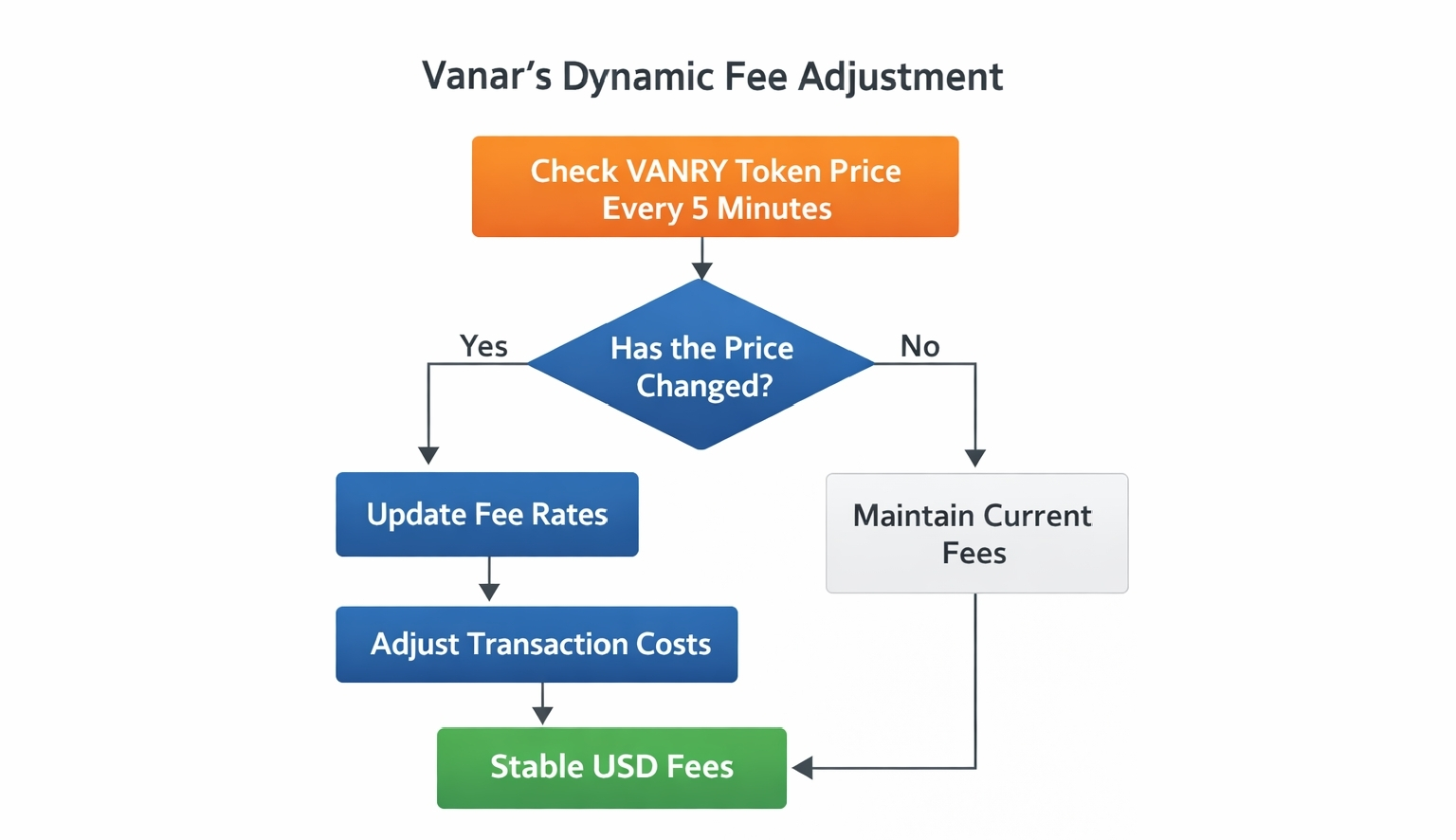
The core shift is simple to say, but meaningful in practice. Instead of letting transaction fees float purely with token price and congestion dynamics, Vanar targets fees in dollar terms and then adapts the chain’s internal fee settings as the market price of the native gas token (VANRY) moves. The documentation is explicit about the mechanism: the protocol updates transaction fees every five minutes, checking price every 100th block, using a VANRY token price feed and then adjusting fees accordingly. That’s a very different mental model from “gas is an auction” or “gas is cheap because blocks are big.” It’s closer to a feedback loop that tries to keep user-facing costs stable even when the token isn’t.
For developers, this is where the friction reduction actually shows up. On most chains, building a dApp means you’re also building a set of assumptions about gas that can break the moment volatility spikes. Suddenly your onboarding flow costs too much, your in-app actions need repricing, or your “free mint” idea dies on contact with reality. Vanar’s fixed-fee approach is designed to make those assumptions less fragile. Common actions transfers, swaps, minting, staking, bridging are meant to live in the lowest fee tier, described as roughly the VANRY equivalent of $0.0005 per transaction. Whether you think that number is sustainable long term is a fair question, but the point is that it’s expressed as a target cost you can plan around.
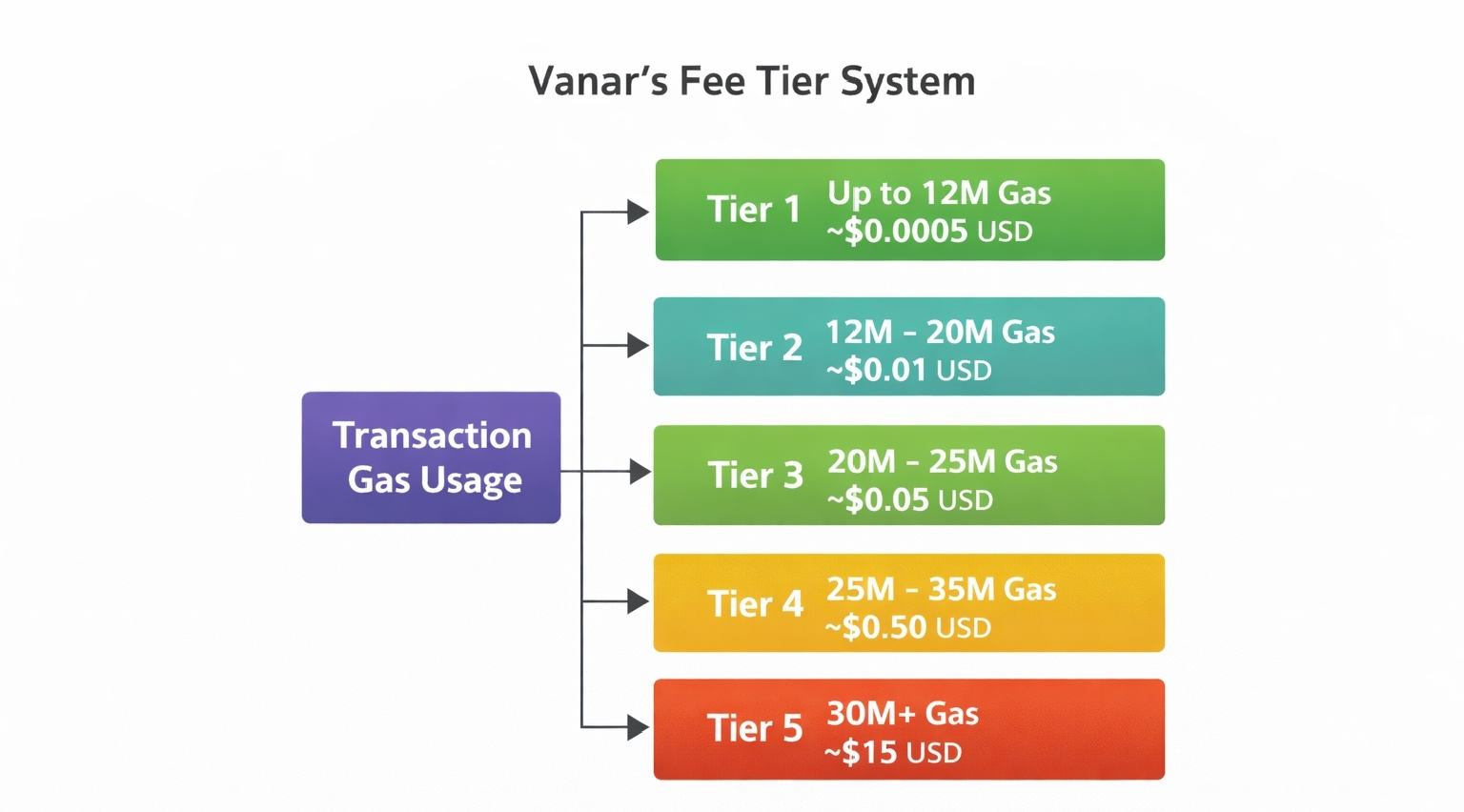
The tiering piece matters too, and it’s not just window dressing. Low fee chains have a known problem: if everything is nearly free, spam becomes cheap, and “cheap” quietly turns into “unavailable.” Vanar addresses that with five fee tiers based on transaction size (gas consumed). The smallest tier runs up to 12,000,000 gas at ~$0.0005, while larger tiers step up sharply, reaching $15 for the biggest transactions. The docs even give a concrete abuse example: with a ~3-second block time, 10,000 oversized transactions could effectively clog the network for about 8 hours and 20 minutes; if each one were only $0.0005 that’s around $5 of pain inflicted, but at higher tiers the same behavior becomes economically punishing. As a trader, I read that as “they’re trying to keep the chain usable under stress,” which is the only time fee design really gets tested.
Speed and simplicity aren’t just marketing words when they connect back to execution risk. Vanar’s public mainnet went live in 2024 and has pointed to sub three second finality and millions of transactions processed, framing itself as an infrastructure first chain rather than a novelty gas experiment. That matters because predictable fees without throughput is just a different kind of bottleneck. And the broader narrative especially through 2025 into early 2026 has been about shipping “real stack” features, like onchain storage/compression (highlighted publicly around an April 30 event in Dubai) and an AI native infrastructure push discussed in January 2026 updates. You can disagree with the AI angle, but the market’s attention tends to follow networks that keep releasing tangible components instead of only token narratives.
Now, the part developers will still need to understand: “fixed fees” doesn’t mean “forget gas exists.” Vanar still uses gas limits and transaction sizing under the hood, and that can trip people up if they treat it like a flat-fee web API. The developer docs note that gas estimation defaults to the first tier (up to 12,000,000 gas) unless a gas limit is provided; if your transaction is larger, estimation can fail unless you pass a higher gas limit (up to the 30,000,000 block limit). In plain English: costs may be predictable, but you still have to size your transactions correctly, or your tooling will complain. The upside is that once you learn the tier model, you’re not constantly rewriting fee assumptions every time the token chart moves.
So why is this “volatile gas to fixed costs” framing trending right now? Because the market is maturing in the boring direction, and boring is where money sticks. Traders still chase volatility, sure, but builders and product teams want something closer to an operating expense than a variable toll road. When fee uncertainty disappears, whole categories of apps get easier: microtransactions, high frequency in-app actions, consumer onboarding flows where you can’t ask users to “try again later when gas is lower.” From an investor lens, predictability also changes how you model adoption: you can estimate unit economics without needing a heroic assumption about future congestion.
My personal take, wearing the trader hat, is that fee predictability is one of those features you don’t fully appreciate until you’ve watched a narrative flip during a real spike. In calm markets, everyone claims they’re fast and cheap. In stressed markets, the only chains that feel “simple” are the ones that planned for stress. Vanar’s approach pegging user-facing fees to dollar targets, updating on a regular cadence, and using tiering to price abuse out of the system doesn’t remove all risk, but it does move a big chunk of uncertainty out of the day to day developer experience. And that, more than any slogan, is how protocol design changes the game.
