

When an asset drops below its realized price, most casual traders ignore it. Experienced on-chain observers do not. Recently, $XRP moved below its realized price a level that historically appears during late-stage corrections or early accumulation phases.
But before turning this into a “bottom is in” narrative, let’s slow down and understand what this actually means — and more importantly, what you should do in environments like this.
Realized price represents the average acquisition cost of all coins currently in circulation. When market price falls below that level, it means most holders are sitting at unrealized losses. Psychologically, this shifts behavior. Weak hands typically capitulate earlier in the drawdown. Long-term holders tend to stay. Over time, selling pressure can exhaust itself.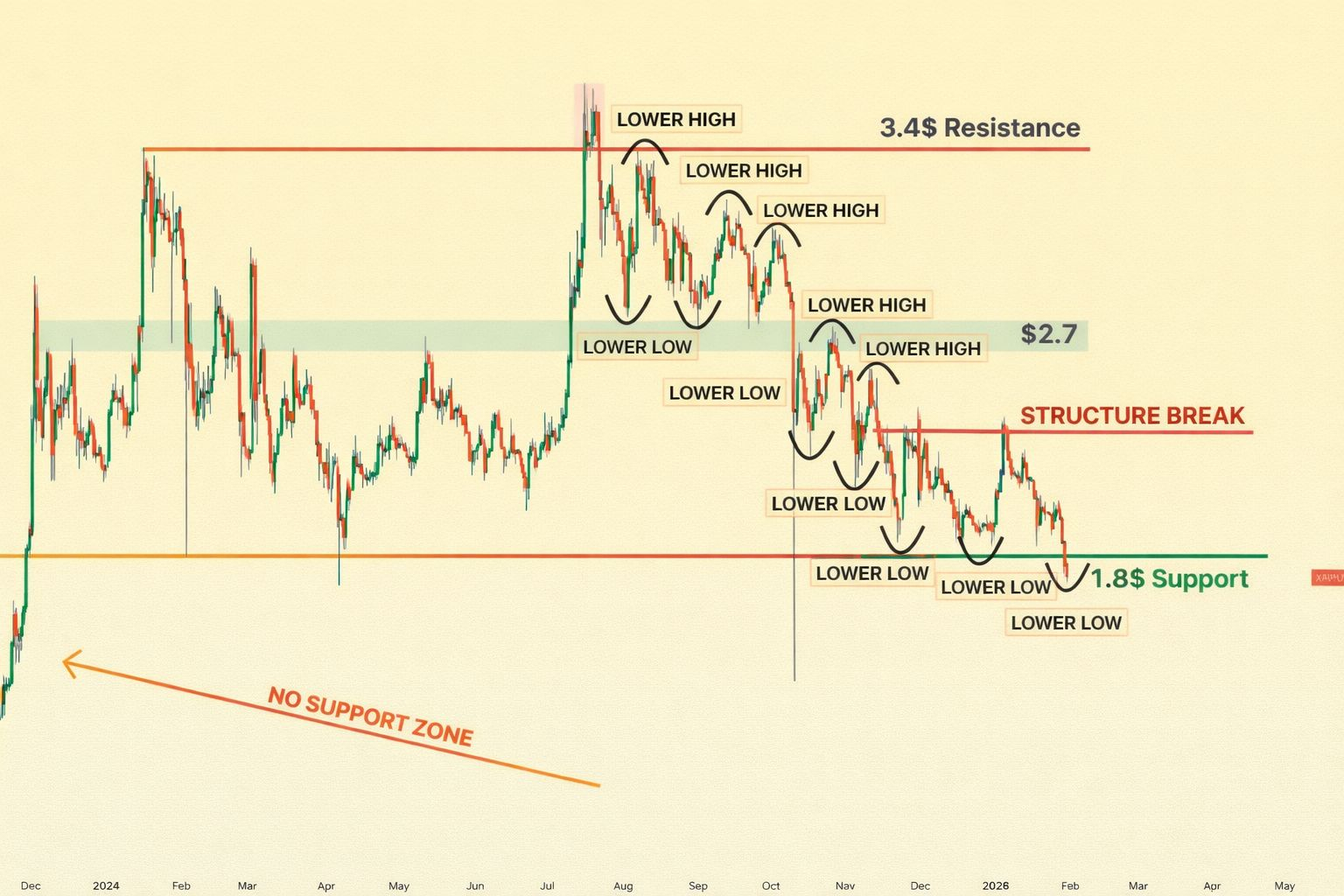
Historically across crypto cycles, price moving below realized price has often aligned with bottoming zones. Not immediate reversals but structural accumulation phases.
That distinction is critical.
Bottoms form through time, not headlines. They form through sideways movement, reduced volatility, and emotional fatigue. If XRP is forming a bottom, it will likely look boring before it looks bullish.
Now let’s address the whale activity.
Recent on-chain data shows larger wallets reducing exposure. Distribution from mid-sized and large holders explains why price feels heavy even without major negative news. But here’s the educational insight many traders miss: whale selling does not automatically mean long-term bearishness.
Sometimes it reflects rotation.
Sometimes redistribution.
Sometimes risk reduction before re-entry.
Markets often need supply to change hands before structure rebuilds. Redistribution can be part of base formation.
But this is where education matters most.
Seeing a potential bottom signal does not mean you rush in blindly.
If markets are fragile, the first rule is capital preservation.
Reduce leverage early.
Leverage turns normal volatility into account-ending events. If you cannot survive a 40–50% move against your position, your sizing is wrong.
Use position sizing intelligently.
Never allocate more capital than you can psychologically tolerate seeing decline by 60–70%. Volatility is part of crypto’s structure.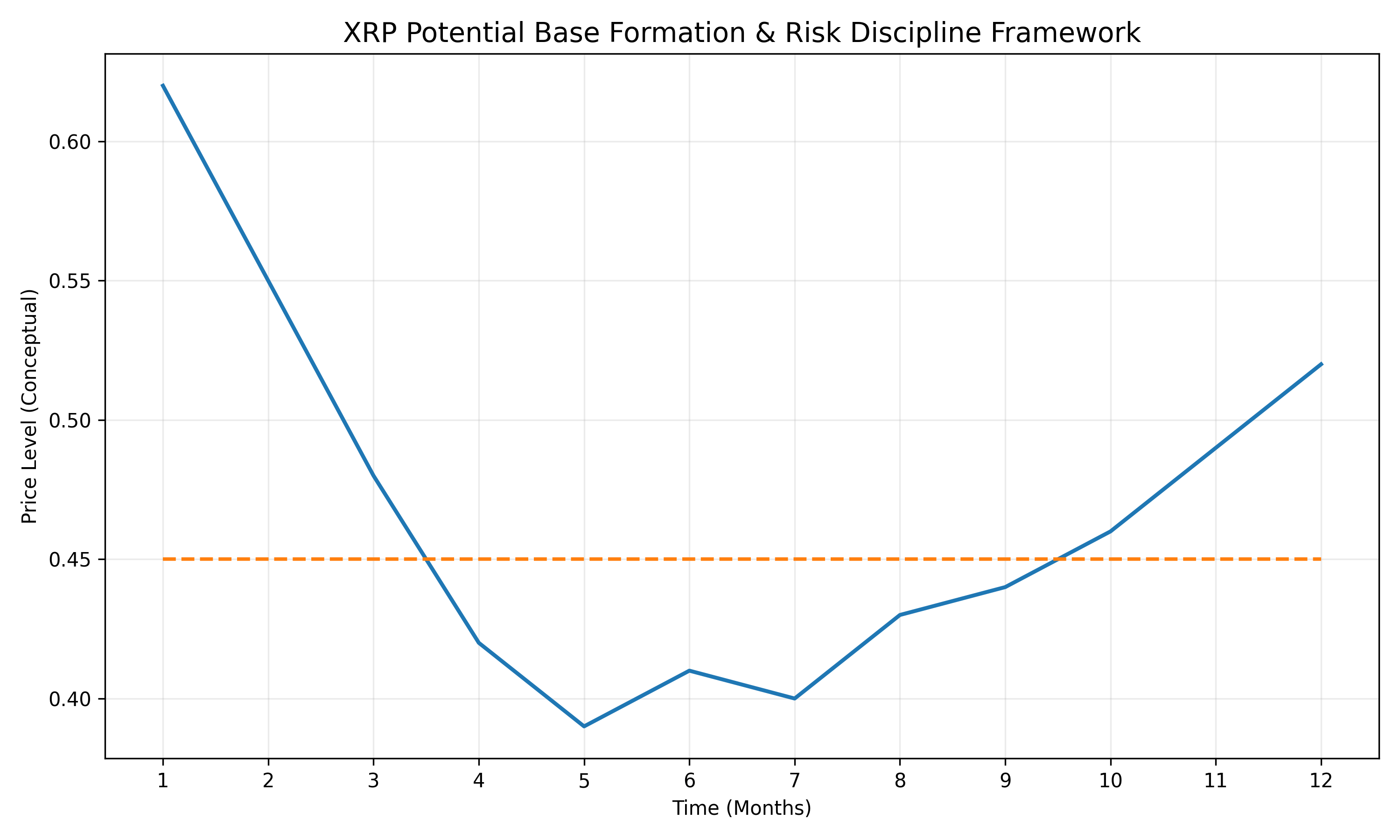
Separate conviction from speculation.
If your XRP position is a long-term thesis, manage it differently from short-term trades. Mixing the two leads to emotional errors.
Build liquidity reserves.
Holding cash or stable assets provides flexibility. Flexibility reduces panic. Panic creates bad decisions.
Avoid emotional averaging down.
Buying every dip without structural confirmation is not discipline — it is hope disguised as strategy.
Study liquidity conditions.
Crypto cycles correlate with macro liquidity. Interest rates, global risk appetite, and monetary policy influence capital flows. A strong on-chain signal during tight liquidity conditions may take longer to play out.
Another key lesson is understanding psychological traps.
When price falls sharply, the brain shifts into survival mode. Loss aversion amplifies fear. The mind interprets volatility as permanent collapse. In 2018, many believed crypto was finished. In 2022, people believed institutions were done. Every cycle feels existential at the bottom.
But price volatility is not the same as structural failure.
Ask rational questions during downturns:
Has network usage collapsed?
Has adoption reversed structurally?
Has regulation permanently impaired utility?
Or is this cyclical deleveraging?
Learning to separate emotional reaction from structural analysis is one of the most valuable skills you can develop.
Now let’s talk about preparation.
If markets deteriorate further, what should you actually do?
Lower correlated exposure.
Holding multiple assets that move together amplifies drawdowns.
Diversify across asset classes if possible.
Do not tie your entire financial stability to one volatile market.
Lower risk per trade.
During uncertain environments, preservation matters more than aggression.
Protect mental capital.
Constant exposure to negative sentiment can cloud judgment. Sometimes reducing screen time improves clarity.
Re-evaluate your financial goals realistically.
If your strategy only works in bull markets, it is incomplete.
Another powerful habit is pre-commitment.
Before increasing exposure, define:
What is my thesis for XRP?
What invalidates this thesis?
At what point do I reduce risk?
How much drawdown can I tolerate without emotional breakdown?
Write it down. Follow the plan when volatility spikes.
Markets transfer wealth from the impatient to the disciplined — but only when discipline includes risk control.
Blind faith is dangerous. Blind fear is equally dangerous.
Balance historical pattern recognition with present data.
If realized price continues to act as an accumulation marker and structure stabilizes above key support zones, mid-term outlook becomes constructive. If support fails and macro liquidity tightens, deeper retracement remains possible.
Have plans for both outcomes.
That is what separates strategic investors from reactive traders.
The real educational takeaway is this:
Potential bottoms are opportunities only for those prepared to survive the uncertainty.
XRP below realized price does not guarantee a reversal. It signals a zone worth attention. What happens next depends on liquidity, structure, and behavior.
History shows that the least exciting phase of a cycle often becomes the most rewarding in hindsight.
But hindsight only benefits those who managed risk in real time.
The question isn’t whether $XRP will bounce tomorrow.
The question is whether you are financially, emotionally, and strategically prepared if it doesn’t.
Because cycles repeat.
And your behavior inside those cycles determines whether you grow or get shaken out before the next expansion begins.
