

Imagine a world where sending money feels as fast and effortless as sending a text. No delays, no confusing fees, no juggling gas tokens, no wondering if the network is congested, no waiting for hours for your money to “finalize.” Just instant digital cash that moves anywhere on the planet in the blink of an eye. That is the world Plasma is trying to build and it’s doing it with a laser-focus on stablecoins, the digital dollars already powering billions in global payments every single day.
Plasma isn’t trying to be everything for everyone. It’s not chasing the next meme coin trend or trying to become a playground for speculative gambling. Instead, it has its eyes set on the biggest, most universal use case of blockchain: the movement of real money. And for that mission, stablecoins are the perfect fuel. They’re already the most-used assets in crypto, surpassing Bitcoin and Ethereum in daily usage. People use them for trading, saving, sending, lending, paying, and crossing borders without the headaches of banks.
But here’s the problem: the blockchains stablecoins live on weren’t built for them. Ethereum is powerful but slow and expensive when traffic spikes. Tron is fast but limited and lacks deep security innovation. Solana is quick but not built with stablecoins as the main design target. All of these chains treat stablecoins like optional guests Plasma treats them like the VIP the whole party revolves around.
Plasma is a Layer 1 chain created from scratch to be a stablecoin settlement engine. Instead of designing a general blockchain and later adding payment features, Plasma flipped the formula: design the perfect environment for stablecoins first, then let everything else sit on top. That simple shift changes everything. The chain uses a lightning-fast consensus model inspired by Fast HotStuff, giving sub-second finality, meaning your transactions don’t just get confirmed they get locked in instantly. No nervous waiting. No spinning wheels. No “stuck” transfers.
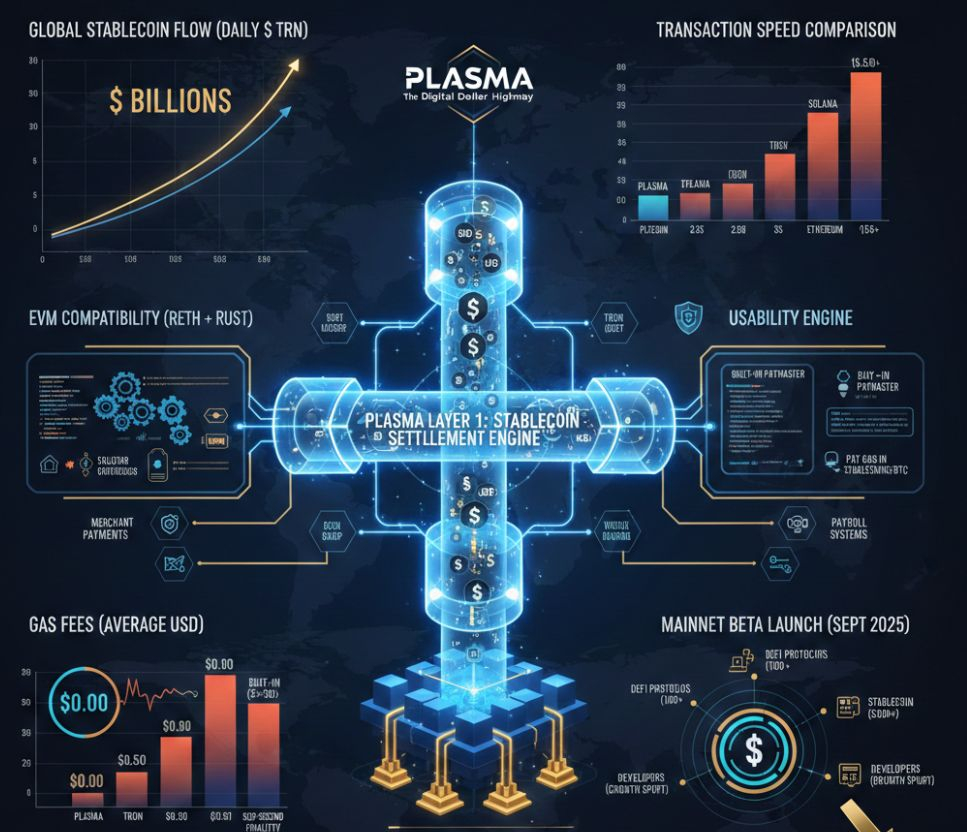
What makes Plasma even more thrilling is how it handles usability. On Plasma, you can send USDT without paying gas fees. Yes literally zero fees for moving the world’s most-used stablecoin. Plasma uses a built-in paymaster system to sponsor these transactions, letting anyone send money without touching the network’s native token. For the first time, a blockchain feels like a real digital cash system. You don’t need special tokens. You don’t need to manage wallets full of volatile assets. You just send dollars.
And when you do need gas for something beyond basic payments, Plasma lets you pay in stablecoins or even BTC. The chain automatically handles conversion so you don’t have to worry about holding XPL unless you want to. For everyday users, this feels like magic: you treat stablecoins like real money, and the chain makes the rest invisible.
The tech behind Plasma is equally impressive. It uses Reth a high-performance Ethereum engine written in Rust giving full EVM compatibility. That means developers can bring their Solidity apps over instantly, and users can keep using the tools they already know. Plasma isn’t trying to rewrite the developer world it’s trying to supercharge it.
Then comes the most powerful twist: Bitcoin-anchored security. Plasma commits its state to the Bitcoin blockchain, giving it censorship resistance and neutrality backed by the most decentralized network ever created. It’s a rare combination Ethereum-level programmability with Bitcoin-level anchoring and it pushes Plasma into a category most chains can’t reach.

Plasma’s launch was explosive. When the Mainnet Beta dropped in September 2025, billions in stablecoin liquidity flowed in almost immediately. Hundreds of DeFi protocols either deployed or lined up to integrate. Developers started flocking in because the chain offered something almost too good to ignore: the speed of a high-performance L1, the ecosystem of Ethereum, the stability of Bitcoin security, and the usability of a digital dollar payment system.
Beyond crypto speculation, Plasma aims at massive global markets: remittances, merchant payments, cross-border commerce, fintech apps, neobanks, and even payroll systems. Its goal is bold but simple to move real money for real people in real time. Whether it’s a worker sending money home, a business settling an invoice, or a user paying online without fees or friction, Plasma wants to be the invisible highway carrying those digital dollars.
Of course, there are challenges. Competing with giants like Ethereum or Tron is no small task. Regulatory changes around stablecoins will shape how Plasma grows. And building true decentralization takes time. But the vision is unmistakable and refreshing in a space often distracted by hype cycles. Plasma isn’t chasing shiny narratives it’s chasing usefulness.
The future of money is digital, instant, global, and stable. And if Plasma succeeds, it might become the hidden engine powering that future — a chain where stablecoins flow like water, where payments feel effortless, and where blockchain finally feels like everyday infrastructure instead of a complex science experiment.

