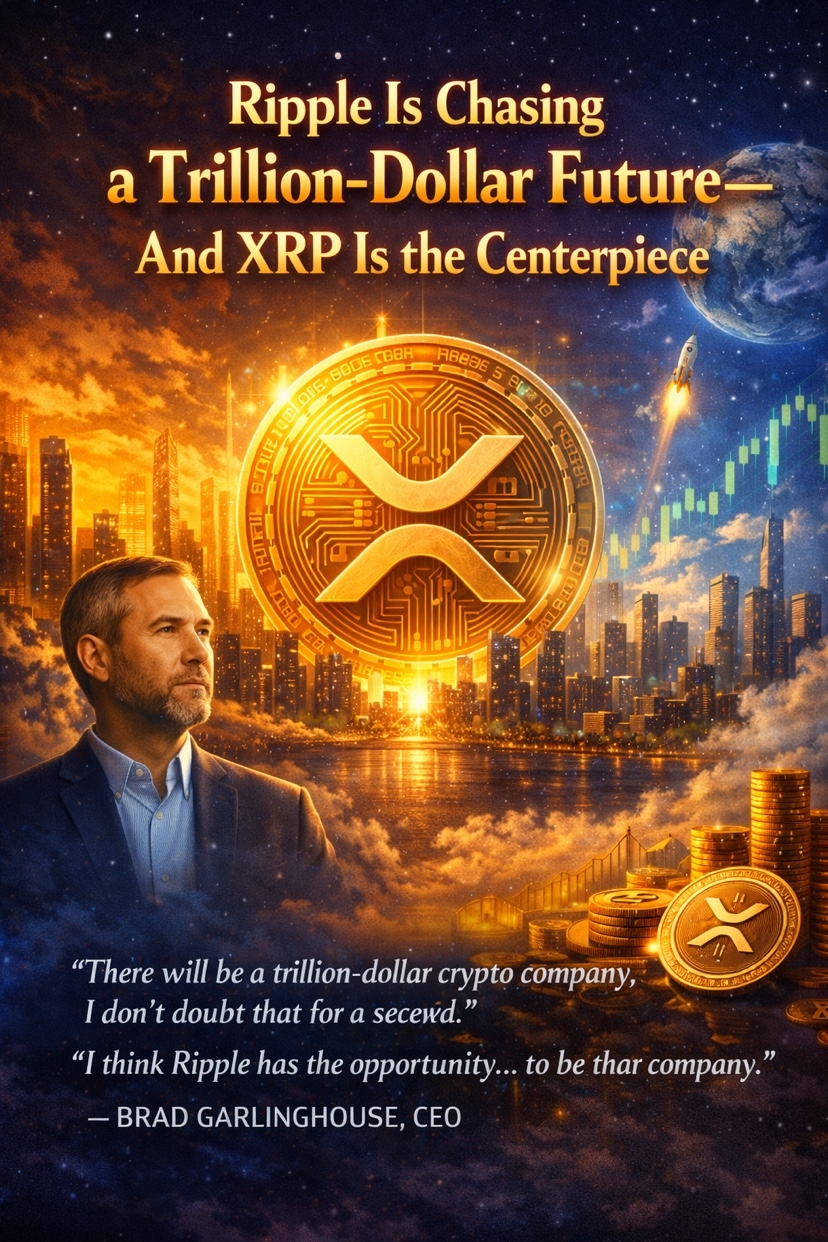
Fifteen years into crypto’s evolution, most leaders still speak in careful projections. Brad Garlinghouse didn’t.
During $XRP Community Day on X, he said it plainly: “There will be a trillion-dollar crypto company, I don’t doubt that for a second.” Then he took it a step further. “I think Ripple has the opportunity… to be that company.”
That kind of statement carries weight. #Ripple is currently valued around $40 billion after raising $500 million from investors including Citadel Securities and Fortress Investment Group. To reach a trillion dollars, it would need to grow roughly 25 times from here. In traditional markets, that kind of expansion defines eras. Apple. Nvidia. Alphabet. Companies that became foundational to how the world operates.
In crypto, ambition is common. Execution is rare.
What makes Ripple’s claim worth paying attention to is where the conviction is anchored. Garlinghouse has repeatedly described $XRP as the company’s “north star,” adding,
“Ripple’s reason for existence is driving success around XRP and the XRP ecosystem.”
That statement shifts the frame. XRP is presented as infrastructure, a liquidity layer designed for settlement, cross-border efficiency, and treasury movement.
This is not positioning built on short-term excitement. Over the past year, Ripple has deployed billions into expansion. It acquired prime brokerage Hidden Road for $1.25 billion, treasury management firm GTreasury for $1 billion, and Rail for $200 million, while adding Palisade to strengthen its stack. These moves point to vertical integration. Build the rails. Own more of the flow. Strengthen the financial plumbing before scale arrives.
All of this unfolds against a volatile market backdrop. #xrp has retraced significantly from its $3.56 all-time high and has traded near $1.38. Bitcoin and the broader market have experienced similar drawdowns. Garlinghouse addressed the moment directly, urging the community to zoom out. He reminded listeners that these are massive markets and that the opportunity to “rewire and accelerate” global financial infrastructure is far bigger than any single quarter’s price action.
There is also context that cannot be ignored. After years of legal uncertainty, a U.S. judge ruled that $XRP itself is not a security when sold on exchanges. That partial clarity reduced a regulatory weight that had lingered over Ripple’s strategy. It does not eliminate risk, but it changes the starting point. The conversation begins to shift from survival to adoption.
None of this guarantees a trillion-dollar outcome. Moving from $40 billion to $1 trillion would demand sustained institutional usage, global regulatory coordination, deep liquidity integration, and real-world dependency. That is a steep climb.
But there is a clear narrative emerging. Ripple is not trying to win a meme cycle. It is attempting to embed itself into the underlying infrastructure of finance, with XRP positioned at the center of that design.
The real tension sits here. Does the first trillion-dollar crypto company emerge from consumer speculation and retail momentum, or from institutional rails that quietly power global flows?
One path is louder. The other is slower and harder to build.
lf a trillion-dollar company does emerge from crypto, it will likely become indispensable before it becomes celebrated. The question for anyone watching is simple: are we witnessing the early stages of that kind of buildout, or just another ambitious promise in a market known for bold claims?
That is where the conversation should begin.