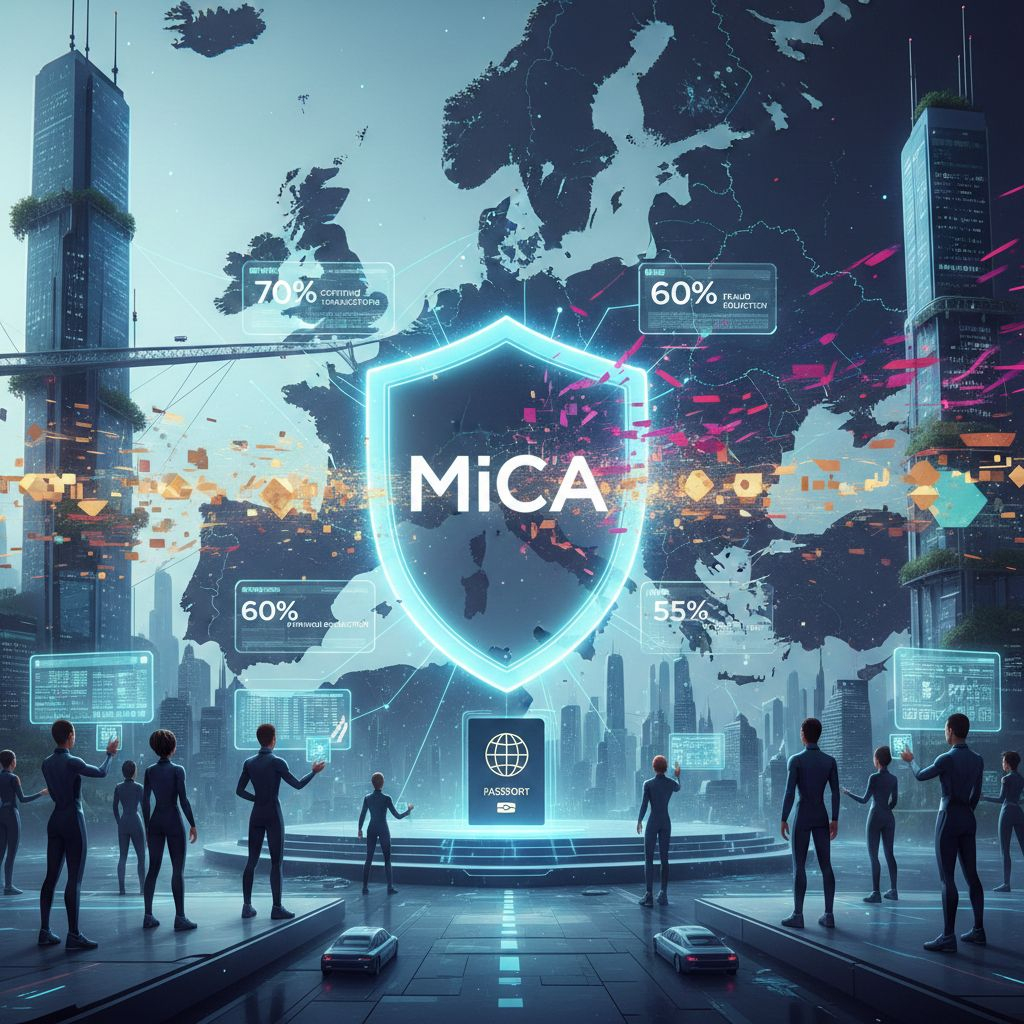
The entry into the year 2026 marks a decisive turning point for the European financial landscape with the full implementation of the regulation on crypto-assets markets, better known by the acronym MiCA. This legislative framework has transformed an ecosystem once perceived as an uncertain technological frontier into a structured, transparent, and highly secure market.
In the face of this change, our organization, MiCA, asserts itself as the trusted partner for regulating fraud related to investments and financial products. We help victims recover funds stolen by fraudulent financial companies, in France, Europe, and worldwide.
I. The Genesis of a Trust Market: Why MiCA Changes the Game
The MiCA regulation was not born from a desire for restriction, but from a strategic necessity to provide legal security to market participants while preserving financial stability. Before its introduction, the lack of clear rules hindered innovation and exposed participants to major operational risks.
Today, the MiCA framework is based on three fundamental pillars aimed at stabilizing the ecosystem:
The rigorous protection of crypto-asset holders.
The guarantee of absolute integrity of the financial market.
The promotion of healthy competition among service providers.
By replacing a mosaic of fragmented national regulations with a body of harmonized rules, the European Union has not only strengthened investor protection but has also created fertile ground for institutional innovation.
II. A Precise Classification to Eliminate Ambiguity
One of the major successes of this regulation lies in its ability to precisely define the subject of regulation. A crypto-asset is now defined as a digital representation of value or a right that can be transferred and stored electronically via blockchain or similar technology.
To ensure appropriate oversight, assets are segmented into three key categories:
Electronic money tokens (JME / EMT): These assets aim to stabilize their value against a single official currency (e.g., the Euro) and mainly serve as digital means of payment.
Tokens referring to one or more assets (JRA / ART): They stabilize their value against multiple currencies, commodities, or other assets, offering stability through a diversified basket of values.
Other crypto-assets: This category includes utility tokens and traditional cryptocurrencies like Bitcoin (BTC) or Ethereum (ETH), which remain subject to transparency rules.
This structure clarifies the status of many projects and avoids unnecessary regulatory burdens for innovative companies while ensuring that no normative overlap exists with already regulated financial instruments.
III. The CASP Approval and the European Passport: A Guarantee of Legitimacy
For businesses, the major innovation is the status of Crypto-Asset Service Provider (PSCA or CASP). This status replaces heterogeneous national registrations with a unique license, opening the doors of the European internal market to any certified entity.
The "European passport" allows a certified company in its home country (like by the AMF in France or BaFin in Germany) to offer its services in the 27 Member States of the Union without having to apply for new local licenses. This mechanism ensures unprecedented operational fluidity and drastically reduces compliance costs.
To obtain this approval, providers must meet permanent minimum capital requirements (ranging from €50,000 to €150,000 depending on the services), ensuring that providers have strong enough backing to cope with extreme volatility, thus protecting the entire financial system.
IV. Consumer Protection: Your Shield Against Spoliation
One of MiCA's primary objectives is to transform the retail investor's experience by offering a level of protection equivalent to that of traditional financial markets. This architecture relies on several concrete measures:
The Transparency of the White Paper
Any public offering of crypto-assets must be preceded by the publication of a detailed white paper. This document must provide honest and non-misleading information about the risks, costs, and rights attached to the tokens. Issuers are now legally responsible for damages caused by erroneous or incomplete information, providing a powerful legal lever for fund recovery actions.
The 14-Day Right of Withdrawal
The introduction of a 14-day right of withdrawal for retail investors is a historic advancement. It offers a crucial reflection period, allowing investors to disengage from an impulsive purchase without penalty, significantly reducing the impact of aggressive sales techniques.
Segregation of Assets and Safeguarding of Client Funds
A critical aspect of security is the obligation to segregate assets. Providers must ensure that client funds are strictly separated from their own funds. In the event of insolvency or bankruptcy of the provider, client assets are protected and cannot be used to repay the company's creditors.
V. Institutional Adoption and the "Bank Rush" of 2025-2026
One of the most spectacular impacts of MiCA is the removal of mental and legal barriers that kept traditional banks away from the sector. Since July 2025, we are witnessing a true phenomenon of "bank rush" in Europe.
Leading institutions like ING Deutschland, BBVA in Spain, or CaixaBank have integrated crypto-asset services directly into their banking applications. By becoming regulated trusted third parties, these banks enable millions of users to access digital assets securely, thereby reducing the risks of migrating to unregulated fraudulent platforms.
VI. Fighting Fraud: Enhanced Surveillance Tools
For the market to be considered mature, it must be free of manipulations. MiCA transposes the principles of the European directive on market abuse (MAR) to the digital asset sector, formally prohibiting insider trading and market manipulation.
The regulation requires providers to implement sophisticated systems for detecting suspicious activities. National authorities now have extensive investigative powers and can impose substantial fines, potentially reaching 12.5% of annual revenue for the most serious offenses. This rigor has already led to a 60% reduction in reported fraud cases since 2024.
VII. Why Call on Our Organization?
Our mission is to act where fraudulent companies attempt to escape. With our expertise and the surveillance and compliance tools offered by the MiCA framework, we assist victims in identifying fraud and recovering funds stolen by illegally operating financial companies.
In 2026, the lead taken by the European Union is striking. While other economic blocs are still struggling with vague definitions or repressive approaches, Europe offers a safe, predictable, and sovereign environment that attracts capital and protects citizens.
Contact our experts
If you have suffered a financial loss related to a suspicious trading platform or fraudulent investment, do not stay alone. Our specialized team supports you in your recovery efforts on a global scale.
Organization: MiCA
Phone: 04 22 14 07 76
Website: https://mica.finance/
Email: contact@mica.finance
MiCA represents much more than a simple regulation: it is the assurance of a stable, prosperous, and secure digital future for all investors.