The blockchain industry has spent more than a decade trying to answer one central question: how do you bring millions of everyday users into decentralized ecosystems without forcing them to understand complex technology? While decentralized finance introduced powerful financial tools, it also created steep learning curves. Wallets, private keys, gas fees, and network congestion often discourage non-technical users.
Gaming, however, presents a very different path forward.
KoUnlike financial products that demand immediate trust and capital, games are familiar, engaging, and emotionally driven experiences. They are environments where users already spend time, build communities, and invest effort. This is precisely why gaming may become the most natural gateway for blockchain adoption — and why Vanar is placing gaming at the core of its strategy.
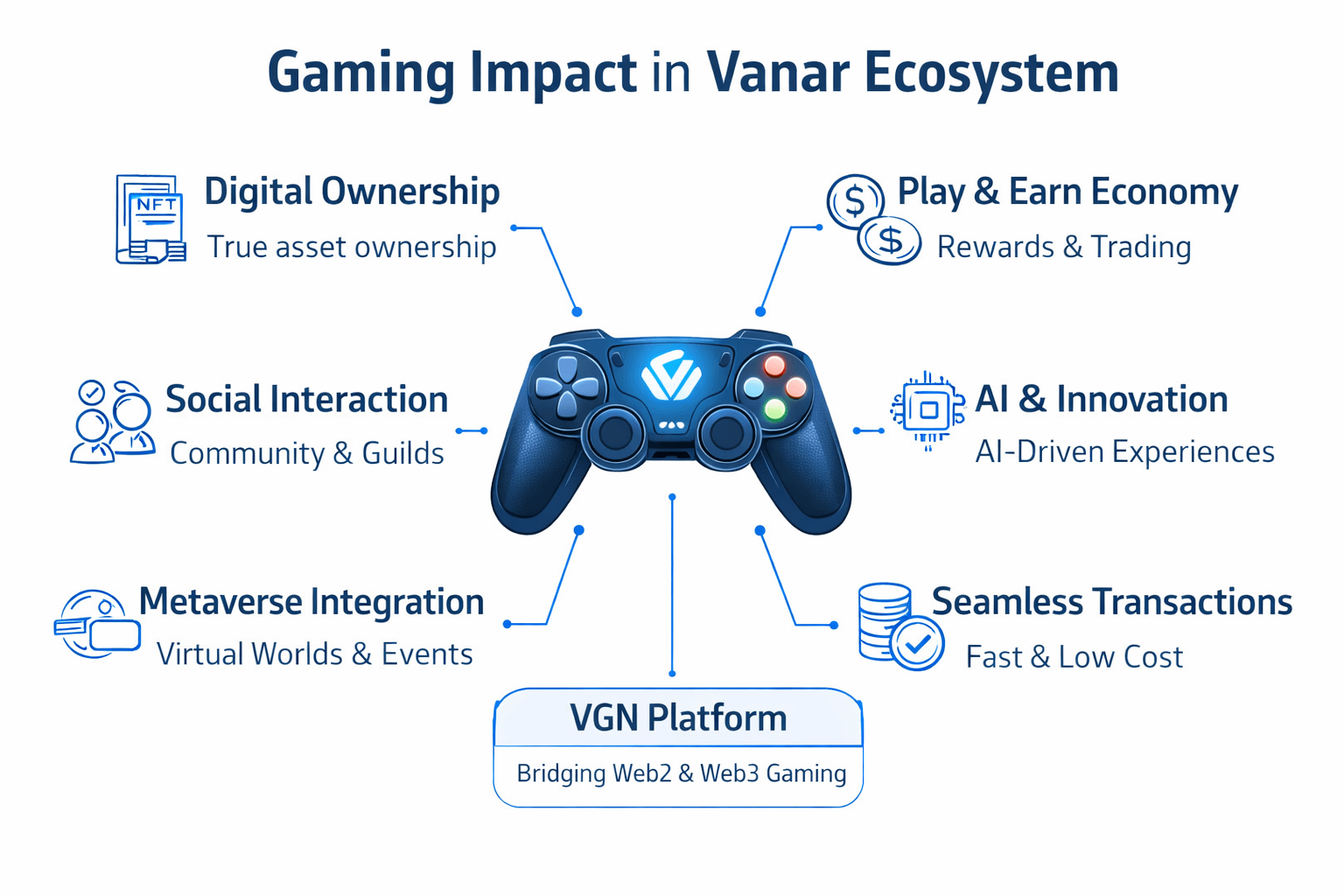
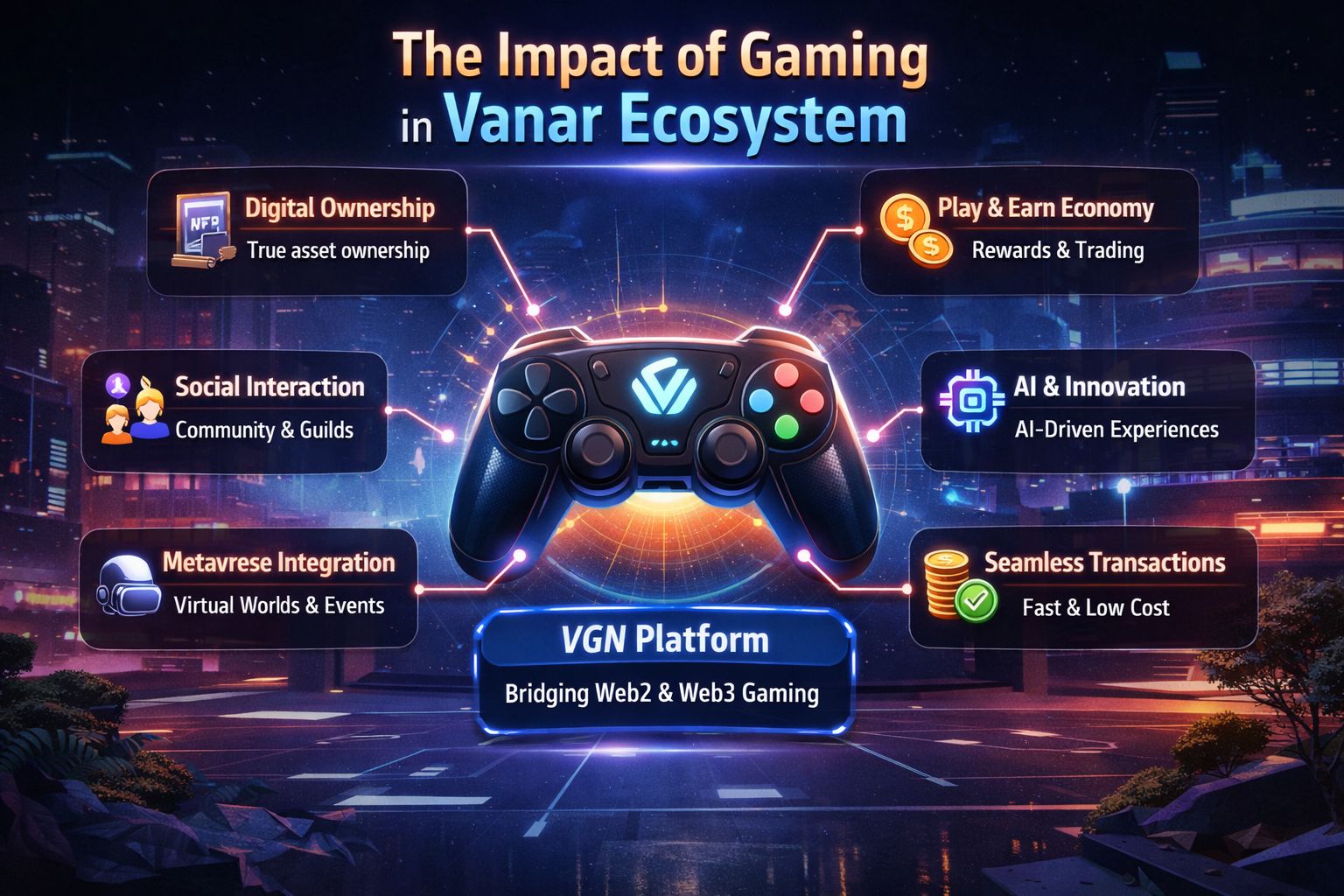
Vanar is a Layer-1 blockchain built with mainstream usability in mind. Rather than focusing purely on speculation or trading, it is developing infrastructure that supports gaming, entertainment, virtual worlds, and AI-powered applications. At the center of this ecosystem sits the Vanar Games Network (VGN), a dedicated gaming layer designed to unify traditional gaming and Web3 mechanics under one seamless framework.
This gaming-first direction could be Vanar’s quiet advantage in the race toward large-scale blockchain adoption.
The Evolution of Blockchain Gaming
Early blockchain games revolved around simple NFT ownership. Players could buy digital characters or collectibles and trade them. While this introduced the concept of verifiable digital ownership, most early projects lacked gameplay depth. They were driven more by token speculation than immersive design.
Over time, the industry began shifting.
Developers realized that sustainable ecosystems require more than financial incentives. Strong gameplay, community engagement, and long-term value loops became essential. Modern blockchain gaming is now evolving into something more complex — digital economies where assets, rewards, and player contributions have real, transferable value.
This is where infrastructure becomes critical.
To scale gaming ecosystems, a blockchain must offer:
High throughput
Low transaction costs
Smooth onboarding
Developer-friendly tools
Cross-platform compatibility
Vanar’s approach is built around these requirements.
Why Gaming Is a Strategic Entry Point
There are several reasons gaming is uniquely positioned to drive blockchain adoption:
1. Familiar User Behavior
Gamers already understand digital assets. Skins, upgrades, characters, and in-game currencies have existed for decades. Blockchain simply upgrades ownership from centralized databases to verifiable digital property.
2. Natural Community Growth
Games create social environments. Guilds, tournaments, digital events, and multiplayer interaction foster organic network effects.
3. Built-In Economies
Virtual economies mimic real-world financial systems. Players earn, trade, upgrade, and invest within game environments.
4. Emotional Engagement
Unlike financial tools, games connect with users emotionally. This builds loyalty beyond speculative incentives.
Vanar’s ecosystem is structured around these realities rather than forcing users into purely financial use cases.
Vanar’s Broader Vision Beyond Speculation
Vanar is not positioning itself as just another smart contract chain competing on transaction speed alone. Instead, it is focusing on real-world digital experiences — gaming, metaverse platforms, AI-driven content, and entertainment ecosystems.
This strategy reduces dependency on short-term market cycles.
While many blockchains rise and fall based on DeFi activity, gaming ecosystems operate differently. They rely on user retention, content updates, partnerships, and immersive experiences. This creates potentially more stable long-term engagement.
Within this ecosystem, the $VANRY token functions as a unifying element. It facilitates transactions, rewards, staking, asset purchases, and ecosystem participation across platforms.
Rather than being limited to one application, it connects multiple layers of the Vanar digital environment.
Understanding the Vanar Games Network (VGN)
The Vanar Games Network acts as the gaming infrastructure layer within the broader Vanar ecosystem.
Instead of forcing developers to redesign entire game engines around blockchain mechanics, VGN is built to integrate smoothly into existing development frameworks. This is important because most game studios are not blockchain-native. They prioritize user experience, performance, and retention.
VGN allows:
Seamless asset tokenization
In-game reward distribution
NFT integration without disrupting gameplay
Cross-game digital asset compatibility
Wallet abstraction for smoother onboarding
One of the major barriers to blockchain gaming has been complexity. If a player must leave the game interface to manage wallets or sign transactions, friction increases.
Vanar’s gaming infrastructure aims to reduce that friction significantly.
Bridging Web2 and Web3 Gaming
A major challenge in the blockchain gaming space is the divide between traditional (Web2) games and blockchain-native (Web3) titles.
Web2 developers often hesitate to integrate blockchain because of:
Regulatory uncertainty
User onboarding complexity
Performance concerns
Reputation risks from speculative models
VGN addresses this by providing optional integration layers. Developers can introduce digital ownership gradually rather than restructuring their entire game economy overnight.
This hybrid approach could allow millions of traditional gamers to interact with blockchain technology without even realizing it initially.
When adoption feels invisible, resistance decreases.
Digital Ownership as the Core Advantage
In traditional games, players spend money on skins, weapons, and upgrades, but ownership ultimately belongs to the publisher. Assets cannot usually be transferred outside that ecosystem.
Blockchain changes this dynamic.
With verifiable ownership:
Players can trade assets securely.
Items can potentially move across compatible games.
Digital collectibles gain independent value.
Secondary markets become transparent.
Vanar’s infrastructure supports this ownership model while attempting to maintain performance and usability.
Digital ownership transforms players from mere participants into stakeholders.
Sustainable Play-to-Earn Models
The early wave of play-to-earn (P2E) games created excitement but also revealed weaknesses. Many projects relied heavily on token emissions to attract players, which led to unsustainable inflation once growth slowed.
Vanar’s gaming vision appears more aligned with “play-and-own” rather than purely “play-to-earn.”
This means:
Gameplay quality comes first.
Rewards enhance engagement rather than replace it.
Digital assets gain value through utility, not just speculation.
Economic design focuses on longevity.
Sustainable digital economies require balanced tokenomics, controlled emissions, and real demand drivers.
If executed properly, this model can create stronger retention than purely reward-driven systems.
The Role of the Metaverse and Immersive Worlds
Vanar’s ecosystem also connects gaming with broader metaverse applications.
Virtual worlds like Virtua Metaverse demonstrate how gaming and social interaction can merge into immersive digital environments. These platforms expand beyond traditional gaming mechanics into:
Virtual events
Brand partnerships
Digital real estate
Interactive communities
When gaming connects with virtual worlds, user engagement multiplies.
Instead of isolated games, the ecosystem becomes an interconnected digital universe.
AI Integration in Gaming Infrastructure
Artificial intelligence is becoming increasingly important in gaming — from NPC behavior to content generation.
By positioning itself at the intersection of AI and blockchain, Vanar opens new possibilities:
AI-generated assets tokenized on-chain
Adaptive gaming environments
Personalized digital experiences
Smarter in-game economies
This convergence could create next-generation gaming models where digital ownership and AI-driven interaction coexist seamlessly.
Scalability and User Experience
Mass adoption depends on user experience more than technical architecture.
For gaming ecosystems to succeed, transactions must feel instant. Fees must remain minimal. Onboarding must not intimidate new users.
Vanar’s Layer-1 infrastructure is designed to handle high throughput while maintaining low-cost operations. For gamers, this translates to:
Smooth gameplay
Instant asset transfers
Reliable network performance
Minimal visible blockchain friction
If blockchain disappears into the background, adoption accelerates.
Long-Term Growth Through Entertainment
Entertainment has historically driven technology adoption. Streaming platforms accelerated internet infrastructure. Mobile gaming drove smartphone innovation.
Similarly, blockchain adoption may scale through entertainment rather than finance.
Gaming ecosystems encourage:
Daily active users
Community events
Long session times
Recurring microtransactions
These behaviors naturally align with blockchain’s strengths in digital ownership and transparent economies.
Vanar’s strategy leverages this alignment rather than competing directly in saturated DeFi sectors.
Economic Flywheel Effect
When gaming ecosystems mature, they create economic flywheels:
More players join.
Asset demand increases.
Developers build new content.
Token utility expands.
Network value grows.
Ecosystem attracts partnerships.
This cycle reinforces itself.
If Vanar’s gaming infrastructure successfully attracts developers and users, network effects could compound over time.
Reducing Volatility Dependence
One overlooked advantage of gaming-focused blockchains is reduced dependency on speculative trading volume.
DeFi chains often rely on liquidity spikes and yield farming cycles. Gaming ecosystems, however, rely on content updates, competitive seasons, and player retention.
This may produce more consistent on-chain activity over time.
For long-term sustainability, diversified utility is essential.
The Psychological Advantage of Gaming
From a behavioral perspective, gaming lowers psychological barriers.
Users do not join games expecting financial returns first. They join for enjoyment, competition, and social interaction.
When blockchain elements are integrated naturally, they feel like enhancements rather than financial risks.
This subtle psychological shift may be one of Vanar’s strongest strategic advantages.
Potential Challenges
While the opportunity is significant, challenges remain:
Regulatory clarity for tokenized gaming assets
Developer adoption speed
Competition from other gaming-focused chains
Market cycles affecting token value
However, infrastructure built for real user engagement tends to outlast purely speculative ecosystems.
Execution will ultimately determine long-term impact.
Final Perspective
Gaming may not just be another vertical within the blockchain industry — it could become the primary onboarding mechanism for millions of users.
Vanar’s decision to prioritize gaming infrastructure, metaverse integration, AI compatibility, and seamless developer tools positions it uniquely within this transition.
By focusing on entertainment-driven adoption rather than purely financial speculation, Vanar is attempting to build an ecosystem where blockchain operates quietly in the background while users engage with immersive digital experiences.
If successful, gaming could indeed become Vanar’s most powerful lever for mainstream blockchain adoption — not through hype, but through habit.
And habit is what builds lasting ecosystems.