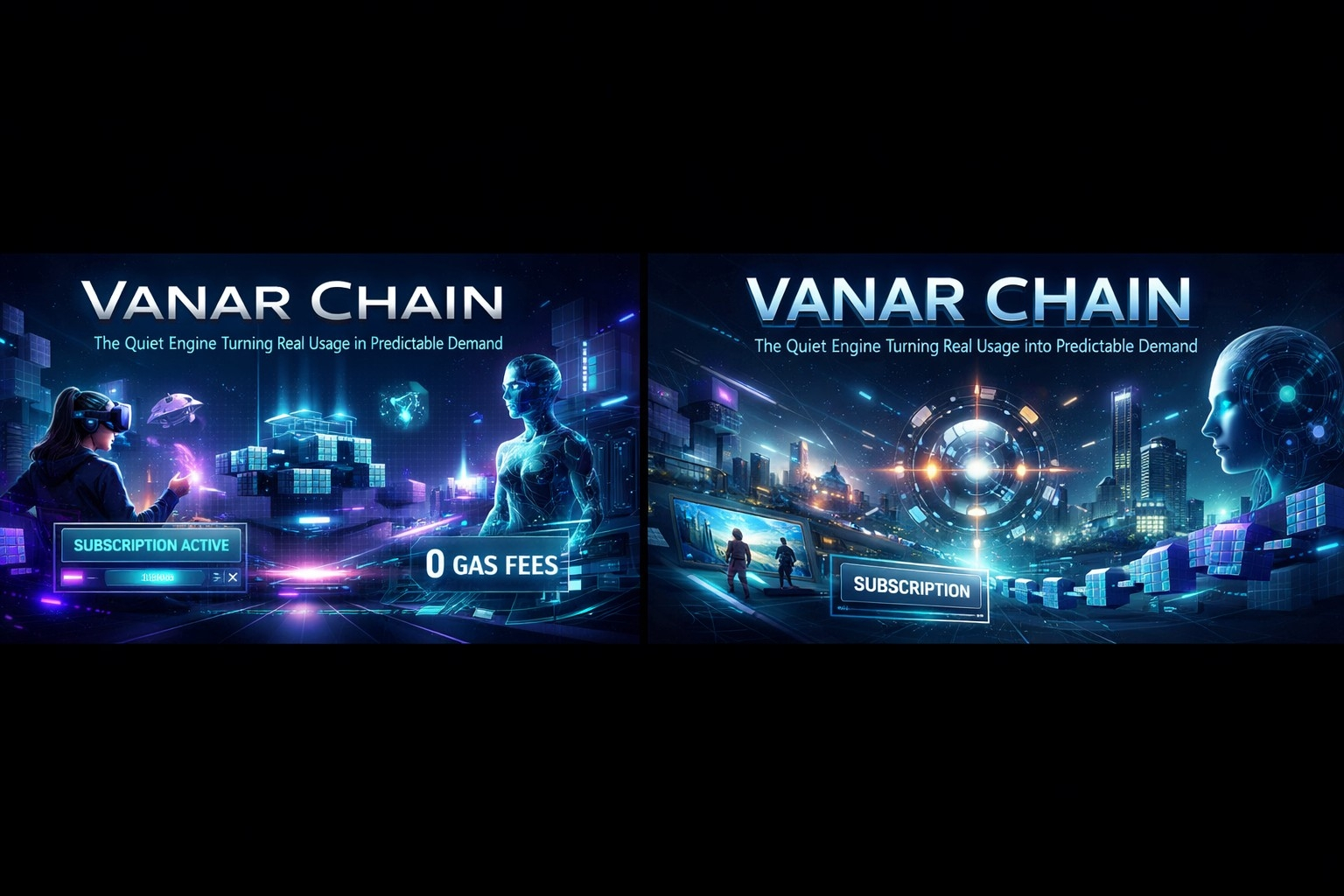
In a market where most Layer 1 stories are built on momentum, liquidity cycles, and short-lived rotations, Vanar Chain is trying to make a quieter bet: value should be engineered through product usage, not borrowed from trader attention. That framing matters, because it changes what success looks like. Instead of measuring relevance by how loudly a token trends, the more honest metric becomes whether the network can produce repeatable demand through services people actually use.
At the center of that approach sits VANRY, increasingly treated less like a passive asset and more like an operating unit inside a growing digital economy. The distinction is not cosmetic. When a token becomes “operational,” its demand can be linked to activity—payments, access, settlement, and recurring consumption—rather than to sentiment alone. Vanar’s thesis is that if you can create enough real workflows where VANRY is required or preferred, token demand becomes more structured, more budgetable, and harder to fully erase when narratives shift.
This is where Vanar’s multi-vertical direction becomes strategically important. Networks that rely on a single thesis often look unstoppable until the market stops caring about that thesis. Vanar is attempting to diversify its demand sources through gaming economies, immersive metaverse environments, microtransactions, and AI-oriented tooling. In applied consumer ecosystems such as Virtua and the VGN Games Network, “usage” is not an abstract promise; it is a pattern: assets are bought, upgraded, traded, and circulated, producing natural token velocity through routine behavior rather than forced incentives. If those loops are authentic, they can support a steadier baseline of activity than speculation can.
The more ambitious layer is Vanar’s push toward AI services and semantic infrastructure—systems designed to make data, memory, and context usable inside applications, not merely stored. If AI is the interface layer of the next internet, then the durable value is not just in inference; it is in the data structures that make inference reliable, contextual, and repeatable. Vanar’s emphasis on semantic memory and portable context suggests it wants to be more than “another chain.” It wants to be the underlying AI-ready layer that applications can build on, where context becomes an asset and memory becomes a utility.
Where this becomes economically consequential is the move toward subscription-style consumption for AI services denominated in VANRY. Most on-chain products have historically depended on sporadic transactions. That makes demand unpredictable, and it also makes token velocity fragile: activity can vanish the moment a campaign ends or the market mood turns. Subscription economics changes the shape of demand. When developers or businesses integrate reasoning workflows, indexing, analytics, or memory-based tooling into their stack, payment becomes recurring. Demand becomes a planned line item rather than a speculative impulse.
That shift mirrors traditional cloud economics more than traditional crypto economics. Companies do not “feel bullish” about compute; they budget for compute because it is operationally necessary. If Vanar’s AI tooling becomes embedded in builders’ workflows, VANRY moves closer to being a utility token in the strict sense: not optional, but operational. It is a subtle pivot, but subtle pivots often have the longest shelf life.
User experience is the other side of the same equation. Web3 still loses real users at the point of friction: visible fees, constant prompts, confusing wallet flows, and the psychological tax of feeling like every click could cost money. Vanar’s “0 gas” design aims to remove that friction for end users by abstracting complexity away from the consumer. The practical idea is simple: the user experience should feel seamless, while settlement is handled in the background by systems and entities that can manage it reliably. A useful analogy is automated tolling on highways—drivers pass through without interruption while the system handles billing behind the scenes. When friction becomes invisible, adoption becomes easier to sustain.
Importantly, “0 gas” in consumer language is not the same as “no cost” in system reality. What it should mean, if executed honestly, is that costs become predictable, low, and strategically placed so they do not interrupt immersion—especially in gaming and consumer apps where interruptions destroy retention. This is not a marketing detail; it is a design philosophy. Removing friction is not about making the network free; it is about making the network feel effortless.
Vanar’s longer-range ambition appears to extend beyond a single chain. If its AI tooling and semantic memory layers can serve applications across ecosystems while VANRY remains a settlement or payment unit, demand can emerge cross-chain. That would reframe Vanar from a chain competing for attention to an infrastructure provider competing for integration. The difference is profound: attention is rented; integration is earned. In practice, this kind of positioning is more durable, but also more difficult, because it depends on developer trust, documentation quality, performance consistency, and a product that delivers measurable outcomes.
And this is the real test. Subscriptions do not guarantee success; they increase accountability. A recurring model forces the product to justify itself every billing cycle. AI services must save time, reduce cost, increase accuracy, or unlock a capability that users genuinely cannot replace elsewhere. Developer onboarding must be clear and fast. Billing must be transparent. Support must be responsive. Ecosystem partners must see reliable performance, not sporadic hype. If these conditions are met, then token economics becomes more measurable and repeatable. If they are not met, the subscription thesis collapses quickly, because recurring payments do not survive on narrative alone.
What makes Vanar’s approach feel unusually mature—especially in a market addicted to volatility—is the emphasis on discipline over drama. By tying demand to product loops, recurring services, and frictionless UX, Vanar is attempting to anchor value in activity rather than attention. That is not an easy path, because it is slower and less glamorous than speculative mania. But it is also the path most aligned with how sustainable networks are built: not by asking the market to believe, but by building something worth using often enough that belief becomes secondary.
If Vanar executes, it may help shift its token from a story people trade into an instrument people consume. In a speculative industry, engineering predictable utility is not the loudest innovation. It may be the most difficult one—and the one with the longest horizon.