Settlement finality is one of those technical concepts that rarely trends on social media, until a network stalls, reorganizes or reverses transactions. In traditional finance, finality is everything. When a bank confirms a wire or a central bank settles obligations between institutions, there is legal and operational certainty. The transaction is done. No ambiguity. No rollback. That level of assurance is what allows entire economies to function smoothly.
In blockchain systems, finality has historically been more nuanced. Many early networks relied on probabilistic settlement, meaning a transaction becomes “safer” over time as more blocks are added on top of it. While this model works for certain use cases, it introduces uncertainty, especially for financial infrastructure. Waiting through multiple confirmations may be acceptable for retail transfers but it becomes inefficient and risky for high-value payments, institutional flows, or stablecoin settlement.
This is where Plasma’s philosophy stands out to me.
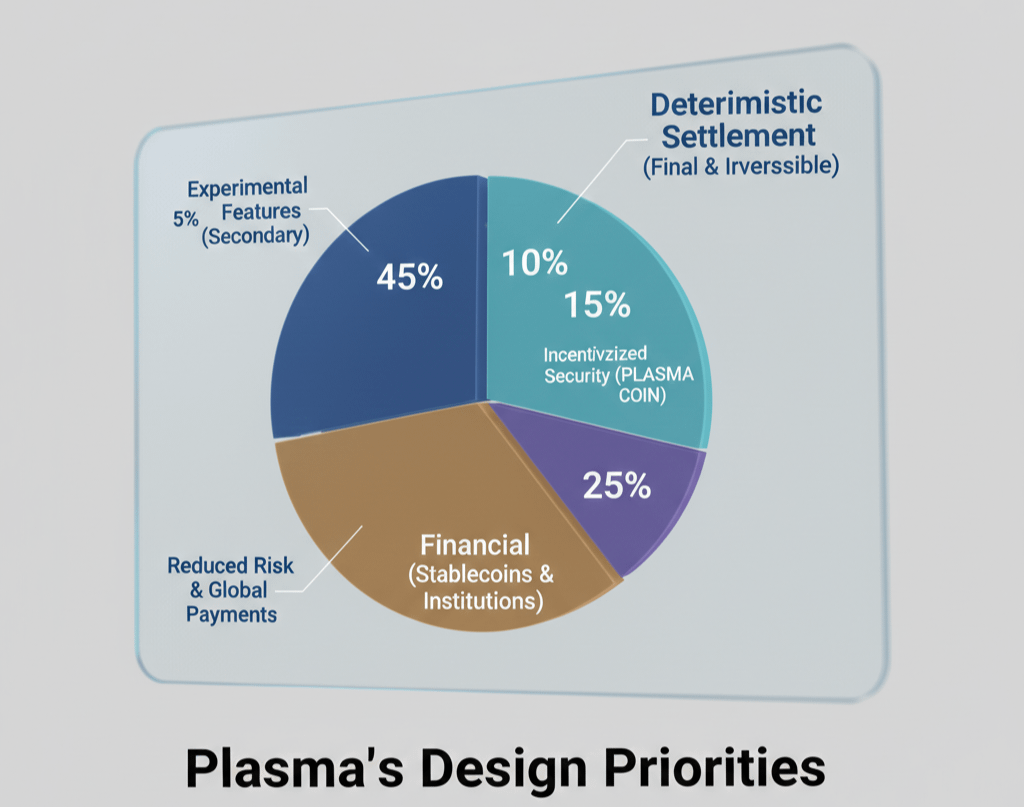
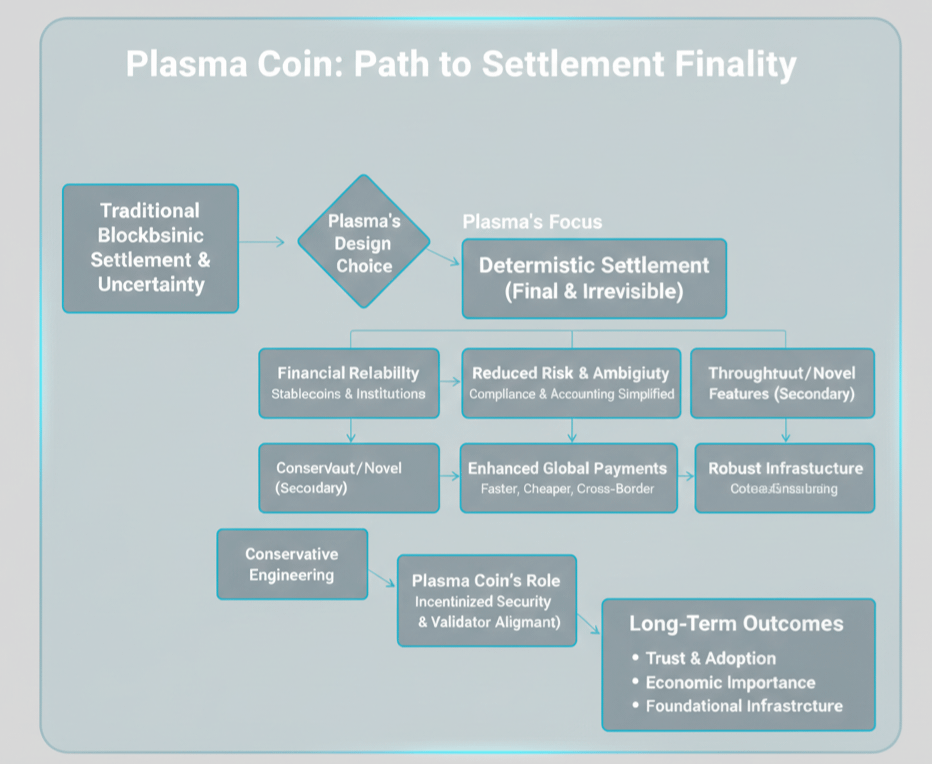
Plasma appears to prioritize deterministic settlement, the idea that once a transaction is confirmed under the network’s consensus rules, it is final and irreversible. There’s no extended waiting period to achieve practical certainty. Instead, finality is built directly into the protocol’s architecture. That design choice signals something important: the network isn’t just optimizing for speed or experimentation. It is optimizing for financial reliability.
For stablecoins in particular, this matters immensely. A digital dollar must behave like money. If settlement can be reorganized or delayed unpredictably, confidence erodes. Businesses cannot operate on “probably settled.” They need definitive accounting. Merchants need to release goods. Institutions need to manage liquidity. Payment providers need to reconcile instantly. Deterministic finality transforms a blockchain from a speculative ledger into real infrastructure.
In my view, Plasma seems to understand this difference at a foundational level. Many chains focus heavily on throughput metrics or novel features. Those are impressive but they are secondary to trust. Financial infrastructure must first answer a simple question: can users rely on it when it counts? Plasma’s emphasis on strong settlement guarantees suggests it is designing for long-term integration with real economic systems, not just short-term excitement.
Plasma Coin plays a critical role in this framework. Settlement guarantees don’t emerge from code alone, they are secured through incentives and validator alignment. By tying economic stake directly to consensus integrity, the network ensures that those responsible for validating transactions have meaningful skin in the game. The more value that flows across the network, the more important that alignment becomes.
What I find particularly compelling is how finality reshapes risk perception. In probabilistic systems, there’s always a small residual uncertainty. In deterministic systems, once consensus is reached, that uncertainty collapses. For financial participants, especially institutions, this reduction in ambiguity is powerful. It simplifies compliance, accounting and operational processes. It reduces the need for hedging against rollback risk. It builds confidence layer by layer.
Finality may not generate hype, but it quietly determines whether a blockchain can graduate from experimental technology to foundational infrastructure. As more real-world financial activity migrates on-chain, payroll, remittances, trade settlement, treasury operations, networks that cannot offer consistent, reliable settlement will face limitations. Businesses do not scale on uncertainty. They scale on predictability.
Personally, I see Plasma Coin as directly connected to this reliability narrative. Its value proposition is not built on short-lived speculation or viral momentum. It is anchored in the stability of the settlement layer itself. If the network becomes trusted for deterministic finality, the economic importance of the coin strengthens alongside it. Trust compounds. Usage compounds. And infrastructure that proves dependable tends to endure.
Another aspect worth considering is how finality interacts with global payments. In cross-border scenarios, settlement delays and reversibility risks can introduce friction and cost. A network that offers fast, irreversible confirmation can reduce counterparty exposure and accelerate capital efficiency. That’s not just a technical improvement, it’s a structural one. It changes how participants think about moving value across jurisdictions.
Plasma’s focus on finality also suggests discipline. Instead of chasing experimental features that may compromise consensus guarantees, it appears to prioritize robustness. In financial systems, conservative engineering often outperforms flashy innovation. The systems that survive decades are the ones that resist failure under stress. Deterministic settlement is part of that resilience.
From my perspective, this approach reflects maturity. It acknowledges that blockchain’s future depends less on novelty and more on reliability. When users stop worrying about whether transactions might be reversed, they begin to treat the network as dependable infrastructure. That psychological shift is subtle but transformative.
Finality isn’t glamorous. It doesn’t trend or spark speculation cycles. But it underpins everything. Without it, liquidity fragments. Without it, trust weakens. Without it, financial actors hesitate. Plasma’s commitment to deterministic settlement signals that it understands this hierarchy of priorities.
In the long run, I believe markets reward infrastructure that quietly works. Hype fades. Trends rotate. But systems that consistently deliver certainty tend to attract sustained adoption. Plasma Coin, in my opinion, derives its strength from being embedded in that certainty. It represents participation in a network designed not just to process transactions but to close them definitively.
And in finance, closure is power.