According to the usual script, the exchange suddenly intensifies its focus on a project, which can only mean three things: listing fees, inflating trading volume, and riding the hype. But what you mentioned this time (AMA, CreatorPad) — its 'input-output ratio' clearly doesn't seem to be just for creating a short-term spike. It feels more like doing one thing: preemptively positioning as the 'infrastructure entry' for the next round of narrative.
Let me put the conclusion upfront: Binance is not just pumping this 'coin' $VANRY ; it looks more like they are pushing a combination of 'AI + compliance + seamless user experience' that they themselves need. @Vanarchain is the most useful glove in this set of punches. I speculate this based on the following arguments:
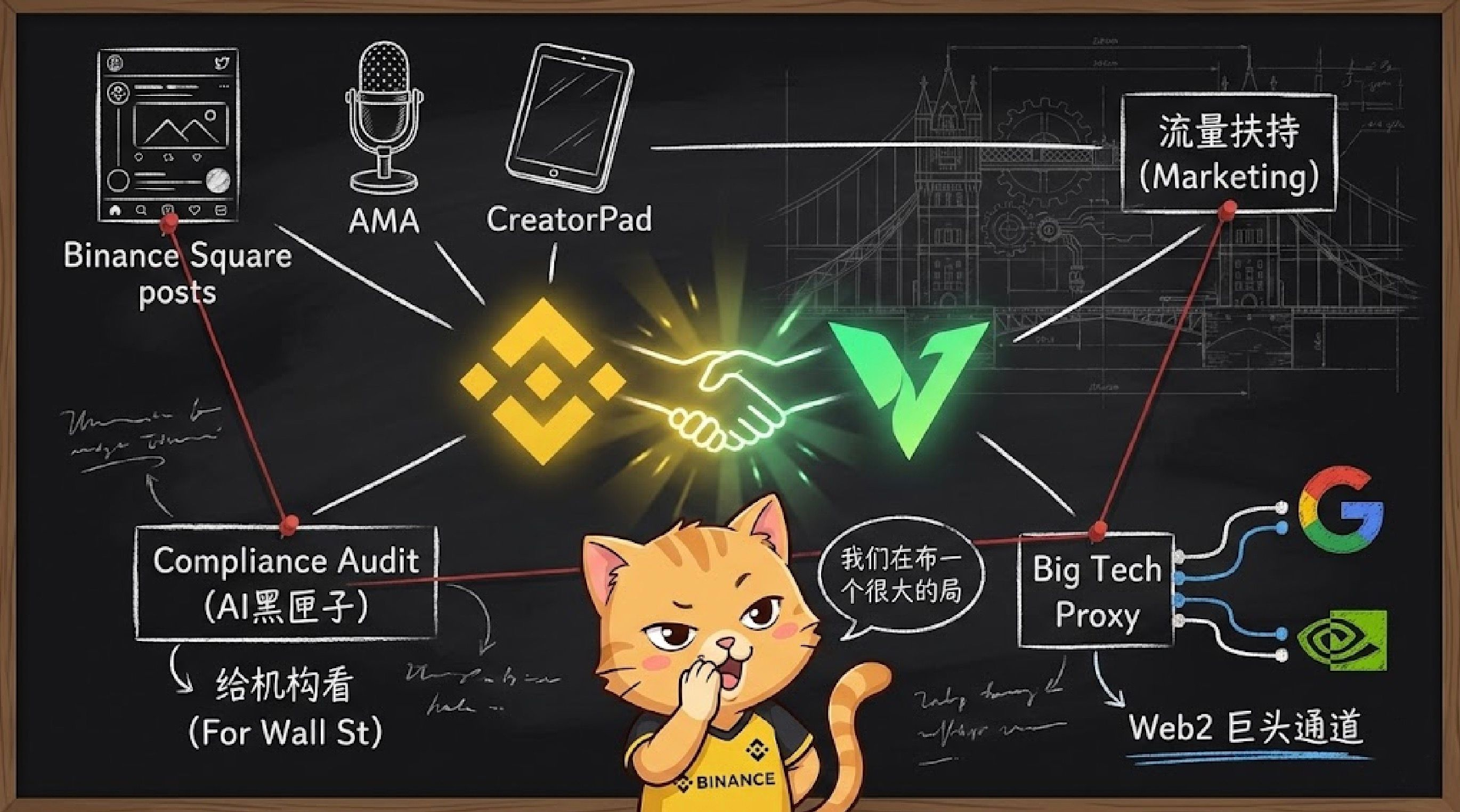
Binance needs an AI narrative that 'can be held accountable and can be audited,' specifically for institutions and major clients.
Now the whole world is shouting AI Agents, but very few traditional enterprises dare to put Agents into 'key business processes.' The reason is simple: AI can have hallucinations and can misbehave, and what's most critical is—when something goes wrong, it's hard to hold anyone accountable. You let an AI do risk control, automatic trading, automatic approval, and it ends up messing up millions, then says, 'What work? Where's the work?' You'd be devastated.
So you see the repeatedly emphasized keyword in the AMA: Business Critical. In plain language, it means: I'm not here to chat with you; I'm here to enter the production environment. What does entering the production environment rely on? It relies on 'what I've done, how I did it, and what the final result is'—there must be an unalterable chain of evidence.
This is Binance's demand point. It currently wants compliance, wants institutional money, and wants to upgrade the exchange from a 'casino' to a 'financial infrastructure.' And if AI wants to enter institutions this time, it must fill in the 'audit black box' puzzle piece. What Vanar talks about—'Before / During / Outcome full chain anchoring'—just happens to fit.
You can understand it as this: if Binance wants to promote 'enterprise-level AI trading/asset management/compliance modules' in the future, it needs a foundational layer that can serve as a 'recorder.' It's not the chain that talks the most, but the one that can clearly outline the chain of responsibility.
Binance doesn't want to be a gold digger; it wants to be part of the group that sells shovels.
The AI track is currently a gold rush: models, applications, shells, concept coins are flying everywhere. The excitement is real, but exchanges of this scale fear one thing most: after the excitement, all that's left are feathers, and regulators come knocking. So what's Binance's most comfortable approach? Betting on infrastructure, betting on 'toll booths,' betting on 'the layer that no one can avoid.'
Vanar's story commercially resembles 'selling shovels': not competing with OpenAI on large models, not comparing parameters with anyone, but focusing on memory, tool chains, and making AI more controllable and usable as an intermediary layer.
These things may not necessarily explode in popularity, but once they take off, they have a long lifecycle, strong stickiness, and are more suitable for compliance narratives. You will find that the long-form style in Binance Square essentially guides towards 'infrastructure': stop fixating on whose demo is cooler, can it enter the production environment is the key.
More subtly: Binance itself often finds it difficult to deeply bind with certain Web2 giants (you know, sensitive). But if there's a 'interface adapter' in between—a project that appears more like a technical foundation—it can make many collaborations smoother and less glaring.
What Binance wants for Mass Adoption is not to make novices learn blockchain, but to make blockchain disappear.
Binance has traffic, but the threshold for Web3 has always been deterring: mnemonic phrases, Gas, authorizations, cross-chain, wallet pop-ups... these things are just 'too complicated for ordinary users to understand.'
So what the exchange really wants is not just another performance chain, but a 'consumer-grade venue' that can accommodate new users: ideally, users should be able to get started using Gmail/Telegram, Gas should ideally be reimbursed, and the complexity should be hidden behind the scenes—users should only feel 'like using an app.'
Looking back at the things emphasized by Vanar (seamless interaction, memory layer, tool chain, Bot entry), it aligns very well with Binance's wallet strategy: keeping users within its own entry point and providing them with a grounded scenario that won't crash.
This is why I say it doesn't look like a simple 'milk coin'; it looks more like giving Binance's Web3 wallet a 'demonstration field': capable of running content, running brands, running AI tools, running lightweight applications—the most important thing is that new users won't find it painful to use.

So what could the 'cooperation opportunity' possibly be? I'll mention a few more specific, verifiable guesses (all are inferences, but can be contrasted with facts later):
-Binance wallet treats Vanar as a key recommended chain for 'AI/content/light applications': directing traffic, task system, CreatorPad in one go, allowing users to use it without realizing it.
-When Binance develops enterprise-level AI solutions, Vanar provides 'auditing and memory layers': you can imagine that in the future there will be compliance products like 'auditable Agent operation logs/traceable strategy execution records.'
-Binance needs a 'accountable, auditable' AI infrastructure story in its RWA/compliance narrative: especially as it brings more traditional assets and institutional tools in, compliance and auditing layers will become increasingly crucial.
You need to judge whether what I'm saying is just speculation; you actually don't need to listen to my stubbornness—you just need to keep an eye on three signals:
-Is there a 'deep default integration' on the wallet side: it's not about whether networks can be added, but about tasks, entry points, recommendation positions, and Bot/tools being directly attached.
-Is there a narrative grounded in 'facing enterprises/institutions': for example, keywords like audit, logs, risk control, compliance suites are starting to appear frequently.
-Is Binance treating this as a 'long-term column' rather than a one-time event: an AMA is publicity, but continuous quarterly support for creators/tools/ecosystem is what is called a bet.
Of course, the pharmacist must remind you: no matter how hard the exchange tries, it doesn't mean you should rush in mindlessly. The most typical risks here are three:
1. Strong marketing doesn't mean the product will actually run: you need to look at real usage and retention, not just popularity.
2. 'AI + Chain' can easily turn into a shell narrative: Vanar talks about infrastructure as an advantage, but it must also provide continuously verifiable grounded data.
3. Regulatory variables are always present: the more Binance wants to comply, the more cautious it will be; once the environment changes, the pace may also adjust.
So the conclusion is still that sentence: Binance seems to be laying out 'compliance recorders for the AI Agent era + a carrier for seamless user experience + long-term infrastructure narrative.' What it's promoting is not a short-term replica, but the 'pipeline' it will use in the next round.
You ask me if it's worth paying attention to? I would say: definitely worth it. Not because it will definitely rise, but because from the intensity of Binance's actions, the game it's playing behind is more important than 'whether the K-line goes up or down.'