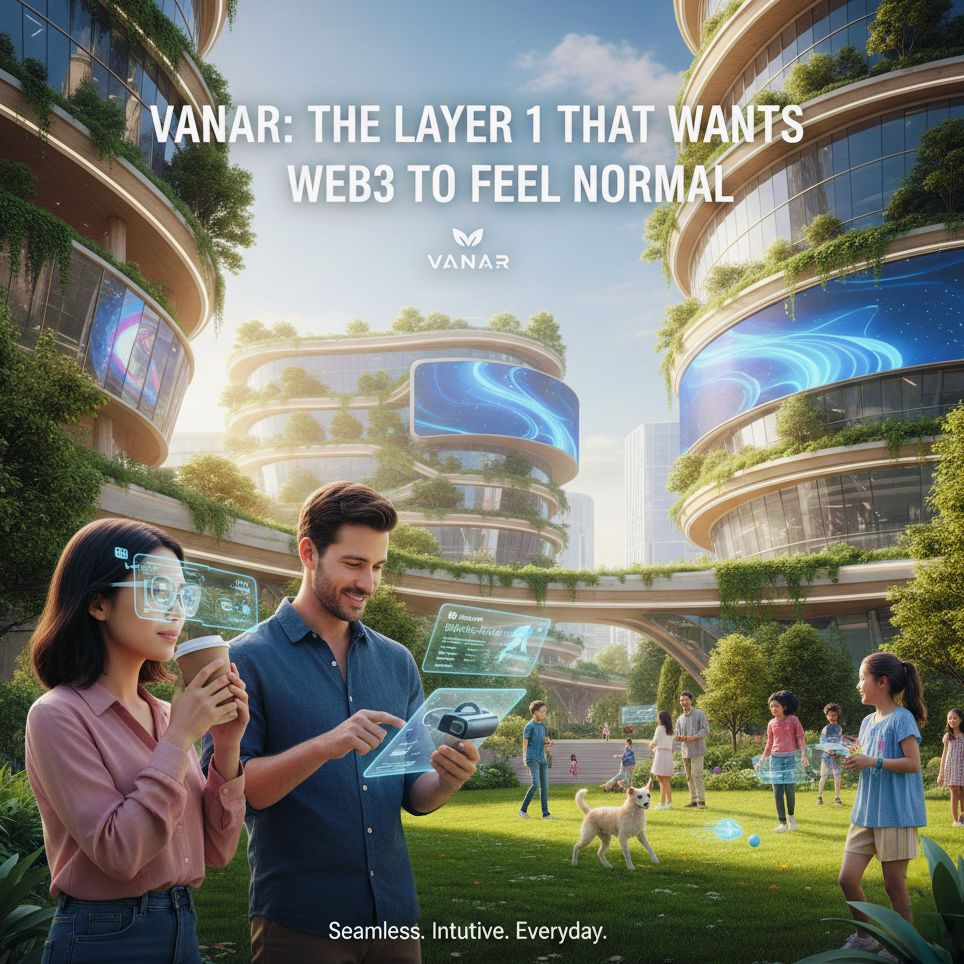
I keep coming back to Vanar with the same thought in my mind: they’re not trying to impress you with complicated words, they’re trying to remove the quiet pain people feel when they use blockchain for the first time and realize it doesn’t behave like the apps they already love. You can almost hear the difference in how the team thinks, because they come from worlds like gaming, entertainment, and brand experiences, and those industries don’t forgive friction, they don’t wait for “the next update,” and they don’t give you ten chances to explain why a transaction fee suddenly jumped or why something takes too long to confirm. That background shapes the whole personality of this project, and it explains why I’m They’re We’re seeing Vanar aiming at real consumers instead of just crypto natives, because the dream here isn’t only a faster chain, it’s a chain that doesn’t scare people away before they even understand what they’re doing.
The reason Vanar exists, at least in the way I read it, is because the old story of Web3 often sounds exciting but feels exhausting, and the gap between those two things is where adoption dies. You might love the idea of owning digital items, moving value without borders, building open communities, and plugging into new economies, but if the experience is slow, unpredictable, or expensive in a way that makes you hesitate, then the magic becomes stress. Vanar’s approach is basically to say: let’s stop treating stress as normal. Let’s make the base layer feel like stable ground, and then build real products on top of it that can live inside mainstream verticals like gaming networks, metaverse-style experiences, AI-driven data tools, and brand-facing ecosystems. And yes, Virtua Metaverse and VGN games network are part of that wider picture, not as random names, but as proof that this team has been thinking in terms of consumer worlds where people actually spend time, build identity, and come back repeatedly.
Under the hood, the chain direction is intentionally practical, and I respect that because practical choices are often the ones that survive. Vanar leans into EVM compatibility, and in everyday language that means developers who already know the Ethereum-style way of writing smart contracts don’t have to throw away their skills and start from zero. If you want adoption, you don’t only need users, you need builders, and builders move faster when they can reuse tooling, libraries, and mental models they already trust. So Vanar tries to become familiar territory for developers, while also aiming for fast confirmations and the kind of throughput that keeps consumer apps responsive. This matters because a game or entertainment experience can’t feel like a banking queue, and a brand experience can’t feel like a technical exam. People don’t “learn patience” because a chain asks them to, they just leave, and they don’t always announce that they left, which is the most painful kind of failure.
Here’s how the system feels when you walk through it step by step. A user or an app triggers an action, maybe it’s a transfer, a contract call, a mint, an update to ownership, or something as simple as a small interaction that should cost almost nothing. That action becomes a transaction, and it enters the network’s flow, where validators handle ordering and inclusion into blocks. Vanar’s validator model is designed to prioritize smooth operation, especially early on, and the philosophy is basically performance first with a pathway toward broader participation as the network grows. This is where their choices become very real, because every chain is negotiating the same tension: if you open everything instantly, you can lose stability, and if you control too much for too long, you can lose trust. They’re trying to walk the line by letting the network start stable and then expand through reputation and delegated participation. If It becomes a mature balance, the result is a chain that feels consistent to users while also evolving toward a healthier, more distributed security model.
Fees are another emotional pressure point, and Vanar tries to treat fees like a product feature rather than a side effect. Instead of asking users to live inside a constantly changing auction for block space, the intent is to make transaction costs feel predictable and small, the way most mainstream apps feel, where you understand what it costs before you tap “confirm.” When fees feel stable, people behave differently, they experiment more, they click without fear, they build habits, and habits are the real doorway to mass adoption. But I’ll say it honestly: any system that stabilizes fees through structured pricing logic must also earn trust through transparency, because stability can be a gift and also a governance responsibility. The best version of this is when the user experience is calm and the underlying mechanism is clear enough that the community doesn’t feel like it’s running on mystery.
Now let’s talk about VANRY in a way that doesn’t sound like a brochure. A token becomes meaningful when it has a job, and VANRY’s job is to keep the network moving, secure it through staking participation, and give holders a role in the direction of the ecosystem. It also carries continuity from an earlier chapter of the project through the migration from TVK, and that matters because continuity is part of trust, especially for communities that supported the early vision. Over time, the network’s incentives and emissions are meant to pay validators, support development momentum, and seed community growth, because a chain without incentives is often a chain without builders. Binance matters only as a bridge in this story, not as the center of it, because support from a major venue can make transitions smoother for everyday holders, but the real test for VANRY is simple: does it become a utility asset inside an ecosystem that people actually use, or does it stay mostly a market symbol people watch from the sidelines.
If you want to track Vanar like a grown-up, the metrics to watch are not the loud ones, they’re the honest ones. I’m watching reliability and responsiveness, because that’s the basic promise. I’m watching fee predictability, because that’s where mainstream comfort lives. I’m watching validator growth and stake distribution, because decentralization is not a slogan, it’s a pattern you can measure over time. I’m watching developer activity and real user retention, because a thousand one-time transactions don’t equal adoption, but recurring usage does. And I’m watching whether their product-layer ideas actually become tools people depend on, because “AI-native” only matters if it produces experiences that feel simpler, safer, or more powerful for the user, not just more complicated in the architecture.
Risks exist, and I won’t pretend otherwise. A controlled early validator phase can create doubt if the roadmap toward wider participation feels slow, unclear, or overly gatekept. A structured fee model can create questions if people don’t understand how pricing is derived or how it behaves during volatility. Token incentives can become a trap if they attract activity that disappears when rewards fade, which is why real product demand matters more than temporary yield. And the biggest risk, the one that hides behind every ambitious infrastructure project, is execution: you can build a beautiful chain and still struggle if the ecosystem doesn’t deliver “sticky” experiences that make people return because they genuinely enjoy it or genuinely need it.
But I’ll end where the real emotional truth lives. Vanar is trying to make blockchain stop feeling like a special event and start feeling like a normal part of digital life, the way the internet itself disappeared into the background once it got fast and reliable enough. If It becomes that, it won’t happen through one announcement or one viral moment, it will happen through thousands of small interactions that feel smooth, affordable, and human. We’re seeing a world where the winning technology is often the technology that feels invisible, and if Vanar keeps building toward that invisibility, then its biggest achievement might be simple: people will use it without needing to “be into crypto” at all, and that’s the kind of future that quietly changes everything.