
I've long been skeptical of blockchain claims about "real world adoption," where flashy roadmaps often mask centralized control, leaving users frustrated by opaque decisions, sudden upgrades that break apps, and governance that favors insiders over the community. But Vanar Chain's approach to governance, network evolution, and decentralized progress hooked me it's not about hype; it's empathetic design that addresses Web3's human pains like exclusion from decisions, instability during transitions, and unfair power imbalances, making the chain feel built for collective ownership rather than top-down dictates.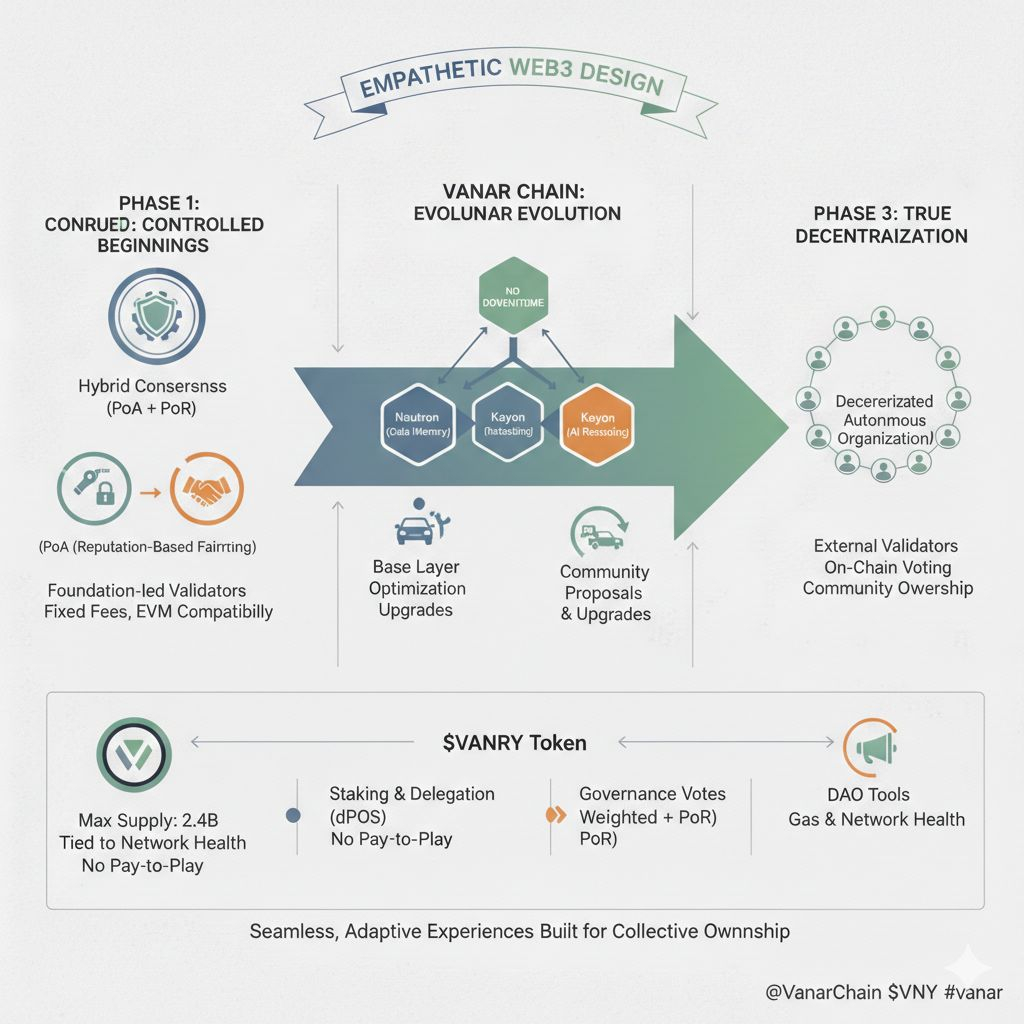
Vanar starts with a grounded thesis: evolve from controlled beginnings to true decentralization without alienating users. Their hybrid consensus Proof of Authority (PoA) blended with Proof of Reputation (PoR) tackles the unfairness of traditional models. PoA ensures initial stability, like a trusted referee starting the game, while PoR adds reputation scoring based on contributions, preventing whale dominance. This empathetic setup lets everyday stakers participate without needing massive hardware, fostering fairness in validator selection.
Network evolution feels predictable, not chaotic. Vanar began as Virtua, rebranding to focus on AI-integrated L1 with EVM compatibility, avoiding the volatility of rushed forks. Upgrades are modular: from base layer optimizations to adding Neutron for data memory and Kayon for AI reasoning. Think of it as upgrading a car's engine without stranding drivers—seamless, with community input via proposals, reducing confusion during shifts. This progress prioritizes user stability, like fixed fees persisting through evolutions.
Decentralized progress shines in community involvement. Initially Foundation led, Vanar transitions to external validators through voting, emphasizing long-term trust over short term gains. It's like a neighborhood coop where members earn voice through consistent participation, addressing the pain of centralized chains where users feel powerless. Roadmap includes DAO tools for on chain proposals, making governance intuitive and fair.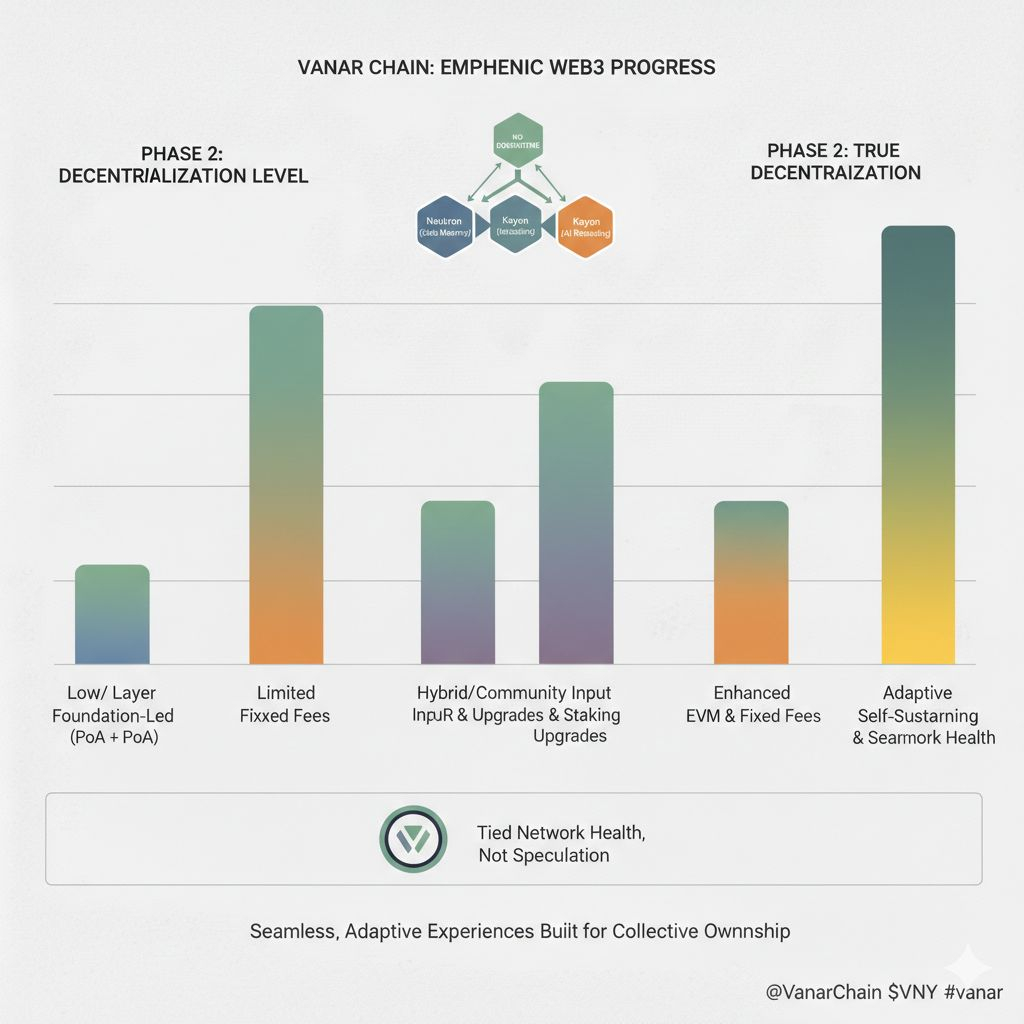
The $VANRY token integrates seamlessly here. Beyond gas, it's for staking and delegation in dPoS holders delegate to validators, earning rewards while voting on upgrades. Max supply of 2.4B ensures scarcity ties to network health, not speculation. Governance uses VANRYweighted votes, but PoR layers in reputation to prevent pay to play unfairness, tying tokenomics to decentralized evolution.
Zooming out, Vanar's vision is a self sustaining Web3 where governance evolves invisibly, delivering seamless, adaptive experiences that outlast trends. In crypto's volatility, quiet reliability through progressive decentralization empowering users without friction emerges as true innovation.
