
There’s a persistent narrative in blockchain culture that immutability is the highest virtue. Code, once deployed, should be untouchable. Rules should be frozen. Logic should be permanent. In theory, this sounds powerful trustless, neutral, incorruptible. But when you step into real finance, immutability alone stops looking like a strength. It starts looking like friction.
Finance does not stand still. Regulations change quarterly. Risk committees adjust exposure limits. Collateral requirements shift with volatility. Fraud patterns evolve. Entire jurisdictions introduce new compliance language overnight. In that environment, a system that cannot adapt without tearing itself apart is not resilient it is brittle.
This is where Vanar’s philosophy diverges from the default blockchain narrative.
Vanar’s real edge lies in recognizing that financial systems must evolve continuously and designing infrastructure that allows that evolution without compromising integrity. Instead of treating change as an exception, Vanar treats it as a design parameter. Instead of forcing teams to redeploy contracts every time policy shifts, it separates core logic from adjustable parameters.
That architectural distinction matters more than it first appears.
In traditional smart contract systems, updating business logic often requires redeployment. That means migrating state, revalidating assumptions, potentially introducing new risks, and increasing operational overhead. Every update becomes an event. Every policy shift becomes technical debt.
Vanar approaches this differently. Through a template-and-parameter model, the core contract logic remains intact while financial variables collateral ratios, risk limits, compliance constraints can be adjusted safely at the parameter layer. The rules evolve. The trust model does not.
This is not about making contracts mutable in a chaotic sense. It is about enabling controlled, auditable adaptability. Governance mechanisms define how parameters can change. Changes are visible. Accountability is preserved. But the system does not require structural surgery every time finance behaves like finance.
And finance always behaves like finance meaning it changes.
Immutability is valuable at the base layer: transaction history, ownership records, state transitions. But at the policy layer, rigidity can become a liability. A system that cannot respond to regulatory updates quickly risks becoming unusable in institutional contexts. A protocol that cannot adjust risk thresholds dynamically struggles in volatile markets.
Vanar doesn’t reject immutability. It reframes it. Core infrastructure remains stable. Execution remains verifiable. But the operational layer acknowledges reality: financial systems must adapt or they become obsolete.
This approach is particularly relevant in real-world asset (RWA) structures and regulated financial products. In those environments, legal wording can change without notice. Risk exposure must be recalibrated rapidly. Compliance frameworks evolve with geopolitical shifts. The ability to update parameters without redeploying entire contract systems reduces adaptation costs significantly.
And adaptation costs matter.
Every redeployment introduces coordination overhead. Legal reviews. Technical audits. Operational migration. Counterparty communication. When systems are designed for permanence at the wrong layer, the hidden cost shows up in complexity, not security.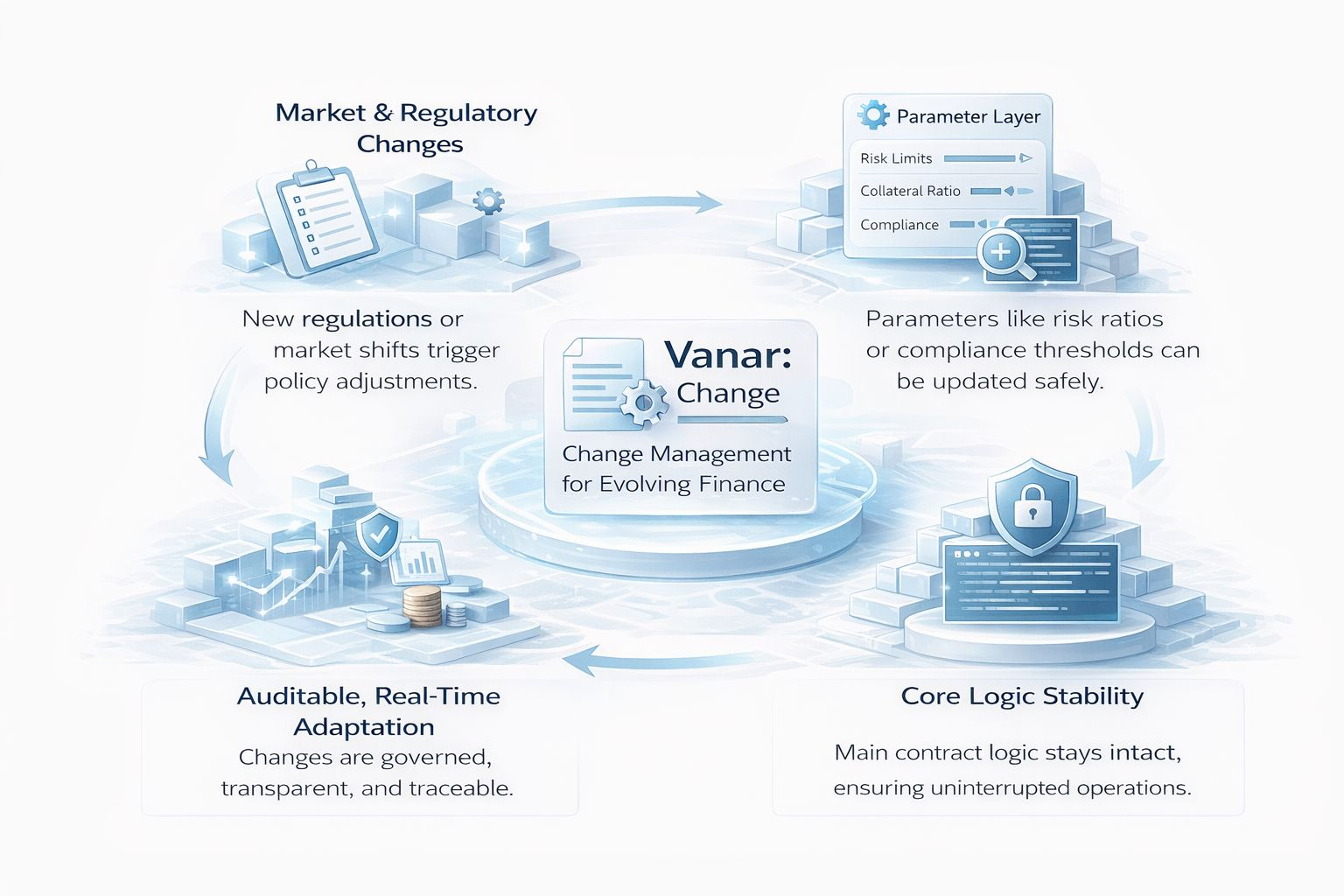
Vanar’s model lowers that friction. Policies can shift without destabilizing execution. Financial rules can adjust without rewriting infrastructure. That is a more realistic fit for how capital markets operate.
The deeper insight here is philosophical: finance is not static code. It is negotiated structure. It is governed policy. It is risk management in motion. Any blockchain infrastructure that aims to integrate with real finance must accommodate that motion.
Speed is attractive. Throughput is measurable. But adaptability under regulatory and market change is what determines long-term viability.
Vanar’s edge is not about competing on abstract performance metrics. It is about acknowledging that trust in finance is not built from frozen rules it is built from predictable evolution. Institutions do not want systems that never change. They want systems that change safely.
In that sense, Vanar positions blockchain not as a rigid monument to immutability, but as programmable infrastructure that respects the fluid nature of financial systems. It bridges a conceptual gap between Web3 ideals and institutional realities.
Because in real finance, the question is not whether rules will change.
The question is whether your infrastructure can change with them without breaking everything else.
