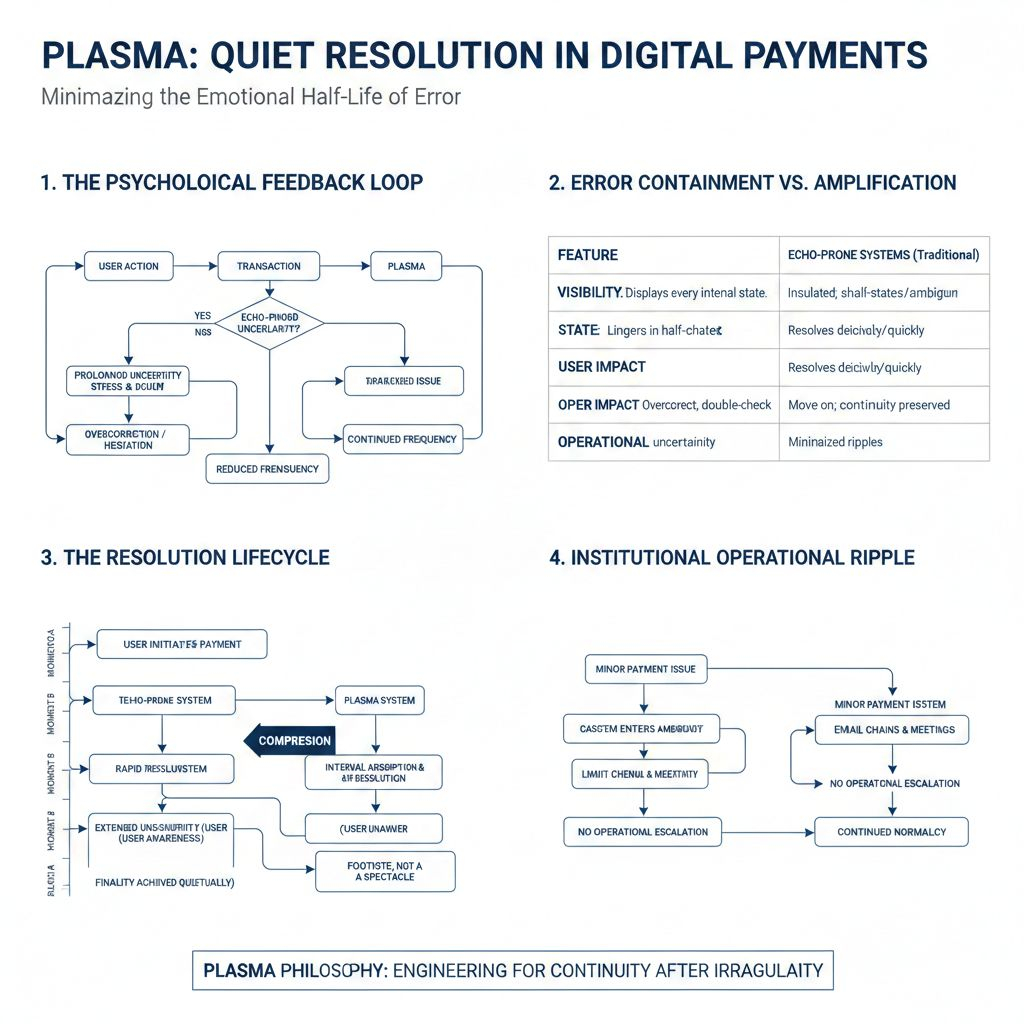
One of the quiet fears in digital payments isn’t speed or cost or even confirmation time.
It’s permanence.
Not the technical permanence of a ledger the psychological permanence of a mistake echoing longer than it should. The fear that a small misstep will spiral into extended uncertainty. That one wrong click will turn into a prolonged state of stress.
Most systems don’t fail often. But when they do, they amplify the emotional footprint of that failure. A delayed transfer becomes a chain of questions. A misjudged action becomes hours of doubt. Even when everything resolves the memory lingers.
What keeps standing out about Plasma is how little it seems to amplify error.
It doesn’t dramatize edge cases. It doesn’t stretch small irregularities into extended ambiguity. The system feels structured to contain disruption rather than echo it.
That containment matters more than raw success rates.
In financial behavior users don’t just remember outcomes they remember how long uncertainty lasted. A short resolved issue feels survivable. A long, ambiguous one reshapes future behavior.
Plasma appears to prioritize closure speed over spectacle.
Not speed in the sense of milliseconds, but speed in the sense of resolution. If something deviates it resolves decisively. The system doesn’t linger in half-states. It doesn’t require prolonged interpretation.
That decisiveness reduces echo.
Many crypto systems expose transitional states prominently. They show every internal phase. That visibility is transparent but it can stretch a minor issue into a drawn out experience. The user watches the problem unfold in real time.
Plasma feels more insulated.
The user sees intent and outcome not every internal wobble in between. That insulation doesn’t hide reality it compresses it. The irregularity is absorbed and resolved before it becomes a psychological event.
There’s a deeper trust dynamic here.
When mistakes echo users overcorrect. They double check obsessively. They delay action. They hesitate. Even if the system statistically succeeds most of the time, one prolonged experience can outweigh dozens of smooth ones.
Plasma seems built around minimizing the emotional half life of error.
The goal isn’t perfection it’s containment.
Containment allows users to move on quickly. It prevents one irregular moment from redefining the system in their minds. The experience remains bounded. You don’t carry it forward.
That boundedness supports frequency.
Systems that amplify mistakes teach users to tread lightly. Systems that compress mistakes teach users to continue normally. The difference shows up in repetition.
Plasma feels engineered for continuity after irregularity.
There’s also an institutional angle. Organizations don’t fear minor issues; they fear cascading uncertainty. When a payment rail enters ambiguous states internal processes multiply. Emails fly. Teams coordinate. What started as a small deviation becomes an operational event.
Plasma’s restraint suggests a system designed to prevent that escalation.
By limiting how long irregular states persist visibly it reduces the operational ripple effect. Problems don’t become spectacles. They resolve before they demand collective attention.
That discipline signals maturity.
Early systems often expose every imperfection. Mature systems focus on preserving the user’s sense of continuity. They understand that disruption is measured not just in frequency, but in emotional duration.
Plasma feels aligned with that philosophy.
Instead of designing for visible resilience dramatic recoveries, public confirmations it designs for quiet resolution. The system doesn’t need applause for surviving stress. It needs to restore normalcy quickly.
Normalcy is the true success state in payments.
What I find compelling is how little Plasma seems to rely on user forgiveness. It doesn’t ask for patience. It doesn’t educate users about volatility. It absorbs variation and delivers finality.
That approach builds a different type of confidence one rooted in the belief that if something goes slightly wrong it won’t spiral.
In financial systems that belief is powerful.
People don’t avoid payments because they expect catastrophe. They avoid them because they fear drawn out uncertainty. Remove the echo and you remove much of the hesitation.
Plasma doesn’t promise a world without mistakes.
It promises a world where mistakes don’t linger.
And in payments that difference may be what ultimately allows users to act without bracing knowing that even if something deviates the system will close the loop quickly and return to calm.
That quiet containment is what turns irregularity from a story into a footnote.
Plasma feels designed for footnotes.
And footnotes don’t shape behavior they fade into the background where money can keep moving without emotional residue.@Plasma #plasma #Plasma $XPL