
As of May 2025, the stablecoin market has reached a staggering $247 billion, representing nearly 10% of all physical U.S. currency in circulation. Yet, this massive growth is hindered by a persistent paradox: while stablecoins are designed to be the frictionless "oil" of digital commerce, they are frequently trapped on general-purpose blockchains characterized by high fees and prohibitive complexity. For a senior researcher, the question isn’t whether stablecoins will dominate, but which infrastructure can actually handle their weight.
Plasma (XPL) has emerged as a purpose-built solution to this dilemma. While the project recently faced a catastrophic price decline and unsubstantiated allegations of insider selling—common growing pains in a volatile market—the underlying on-chain fundamentals tell a more resilient story. Notably, even after slashing yield incentives by over 95%, Plasma’s stablecoin supply held firm at roughly $2.1 billion. This suggests a level of organic demand that few of its peers, including its primary rival "STABLE" (which currently boasts a higher $540 million market cap), can claim.
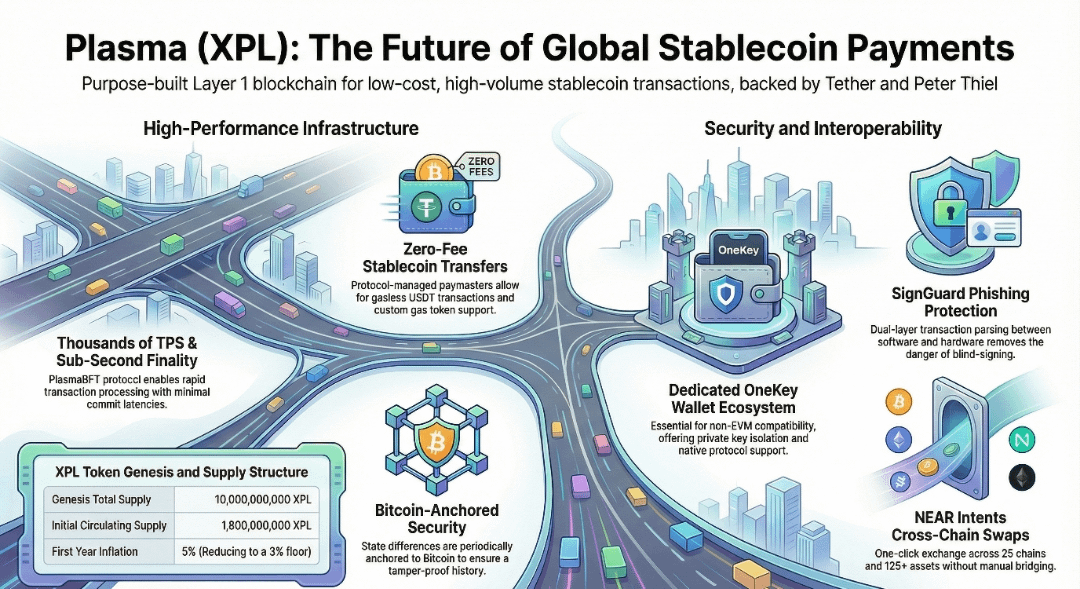
The "Gasless" Revolution: Zero-Fee USDT Transfers
The primary hurdle for mainstream stablecoin adoption has always been the "gas token" friction. Requiring a user to hold a native token like ETH or SOL just to send a payment is a UX failure. Plasma (XPL) addresses this via a "protocol-managed paymaster," which abstracts the fee layer entirely for simple USDT transactions.
This architecture enables a zero-fee environment by allowing the network to manage the costs behind the scenes. However, this isn't just a marketing gimmick; it is a fundamental shift in how a Layer 1 manages its resource allocation.
"Plasma (XPL) is a Layer 1 EVM compatible blockchain that is purpose-built for high-volume, low-cost global stablecoin payments."
By optimizing specifically for high-frequency transfers, Plasma removes the entry barriers that have historically relegated decentralized payments to the "crypto-native" niche, positioning itself for true global commerce.
More Than an EVM Clone: Custom Architecture
While XPL markets itself as "EVM compatible," it is a mistake to view it as just another Ethereum fork. The execution layer is built on Reth, a modular engine written in Rust, which offers significantly higher performance than standard Geth-based setups. Consensus is handled by PlasmaBFT—a custom protocol inspired by Fast HotStuff—enabling thousands of transactions per second (TPS) and sub-second finality.
This technical distinction is the reason standard wallets like MetaMask often struggle with native XPL integration. Because Plasma utilizes a custom gas model—where fees can be paid in USDT0 or even BTC rather than just a native gas token—the transaction structure is fundamentally different. This requires dedicated wallet support to handle the unique signing logic required for gasless and multi-asset fee payments.
Security Anchored by the King: The Bitcoin Bridge
The "scalability trilemma" posits that you cannot have speed, security, and decentralization simultaneously. BFT-based chains often achieve speed by sacrificing the massive decentralization found in PoW networks. Plasma’s solution is a hybrid: it uses a native, trust-minimized Bitcoin Bridge to periodically anchor state differences directly to the Bitcoin blockchain.
This bridge is technically sophisticated, utilizing Threshold Signatures and multi-party computation (MPC) to manage the movement of assets and prevent single points of failure. This allows users to bring native BTC onto the network as pBTC, benefiting from EVM-based DeFi while the underlying security is anchored to the world’s most secure network. By using Bitcoin as the ultimate source of truth, Plasma achieves BFT performance without the terminal risk of a centralized validator set.
Solving "Blind-Signing" with Dual-Layer Parsing
In high-frequency DeFi, the greatest threat isn't the chain failing, but the user being phished. "Blind-signing"—the practice of approving a hex-data string without knowing what it does—is a plague. The OneKey ecosystem has become the premier choice for the XPL network specifically because it addresses this through "SignGuard" and dual-layer parsing.
Unlike traditional software wallets that provide vague warnings, OneKey’s integration with XPL ensures "Clear Signing," where the exact intent of the transaction (e.g., "Transfer 100 USDT0 to address X") is displayed on a secure element before approval.
Key Features of the OneKey Ecosystem:
SignGuard Technology: Eliminates blind-signing by parsing complex contract data into human-readable text.
Open-Source Integrity: All signing flows and firmware are fully auditable, a rarity in the hardware space.
Multi-Chain Breadth: Supports 100+ chains, including native adaptation for Plasma's custom gas structures.
EAL 6+ Isolation: Private keys remain entirely offline, isolated from potential malware on the host device.
The "Chain Abstraction" Leap: NEAR Intents Integration
In January 2026, Plasma integrated with NEAR Intents, marking a significant leap toward "chain abstraction." This system utilizes a network of MPC Solvers to execute user "intents." Instead of a user manually bridging, swapping, and managing gas across three different chains, they simply state an intent: "Swap native BTC for USDT0 on Plasma."
The solvers handle the backend complexity in seconds. This integration has been a massive driver of liquidity; Plasma currently captures 39% of all cross-chain USDT traffic routed through the NEAR Intents model.
"This integration allows Plasma users to complete deposits and withdrawals within seconds without needing multiple wallets or cross-chain platforms, marking a new stage of 'chain abstraction' in decentralized finance."
By abstracting the "chain" away from the user, Plasma and NEAR have created a unified liquidity pool that spans 25+ blockchains, making the XPL network a highly accessible hub for stablecoin activity.
The Settlement Layer of the Future
Backed by institutional heavyweights like Tether, Bitfinex, and Peter Thiel, Plasma (XPL) is clearly positioning itself as the settlement layer for the next decade of finance. However, the path isn't without obstacles. The network must continue to navigate the competitive pressure from the "STABLE" chain and overcome the negative sentiment lingering from its recent price volatility.
The real test will be the upcoming activation of the validator staking system. If Plasma can successfully transition from an incentive-heavy launch phase to a self-sustaining, secure network, it will prove that the "stablechain" model is superior to general-purpose L1s.
As we look toward a future where global commerce moves on-chain, one must ask: Will specialized, purpose-built chains like Plasma eventually render general-purpose blockchains obsolete for the world's most important asset class—money itself?


