
Plasma’s governance is easiest to understand if you stop thinking of it as a constitution and start thinking of it as a habit: who gets to make calls when something needs to change, and what makes everyone involved say “yes, I’ll keep doing my part.”
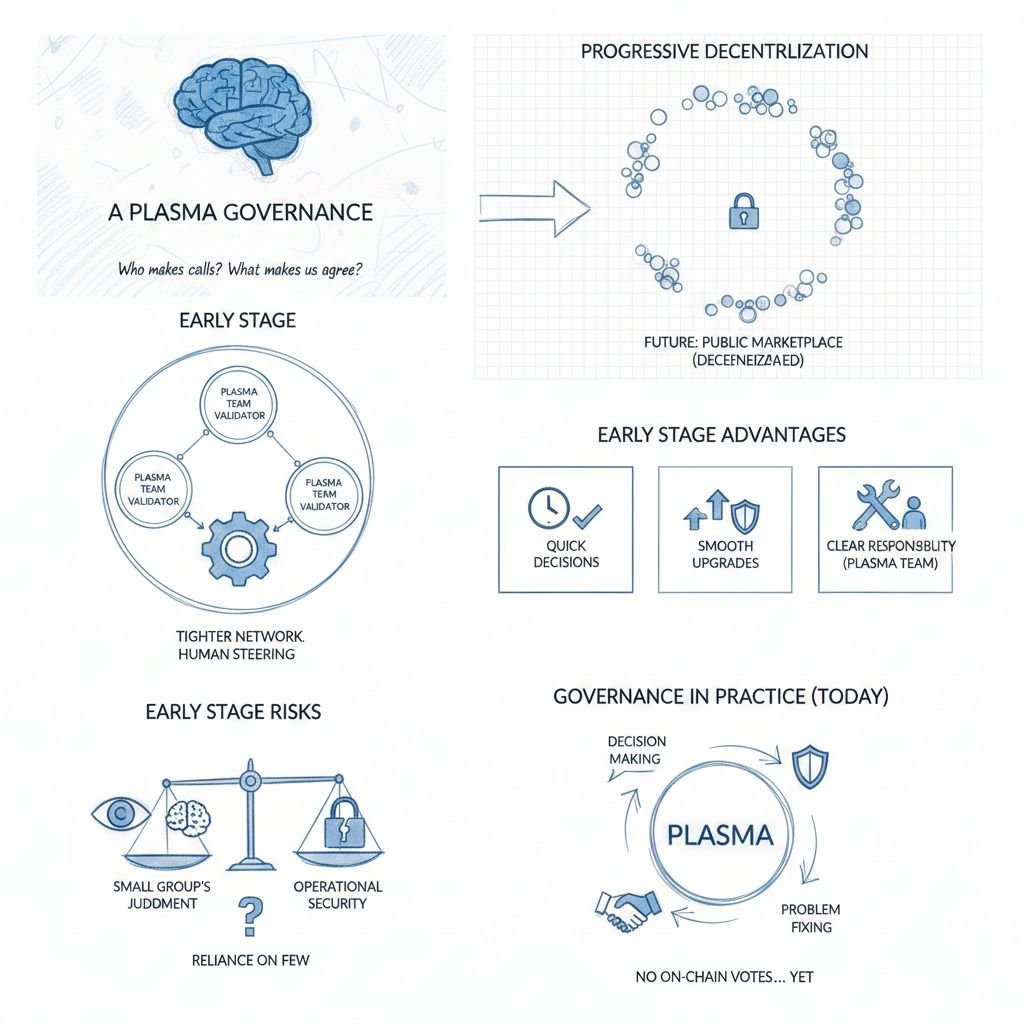
Right now, the biggest thing shaping Plasma’s governance is that it’s still in a progressive decentralization phase. In plain terms, the validator set isn’t a big public marketplace yet. The network is being run in a tighter way, with validators operated by the Plasma team during the early stage. That creates a very specific kind of “human steering.” Decisions can be made quickly, upgrades can be coordinated without drama, and if something breaks there’s a clear party responsible for fixing it. The downside is also clear: the system is relying on a smaller group’s judgment and operational security. That’s governance, even if nobody is clicking “vote” on-chain yet.
When people ask “how does a decision happen,” the most honest answer is: it starts as a proposal, becomes a shared agreement, and then gets executed by whoever controls the machinery. The proposal part is someone saying, “we should change this parameter,” or “we should upgrade this client,” or “we need a new policy for how gas sponsorship works.” The agreement part is where the social layer shows up—feedback from node operators, ecosystem partners, stablecoin users, integrators, and whoever else will feel the change. And then execution is the moment it becomes real: software gets upgraded, rules get enforced, and the network moves forward. Today, because the validator operations are centralized in the early phase, execution is mostly coordinated rather than politically negotiated.
Over time, Plasma’s plan clearly points toward staking and delegation, which is where governance becomes less like “a company shipping a product” and more like “a small economy arguing about rules.” Delegation changes everything because it turns passive holders into a power source. Most people won’t run infrastructure and most won’t follow every proposal, so they’ll delegate. That means validators stop being just technical operators and start behaving like representatives. They have to earn trust, maintain uptime, avoid penalties, communicate well, and convince people their stake is safe with them. Delegators, meanwhile, behave like rational shoppers: they move stake toward good returns and low risk, which sounds healthy until you realize it can quietly centralize power. The biggest validator brands tend to attract more stake simply because people feel safer there. That’s not malicious, it’s human, but it can still lead to a small set of validators accumulating outsized influence.
If you zoom in on voting power, there are two different “votes” people confuse. One is the consensus vote: validators voting on blocks so the chain can finalize quickly and reliably. That’s not optional; it’s the mechanism of the chain. The other is governance voting: humans deciding protocol changes. Even before formal on-chain governance is fully spelled out in public, delegation already creates governance-like behavior because stake becomes a constant feedback signal. Validators who behave well attract stake; validators who behave poorly lose it. That’s a kind of continuous voting that happens whether or not there’s a governor contract.
Now the incentives. Plasma is built for stablecoin settlement, so it tries to make stablecoin movement feel natural and cheap, not like a puzzle where you first have to buy a native token to do anything. That’s why the network highlights gasless simple USDT transfers and stablecoin-first gas mechanics. The moment you do that, though, you create a balancing act: users want the “free and simple” experience to stay free and simple forever, while validators need enough dependable revenue to justify keeping the chain secure and online.
Plasma’s approach is basically: sponsor what matters most for payments UX, but keep the rest of the system fee-paying so validators still have reasons to show up. Only simple USDT transfers are gasless; other transactions still pay fees to validators. Longer-term, validator economics are also expected to include inflationary rewards once external validators and stake delegation go live. That’s important because it tells you what Plasma thinks the mature network needs: not just fees, but a built-in security budget.
Another incentive detail that changes behavior is how penalties work. Plasma leans toward reward slashing rather than harshly punishing stake principal. That lowers the fear barrier for operators and can be friendlier to institutions, because “I might lose rewards” is a very different emotional and financial risk than “I might lose principal capital.” But every design choice has a shadow side. Softer penalties can sometimes encourage “calculated risk” behavior, where an operator quietly weighs “what do I gain if I bend the rules” against “what do I lose if I’m penalized.” Most operators won’t do that, but governance has to assume some will, because incentives eventually attract the edge cases.
This is where misaligned incentives show up, and it’s worth talking about them plainly because they don’t require villains. They happen naturally when rational behavior meets imperfect rules.
Gas sponsorship can be abused. If simple stablecoin transfers are subsidized, someone can try to spam the network with tiny transfers or grief merchants and services with noise. The fix is usually policy: rate limits, paymaster rules, heuristics, sometimes allowlists. But policy introduces a governance question: who controls that policy, how transparent is it, and how do you prevent it from becoming arbitrary? In an early centralized phase, policy can be enforced quickly; in a later decentralized phase, policy has to be robust enough that many stakeholders accept it.
Delegation can centralize power. Not because people are evil, but because people like safety and simplicity. If a few validators become “default choices,” they can accumulate a lot of stake. Once that happens, governance becomes vulnerable to quiet capture even without drama. Nobody needs to collude; inertia does the work.
Fee politics can become culture war. Payments users want “don’t touch my cheap transfers,” validators want “don’t starve the security budget,” and token holders want “don’t inflate forever.” Those are normal competing interests. Governance is how those interests negotiate compromises, and the chain’s long-term health depends on whether it can keep those compromises stable and predictable.
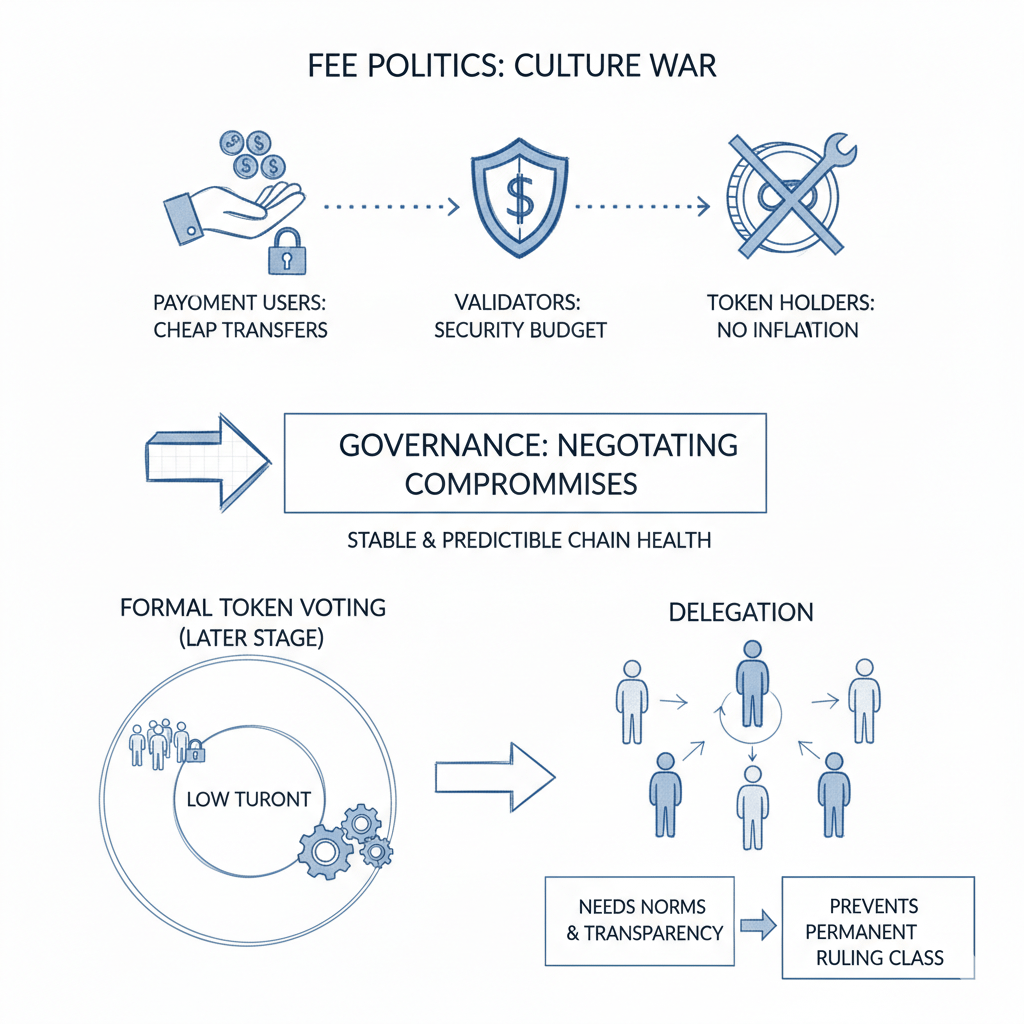
And if formal token voting becomes a bigger part of Plasma later, the most common failure mode is boring: low turnout. When most people don’t vote, small organized groups can push decisions through. Delegation helps, but it also creates a new class of power brokers. That isn’t automatically bad; it just means governance needs norms and transparency so delegates don’t become a permanent ruling class.
So if you want the human version of “how Plasma is steered,” it’s this: today, it’s a coordinated system where changes can be made fast because operations are tight. Over time, it wants to become a stake-driven system where validators and delegators shape outcomes through delegation flows and eventually more formal governance. The incentives are designed to protect the payments experience while still paying validators enough to care. The risks are the usual ones for any network trying to grow up: spam pressure on subsidies, centralization pressure from delegation, and political pressure over fees and rewards.

