

At 8:30 a.m. Eastern, the market received two stories wrapped inside one jobs report.
The first was immediate and straightforward: Nonfarm payrolls rose by 130,000 in January, unemployment held at 4.3%, and wages climbed 0.4% month over month to $37.17, up 3.7% year over year. That is not recessionary data. It is steady, firm, and just strong enough to keep inflation concerns alive.
The second story required scrolling.
The Bureau of Labor Statistics issued a substantial annual benchmark revision, cutting the March 2025 job count by 898,000 on a seasonally adjusted basis and lowering the entire 2025 trendline. In effect, the labor market of last year was not as strong as previously believed.
Bitcoin now sits precisely between those two narratives.
The First Reaction: Higher Yields, Lower BTC
Markets trade the present first.
Following the latest release, Treasury yields seem to move higher. The 10-year rose toward 4.20% from roughly 4.15%. CME FedWatch probabilities for a March rate cut collapsed from around 22% to near 6%. The repricing was immediate: cuts are less likely in the near term if labor and wages remain firm.
Bitcoin responded accordingly, slipping roughly 3% toward the $66,900 region.
This reaction is not emotional — it is mechanical.
Higher yields raise the discount rate applied to all risk assets. Bitcoin, now deeply embedded in macro portfolios, is no longer insulated from rate sensitivity. When the cost of money rises, liquidity tightens. When liquidity tightens, speculative positioning contracts first. Bitcoin tends to feel that compression early.
Wage growth is particularly relevant. At 3.7% year over year, earnings growth keeps inflation “sticky” in the conversation. A patient Federal Reserve becomes the base case. Patience means rates stay restrictive for longer. Restrictive conditions mean liquidity remains scarce relative to the easing cycle that traders have been anticipating.
That is timeline one.
Insight: A Slower Economy Beneath the Surface
The downward revision of almost 900,000 jobs for March 2025 significantly shifts the historical trajectory of the labor market. Investors base their forward-looking assessments on the strength of existing trends. If that trend was overstated, then the resilience narrative weakens.
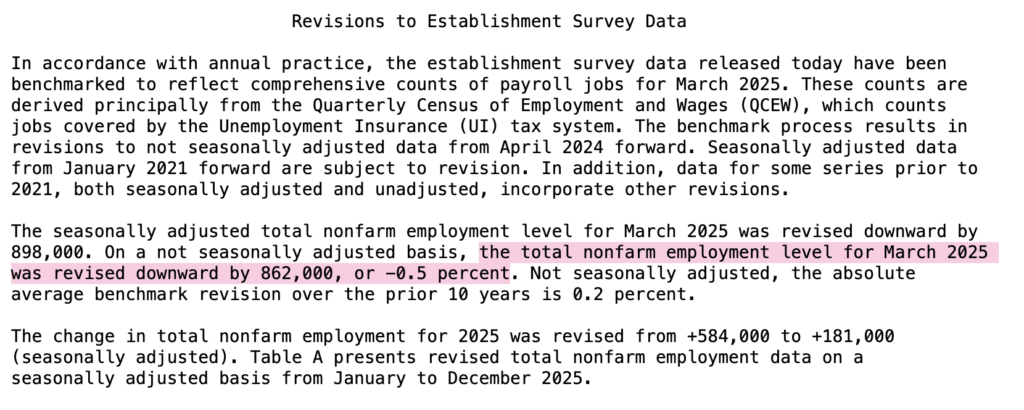
Revisions are often more important than headlines. They change how investors interpret the durability of growth.
If 2025 job creation was softer than believed, then the economy may have been decelerating earlier than markets assumed. That opens the door to a future sequence where hiring cools more visibly in upcoming reports. If that cooling materializes, rate cuts re-enter the picture faster.
Bitcoin does not react only to today’s payroll print. It reacts to the evolving probability distribution of future liquidity.
This is where the tension lies: a firm January versus a softer 2025 baseline.
Macro Wiring: Why Bitcoin Cares So Much
Bitcoin’s macro sensitivity has matured than before
In earlier cycles, crypto industry was largely reflexive — driven by some main narratives, retail flows, and internal leverage dynamics. Today, it sits alongside equities and bonds in institutional portfolios. For example, ETFs, derivatives markets, and cross-asset allocation strategies have linked BTC directly to global liquidity conditions.
The transmission mechanism works like this:
1. Strong data → yields rise.
2. Yields rise → financial conditions tighten.
3. Tighter conditions → leverage reduces.
4. Reduced leverage → BTC feels pressure.
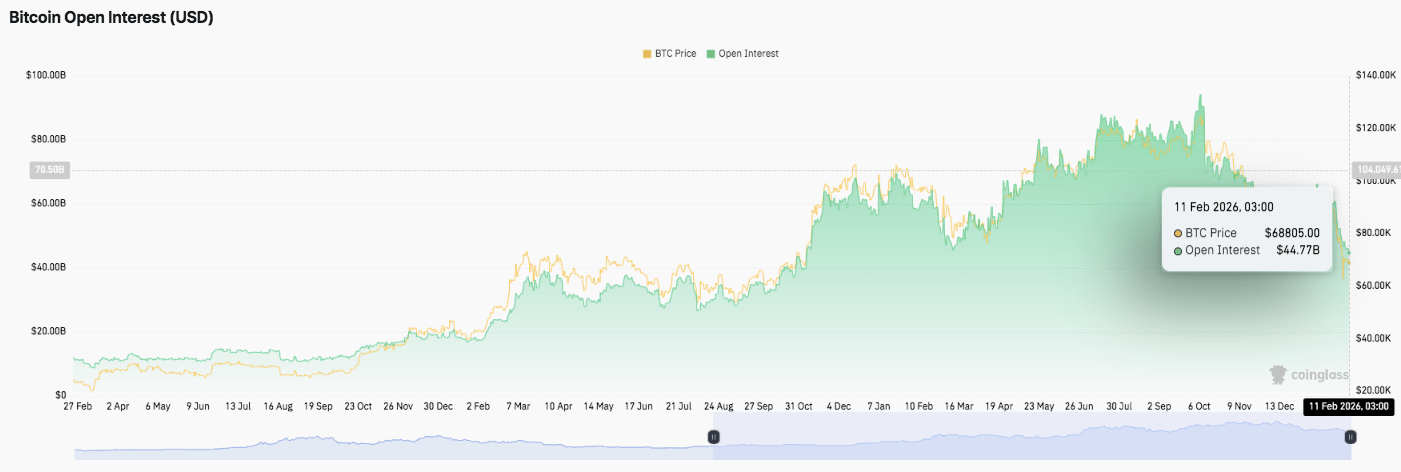
This week’s open interest data supports that mechanism. Bitcoin derivatives open interest has contracted to roughly $44.7 billion, down sharply from peaks above $80 billion. That decline signals deleveraging.
Spot flows of BTC reinforce the defensive posture. We can see that persistent net outflows across months, including a $122 million net outflow on February 11, suggest distribution rather than accumulation.
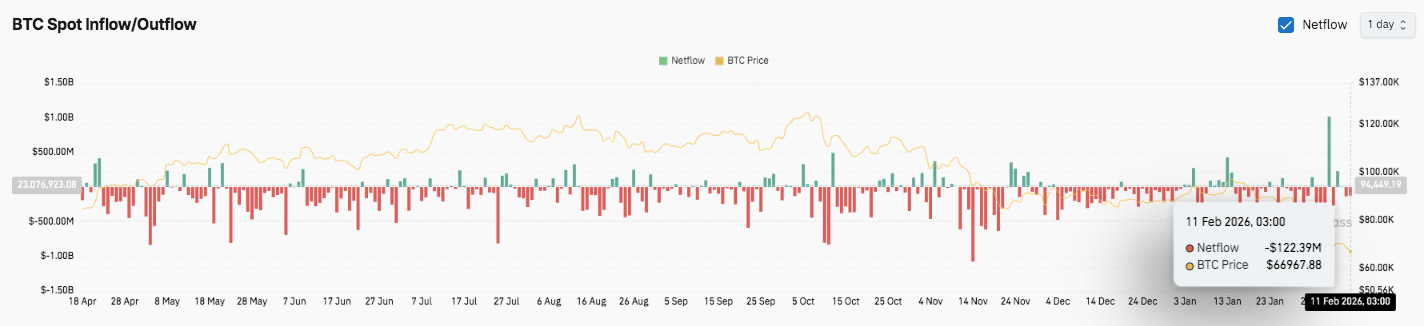
Liquidity is not flowing in aggressively. It is stepping back.
Technical Structure: Compression Under Resistance
Technically, Bitcoin is at a pivotal inflection. After price rejecting near the $97,970 swing high, BTC retraced deeply and found macro support near $60,104. The rebound from that level was meaningful, but structurally incomplete.
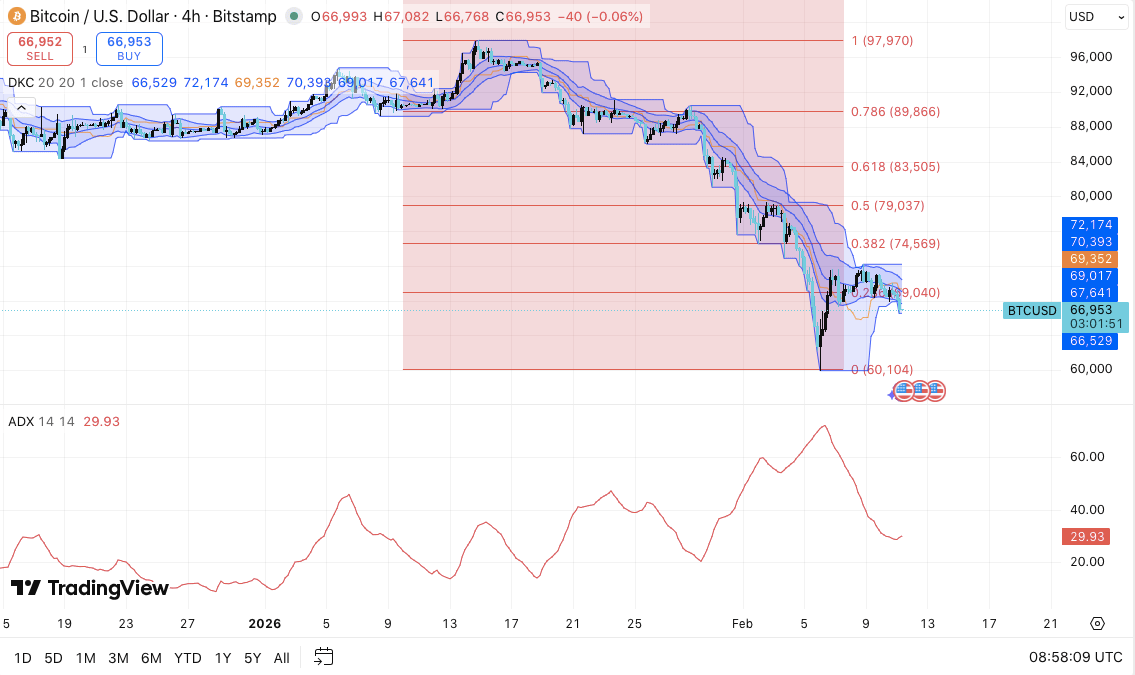
Price now trades below the 0.236 Fibonacci retracement at $69,040 — immediate resistance. This level acts as the first breakout trigger. A decisive reclaim of $69,000 would open a path toward $74,569 (0.382 retracement) and potentially $79,037 (0.5 retracement), which would signal broader structural repair.
Until that occurs, lower highs define the 4-hour structure.
The Donchian Channel shows price hugging the lower boundary — not aggressively bearish, but not strong. Meanwhile, the ADX, which previously signaled strong downtrend momentum, is cooling and momentum compression often precedes expansion.
The key is confirmation of the correction phase. Without volume expansion and renewed inflows, upside attempts may stall under resistance.
Three Plausible Paths Forward
From here, three macro-technical paths emerge.
1. Higher for Longer
Jobs remain steady and Wage growth persists. If Inflation cools slowly -> The Fed delays cuts.
In this environment, yields remain elevated. Bitcoin rallies struggle under big macro pressure. Range-bound or corrective behavior dominates until liquidity expectations shift.
2. Slowdown Materializes
Revisions prove to be the early signal of broader deceleration. Hiring softens. Inflation moderates more decisively. Cut expectations, move forward.
Under this path, Bitcoin benefits from improving liquidity outlook. A sustained reclaim of $69,000 could trigger relief rallies toward $74,500 and potentially $79,000 as positioning rebuilds.
3. A Soft Landing with Noise
The US economy gradually cools without breaking itself. If that happens -> Cuts arrive, but later than markets initially hoped. Volatility remains elevated around each data release.
This environment favors, therefore, tactical trading rather than trend conviction. Bitcoin chops between macro support near $60,000 and resistance near $74,000 until clarity emerges.
The Liquidity Trap Question
There is a deeper structural concern embedded in this debate: liquidity traps.
If growth appears strong enough to delay easing but underlying conditions are weakening, financial markets can experience a squeeze. Liquidity expectations pull forward and backward rapidly, destabilizing positioning. Bitcoin’s high beta makes it sensitive to that instability.
The recent deleveraging in derivatives may be a preemptive adjustment to that risk.
What to Watch Next
Two calendar events matter most:
1. The upcoming CPI release.
2. The March 6 employment report.
If inflation cools while labor remains stable, risk assets can stabilize. If inflation reaccelerates alongside firm wages, rate cut odds will compress further, pressuring Bitcoin below current support bands.
On the downside, $65,000–$66,000 is the first demand zone. Below that, $60,104 remains the macro line. A decisive break under $60,000 could accelerate downside momentum.
On the upside scenario, $69,000 is the pivot point. BTC must flip from resistance to support to alter the short-term bias.
Insights - A Market Holding Two Truths
Bitcoin price today reflects a market holding two truths simultaneously.
The present labor data seems to support patience from the Federal Reserve. The revised past suggests underlying softness.
Bitcoin is not reacting to one headline. It is reacting to the probability that liquidity may remain constrained longer than expected — or loosen sooner than believed.
For now, price compresses beneath resistance while leverage contracts and spot flows hesitate. That combination suggests caution, not capitulation.
The next expansion move — higher or lower — will likely come not from crypto-native narratives, but from the evolving shape of yields and rate expectations.
Bitcoin remains a liquidity instrument.
And liquidity is still being debated.
