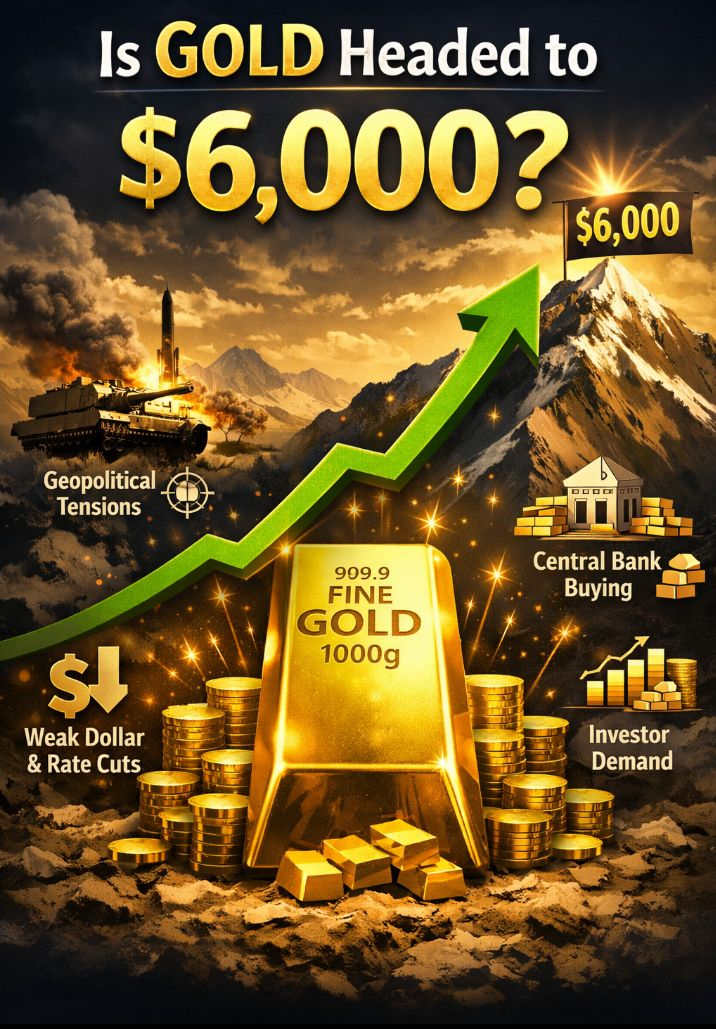
Gold — the timeless pillar of wealth preservation — has recently shattered past records, climbing into the $5,000+ per ounce area in early 2026 amid rising global uncertainty. Now one question dominates market conversations:
Could gold reach $6,000 per ounce — and what scenarios could make it happen?
📈 Why $6,000 Is Being Seriously Discussed
Gold’s ascent is no longer a speculative whisper. Multiple institutional forecasts and analyst projections suggest that if certain macro forces remain in play, a move toward $6,000 per ounce is possible — not mere fantasy.
Key reasons this target is being discussed include:
Persistent geopolitical tensions that drive safe-haven demand
Sustained purchases by central banks around the world
Weakness in the U.S. dollar paired with easing real interest rates
Continued diversification by investors and institutions
Together, these factors could create a price trajectory far stronger than gold’s long-term average.
🔑 Scenarios That Could Propel Gold Toward $6,000
1. Intensifying Geopolitical Risk
Gold thrives during uncertainty. Escalations in global conflict, rising diplomatic friction, or major shifts in global alliances can trigger surges in safe-haven capital flows, rapidly pushing prices higher.
2. Central Bank Accumulation
Central banks — particularly in Asia and emerging markets — have been increasing allocations to gold reserves as part of diversification strategies. This structural demand reduces available supply and supports higher price floors.
3. Weaker U.S. Dollar & Declining Rates
Gold and the U.S. dollar typically move inversely. A weakening dollar — especially if paired with expectations of interest-rate cuts — makes gold more attractive relative to fixed-income assets, boosting demand.
4. Broader Investment Flows
ETFs, institutional allocations, and increased retail interest continue to funnel capital into gold. As financial markets price in long-term inflationary risks, gold’s appeal as a hedge strengthens.
⚠️ Scenarios That Could Temper Gold’s Rise
Not every forecast points to $6,000 — and there are real limitations to such a move:
❌ Higher Interest Rates
If central banks maintain tight monetary policy or raise real yields, gold could lose some shine, as higher yields make non-yielding assets like gold less appealing.
❌ Stronger Dollar
A resilient U.S. dollar weakens gold’s relative attractiveness and dampens demand from foreign buyers.
❌ Economic Acceleration
If global growth accelerates sharply, risk assets may outperform safe havens, reducing gold inflows.
Under these conditions, gold could still rise — but likely at a more measured pace.
📊 Price Outlook — Balanced View
Here’s a simplified view of possible ranges for 2026:
Scenario
Projected Gold Price
Moderate Growth
~$4,000–$4,500/oz
Bullish Momentum
~$4,500–$5,500/oz
High-Stress Rally
$5,500–$6,000+/oz
Bottom line:
🔹 $5,000+ per ounce is widely seen as plausible.
🔹 $6,000+ is achievable — but under stronger macro stress and sustained safe-haven demand.
🧠 Final Takeaway
Gold’s journey toward $6,000 isn’t guaranteed — but it’s unquestionably credible under the right conditions:
Geopolitical risk, central bank demand, currency pressure, and investor diversification can combine to push prices beyond historical thresholds.
In a world marked by uncertainty and macro transition, gold remains not just a relic of the past, but a dynamic store of value for the future.$XAU