

History doesn’t change in Bitcoin. The numbers just get bigger.
In 2017, Bitcoin peaked near $21,000 and then fell more than 80%. In 2021, it topped around $69,000 and dropped roughly 77%. In the most recent cycle, after reaching around $126,000, price has already corrected more than 70%.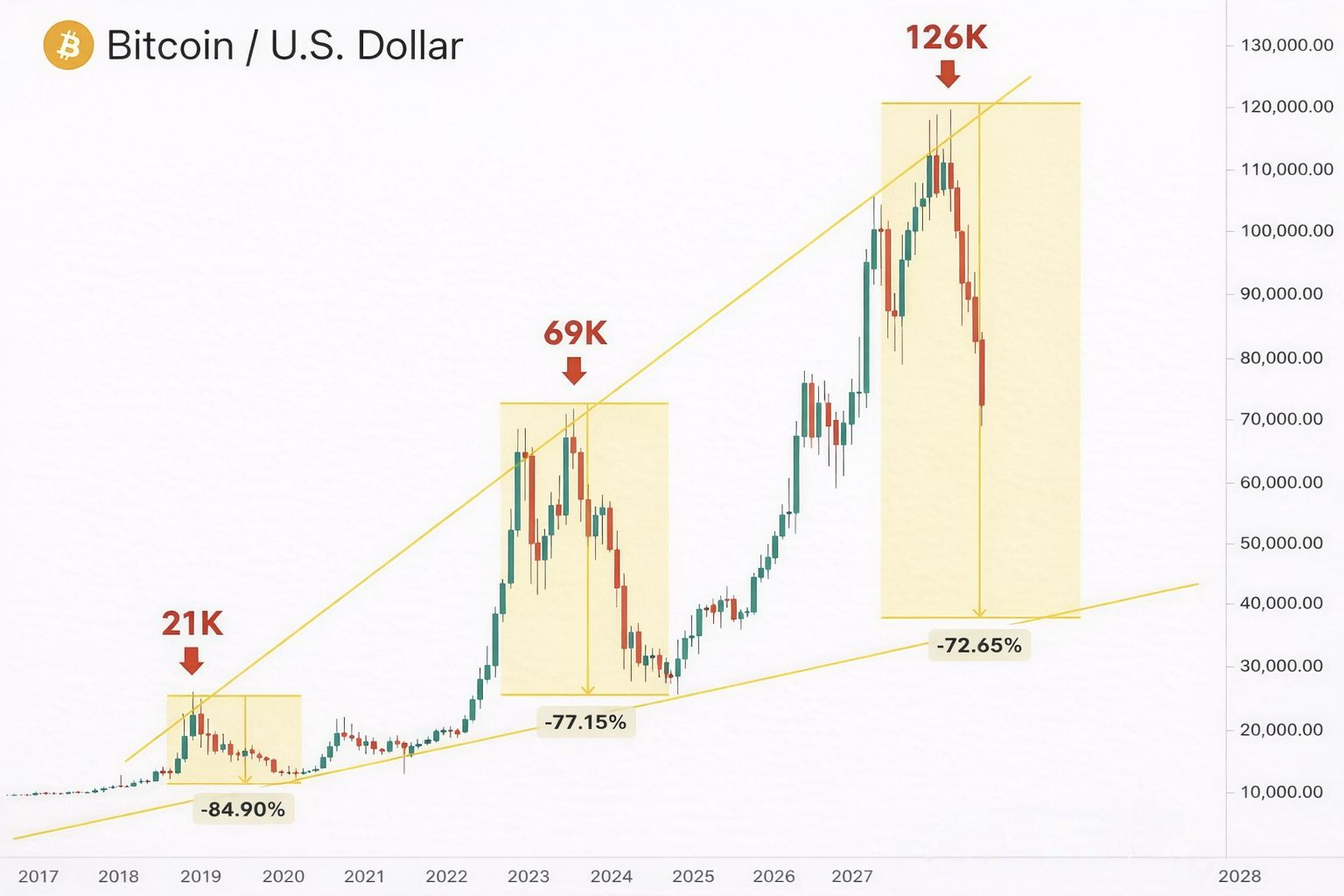
Each time feels different. Each time the narrative is new. Each time people say, “This cycle is not like the others.” And yet, when you zoom out, the structure looks painfully familiar.
Parabolic rise.
Euphoria.
Overconfidence.
Then a brutal reset.
The percentages remain consistent. The emotional pain remains consistent. Only the dollar amounts expand.
This is not coincidence. It is structural behavior.
Bitcoin is a fixed-supply asset trading in a liquidity-driven global system. When liquidity expands and optimism spreads, capital flows in aggressively. Demand accelerates faster than supply can respond. Price overshoots.
But when liquidity tightens, leverage unwinds, and sentiment shifts, the same reflexive loop works in reverse. Forced selling replaces FOMO. Risk appetite contracts. And the decline feels endless.
Understanding this pattern is the first educational step.
Volatility is not a flaw in Bitcoin. It is a feature of an emerging, scarce, high-beta asset.
But education begins where emotion ends.
Most people do not lose money because Bitcoin crashes. They lose money because they behave incorrectly inside the crash.
Let’s talk about what you should learn from every major drawdown.
First, drawdowns of 70–80% are historically normal for Bitcoin. That doesn’t make them easy. It makes them expected.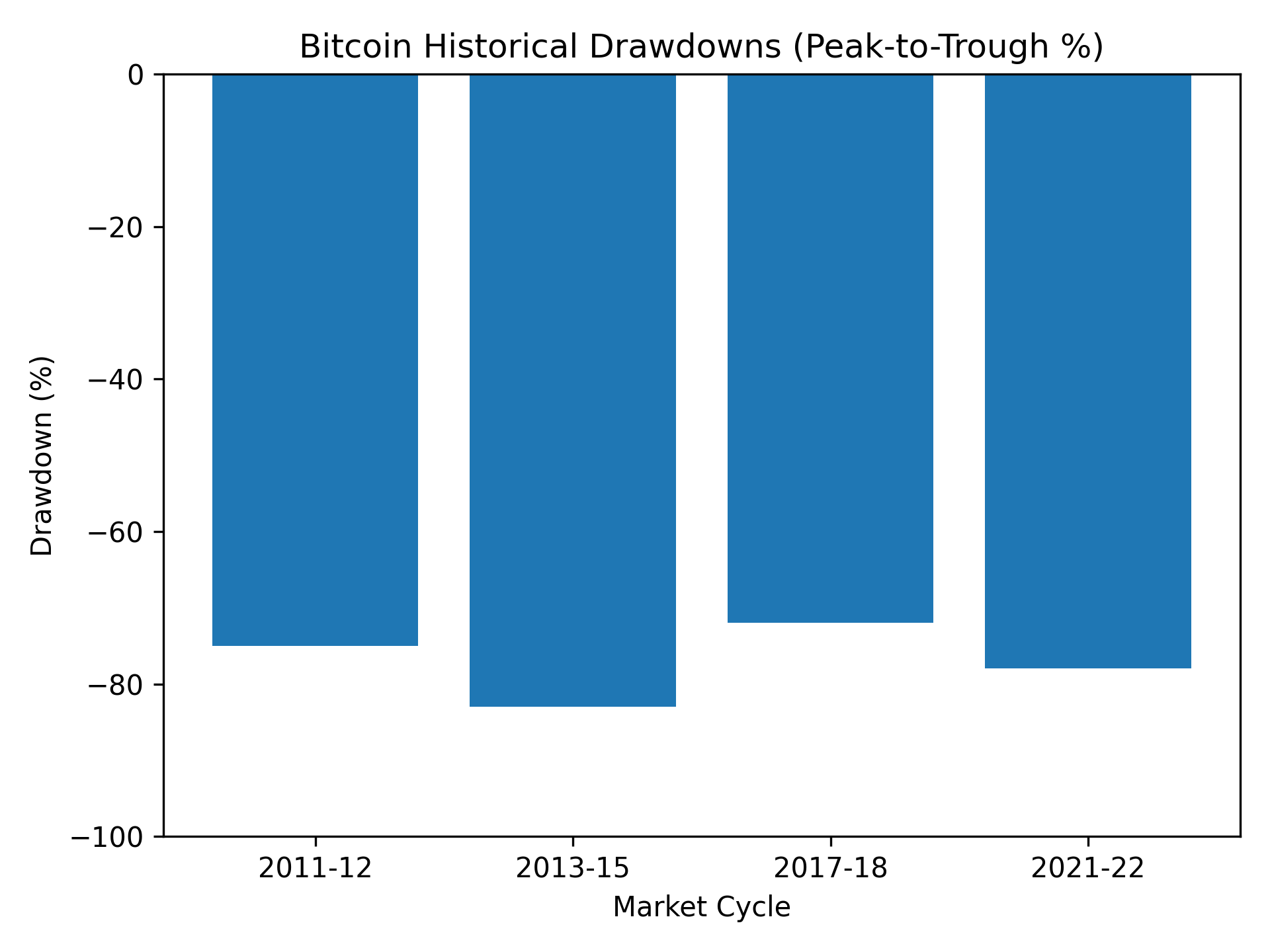
If you enter a volatile asset without preparing mentally and financially for extreme corrections, you are not investing you are gambling on a straight line.
Second, peaks are built on emotion.
At cycle tops, narratives dominate logic. Price targets stretch infinitely higher. Risk management disappears. People borrow against unrealized gains. Leverage increases. Exposure concentrates.
That’s when vulnerability quietly builds.
By the time the crash begins, most participants are overexposed.
If you want to survive downturns, preparation must happen before the downturn.
Here are practical, educational steps that matter.
Reduce leverage early.
Leverage turns normal corrections into account-ending events. If you cannot survive a 50% move against you, your position is too large.
Use position sizing.
Never allocate more capital to a volatile asset than you can psychologically tolerate losing 70% of. If a drawdown would destroy your stability, your exposure is misaligned.
Separate long-term conviction from short-term trading.
Your core investment thesis should not be managed with the same emotions as a short-term trade.
Build liquidity reserves.
Cash or stable assets give you optionality during downturns. Optionality reduces panic.
Avoid emotional averaging down.
Buying every dip without analysis is not discipline — it is hope disguised as strategy.
Study liquidity conditions.
Bitcoin moves in cycles that correlate with macro liquidity. Understanding rate cycles, monetary policy, and global risk appetite helps you contextualize volatility.
One of the biggest psychological traps during downturns is believing “this time it’s over.”
Every crash feels existential.
In 2018, people believed Bitcoin was finished.
In 2022, they believed institutions were done.
In every cycle, fear narratives dominate the bottom.
The human brain struggles to process extreme volatility. Loss aversion makes drawdowns feel larger than they are historically.
That is why studying past cycles is powerful. Historical perspective reduces emotional distortion.
However, here’s an important nuance:
Past cycles repeating does not guarantee identical future outcomes.
Markets evolve. Participants change. Regulation shifts. Institutional involvement increases.
Blind faith is dangerous.
Education means balancing historical pattern recognition with present structural analysis.
When markets go bad, ask rational questions instead of reacting emotionally.
Is this a liquidity contraction or structural collapse?
Has the network fundamentally weakened?
Has adoption reversed?
Or is this another cyclical deleveraging phase?
Learn to differentiate between price volatility and existential risk.
Price can fall 70% without the underlying system failing.
Another key lesson is capital preservation.
In bull markets, people focus on maximizing gains. In bear markets, survival becomes the priority.
Survival strategies include:
Reducing correlated exposure.
Diversifying across asset classes.
Lowering risk per trade.
Protecting mental health by reducing screen time.
Re-evaluating financial goals realistically.
Many participants underestimate the psychological strain of downturns. Stress leads to impulsive decisions. Impulsive decisions lead to permanent losses.
Mental capital is as important as financial capital.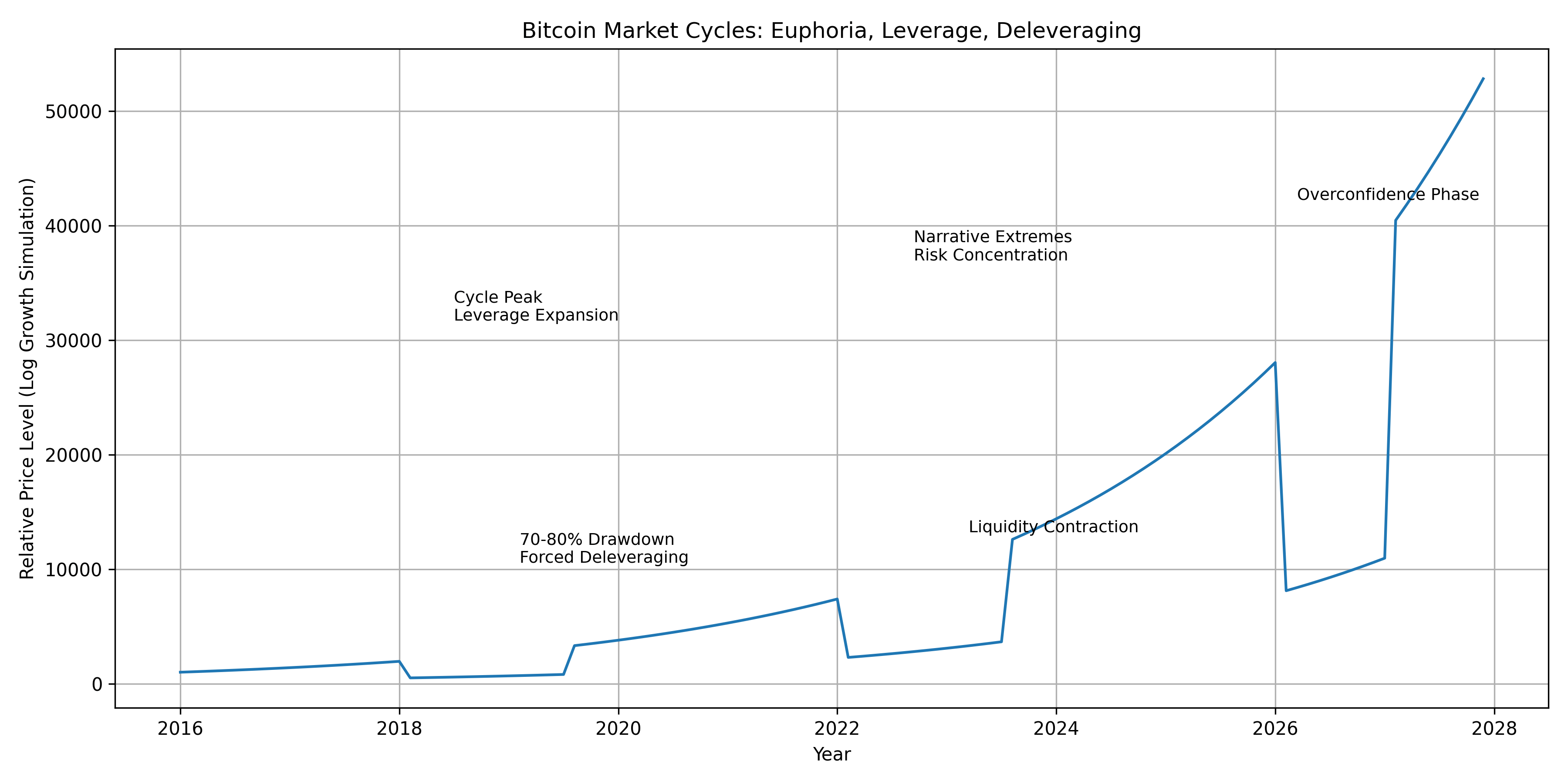
The chart showing repeated 70–80% drawdowns is not a warning against Bitcoin. It is a warning against emotional overexposure.
Each cycle rewards those who survive it.
But survival is engineered through discipline.
One of the most powerful habits you can build is pre-commitment. Before entering any position, define:
What is my thesis?
What invalidates it?
What percentage drawdown can I tolerate?
What would cause me to reduce exposure?
Write it down. When volatility strikes, you follow your plan instead of your fear.
Another important educational insight is that markets transfer wealth from the impatient to the patient — but only when patience is backed by risk control.
Holding blindly without understanding risk is not patience. It is passivity.
Strategic patience means:
Sizing correctly.
Managing exposure.
Adapting to new data.
Avoiding emotional extremes.
Every cycle magnifies the numbers.
21K once felt unimaginable.
69K felt historic.
126K felt inevitable.
Each time, the crash felt terminal.
And yet, the structure repeats.
The real lesson of this chart is not that Bitcoin crashes. It is that cycles amplify human behavior.
Euphoria creates overconfidence.
Overconfidence creates fragility.
Fragility creates collapse.
Collapse resets structure.
If you learn to recognize this pattern, you stop reacting to volatility as chaos and start seeing it as rhythm.
The question is not whether downturns will happen again.
They will.
The real question is whether you will be prepared financially, emotionally, and strategically when they do.
History doesn’t change.
But your behavior inside history determines whether you grow with it or get wiped out by it.
