
Forget seed phrases, gas fees, and clunky transactions. A fundamental shift in how blockchain accounts work is about to make Web3 as seamless as Web2 and most people haven't even heard of it yet.
The "Aha" Moment That Changed Everything
Let me ask you something: When you use your banking app, do you worry about private keys? Do you stress about whether you have enough "ETH" to pay for a transaction? Do you panic that one typo could send your life savings into the void?
Of course not. Because modern finance has abstracted away the complexity. You just log in, tap a button, and magic happens behind the scenes.
For years, crypto has been stuck in the technological stone age. We've been asking billions of people to manage cryptographic keys, understand gas mechanics, and navigate transaction hashes just to participate. It's like requiring someone to understand TCP/IP protocols to send an email.
But that's about to change. Dramatically.
Welcome to Account Abstraction—specifically ERC-4337—the Ethereum standard that's already deployed, already scaling, and already transforming how humans interact with blockchain. This isn't theoretical. It's live, it's growing exponentially, and it's the key to unlocking mainstream adoption.
What Is Account Abstraction? (The Non-Technical Version)
Here's the simplest way to understand it: Right now, your crypto wallet controls your account. With account abstraction, your account IS a smart contract.
That distinction might sound subtle, but it's revolutionary.
Traditional Ethereum accounts (called EOAs, or Externally Owned Accounts) are basically just pairs of cryptographic keys. They can do two things: hold assets and sign transactions. That's it. They're dumb accounts.
Smart contract accounts, enabled by ERC-4337, are programmable. They can have any logic you want: multi-signature requirements, spending limits, social recovery, biometric authentication, automatic payments, batch transactions—you name it.
Think of it like the difference between a basic flip phone and a smartphone. Both make calls, but one is a platform that can run any application.
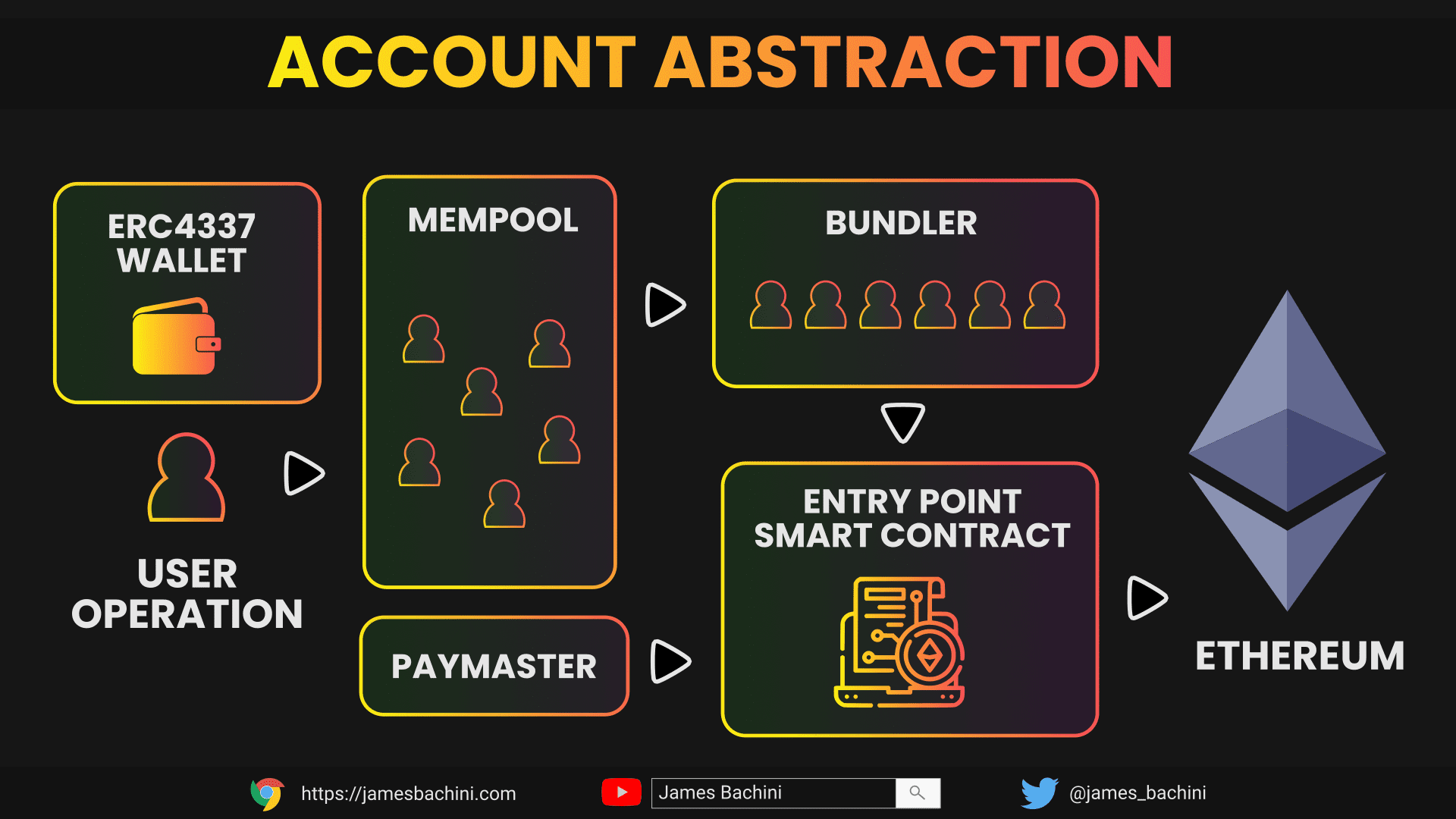
The magic happens through something called a UserOperation—a new type of transaction object that represents your intent. Instead of signing raw transaction data, you're essentially saying "I want to do X," and the network figures out how to execute that securely.
The Numbers Don't Lie: Explosive Growth
Account abstraction isn't a future promise—it's already here and accelerating fast.
Since ERC-4337 launched on Ethereum mainnet in March 2023, the ecosystem has exploded:
Over 40 million smart accounts deployed across Ethereum and Layer 2 networks
Nearly 20 million deployed in 2024 alone—that's 7x year-over-year growth
Over 100 million UserOperations processed, marking a tenfold increase from 2023
Base, Polygon, and Optimism leading adoption with millions of gas-free transactions monthly
Industry projections anticipate over 200 million smart accounts by late 2025, driven by the combination of ERC-4337 and the recent EIP-7702 upgrade (part of the May 2025 Pectra hard fork).
This isn't niche experimentation. This is infrastructure-level adoption happening in real-time.
What This Actually Means for You
Let me translate the technical jargon into tangible benefits that will change your daily crypto experience:
1. No More Seed Phrase Anxiety
Imagine losing your phone and not losing your crypto. With smart contract wallets, you can set up "social recovery"—trusted friends or family who can help you regain access without ever having control of your funds. Or use biometric authentication through your device's secure enclave. Your face or fingerprint becomes your key, not a 12-word phrase scribbled on paper.
2. Pay Gas in Any Token (Or Pay Nothing)
Hate needing ETH to send USDC? With account abstraction, "paymasters" can sponsor your gas fees entirely, or let you pay in any ERC-20 token. Dapps can subsidize onboarding costs, making your first interaction completely free—just like Web2 apps don't charge you for creating an account.
3. Batch Transactions
Approve a token AND swap it AND deposit it into a vault—all in one click, one signature, one fee. No more navigating three separate transactions and paying gas three times. This makes complex DeFi strategies feel as simple as a single tap.
4. Programmable Security
Set spending limits on your account. Require two-factor authentication for large transfers. Automatically freeze transactions to new addresses for 24 hours. Schedule recurring payments. Your wallet becomes as customizable as your smartphone.
5. Familiar Web2 Experience
Log in with email, use two-factor authentication, recover accounts through customer support—account abstraction makes all of this possible on blockchain without sacrificing self-custody.
The Technical Magic (Simplified)
You might be wondering: "If this is so great, why didn't Ethereum work this way from the start?"
The answer is elegant. Instead of changing Ethereum's core protocol (which would require years of contentious debate and risky upgrades), ERC-4337 created a parallel infrastructure layer that sits on top of existing blockchains.
Here's how the flow works:
You create a UserOperation—your intent to do something (swap tokens, mint an NFT, etc.)
Bundlers monitor a special mempool for these UserOperations
Bundlers package multiple operations into a single regular transaction
The EntryPoint contract verifies everything and executes the operations
Paymasters handle gas fees according to whatever rules are programmed
The genius is that only the bundlers need traditional EOAs. Everyone else gets the benefits of smart contract accounts without Ethereum itself needing to change.
And with EIP-7702 (activated May 2025), existing regular wallets can temporarily "upgrade" to smart contract functionality for specific transactions, then revert back. It's backward compatibility meets forward innovation.
Real-World Applications Already Live
This isn't vaporware. Here are concrete ways account abstraction is being used right now:
Gaming
Players can onboard without knowing they're using crypto. Games sponsor gas fees, batch multiple actions into seamless gameplay, and players recover accounts through email if they lose access. The blockchain becomes invisible infrastructure.
DeFi
One-click yield farming strategies that would normally require 5+ separate transactions. Automated dollar-cost averaging with scheduled purchases. Social trading where you can copy experts' moves without managing complex positions manually.
Social Networks
Decentralized social platforms where creating an account is as easy as logging in with Google, but you own your data and followers. No seed phrases required to start posting.
Enterprise
Companies can create corporate wallets with spending policies, require multi-sig approvals for large transfers, and maintain audit trails—all programmatically enforced by smart contracts rather than manual processes.
The Evolution: From ERC-4337 to EIP-7702
The account abstraction ecosystem is rapidly maturing with complementary standards:
ERC-6900 introduces "modular smart accounts"—think of them as plugin systems for your wallet. Want to add two-factor authentication? Install a plugin. Need time-locked withdrawals? There's a module for that. This creates an ecosystem of wallet features that developers can mix and match.
EIP-7702, introduced in the May 2025 Pectra upgrade, is the game-changer for adoption. It allows your existing MetaMask or Trust Wallet address to temporarily act like a smart contract without deploying a new wallet. This means billions of dollars in existing accounts can suddenly access all these features without moving funds or changing addresses.
Major wallets like Ambire and Trust Wallet have already rolled out EIP-7702 support, and the infrastructure is being built to make this seamless.
The Challenges: Keeping It Real
Account abstraction isn't perfect. There are trade-offs to understand:
Higher Gas Costs: UserOperations typically cost 10-20% more gas than simple transactions due to additional verification overhead.
However, on Layer 2 networks where most activity happens, these costs are negligible.
Complexity: Smart contract wallets are more complex than simple key pairs. While this enables features, it also means more code that could potentially have bugs. The ecosystem relies heavily on rigorous auditing and battle-tested implementations.
Adoption Curve: While growth is explosive, we're still early. Not all dapps fully support account abstraction yet, though the infrastructure is improving rapidly.
Why This Matters for the Future of Crypto
Account abstraction solves the user experience problem that has plagued crypto since its inception. It removes the friction that stops normal people from using decentralized technology.
But it's bigger than just convenience. It represents a philosophical shift from "you must protect your keys or lose everything" to "your account is a programmable service that can adapt to your needs."
This shift enables:
Mainstream adoption: Your parents can use crypto without understanding private keys
Institutional participation: Companies can implement proper controls and compliance
New business models: Dapps can subsidize onboarding, creating Web2-like user acquisition strategies
Enhanced security: Programmable protections reduce human error, the biggest cause of lost funds
The infrastructure is being built right now. The standards are live. The growth is exponential. And the implications are profound.
How to Get Started
If you're intrigued, here's your action plan:
For Users: Try a smart contract wallet like Braavos, Ambire, or Rainbow. Experience gasless transactions, social recovery, and batch operations firsthand. Many offer "sponsored" onboarding where the first transactions are free.
For Developers: If you're building dapps, integrate ERC-4337 support through infrastructure providers like Alchemy, Pimlico, or Biconomy. The tooling has matured significantly—what used to take weeks now takes hours.
For Investors: Pay attention to projects building account abstraction infrastructure. The picks-and-shovels play in this space could be as valuable as the applications themselves.
The Bottom Line: The Invisible Revolution
The best technology becomes invisible. You don't think about DNS when you visit a website. You don't consider HTTPS when you shop online. And soon, you won't worry about private keys, gas fees, or transaction complexity when you use blockchain.
Account abstraction is the bridge between crypto's decentralized promise and the user-friendly experience required for billions of people to cross that bridge. It's happening now, it's scaling fast, and it's going to fundamentally change how we interact with digital value.
The future of crypto isn't about making people learn complex new behaviors. It's about making blockchain feel like magic—powerful, secure, and effortless.
That future is already here. You just need to abstract away the complexity and see it.
The wallet in your pocket is about to become as smart as your phone—and just as indispensable.
