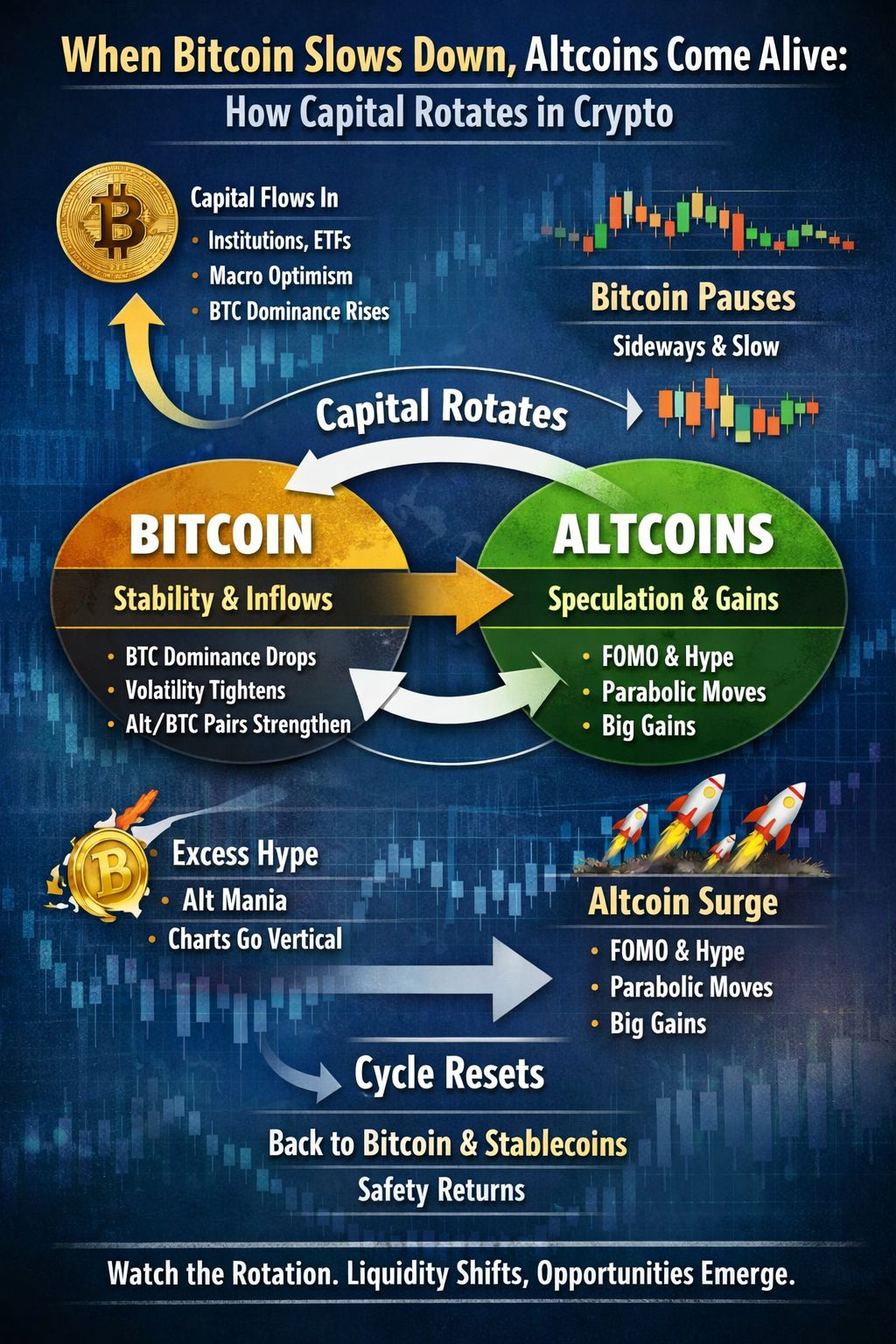
$SOL Crypto markets don’t move in straight lines — they move in cycles of liquidity. Money doesn’t disappear; it rotates. It flows into Bitcoin first, spreads into altcoins, overheats in speculation, then cools off and resets. To many traders it feels random, but in reality it follows a pattern.
The cycle usually begins with Bitcoin.
New capital enters the market through BTC. Institutions, ETFs, positive macro sentiment, and improving risk appetite all push money into the largest and most trusted asset first. Bitcoin dominance rises. Volatility tightens. The move looks controlled and steady.
Bitcoin leads. Altcoins wait.
After a strong rally, Bitcoin often stops accelerating. It doesn’t crash — it simply moves sideways. Momentum slows. Breakouts lose strength. Early buyers take profits. New buyers hesitate.
That pause is important.
When Bitcoin stabilizes instead of exploding upward, traders begin searching for higher returns. And those returns are usually found in altcoins.
Altcoins require far less capital to move. A relatively small inflow can push a mid-cap token up dramatically. When traders see BTC holding steady, they move up the risk curve — from safety to speculation.
Liquidity is the real driver.
Bitcoin needs massive inflows to surge. Altcoins don’t. So when confidence is strong and BTC is no longer absorbing all available capital, money rotates into smaller assets.
This shift often follows narratives — AI, gaming, RWA, Layer 2, infrastructure. Once a few alt leaders start rising, attention spreads quickly. Volume increases. Funding grows. Social media heats up. Momentum builds fast.
But the rotation becomes visible before it becomes obvious:
Bitcoin dominance stops rising or starts declining
BTC volatility compresses
Alt/BTC pairs quietly strengthen
Volume expands beyond BTC pairs
By the time people start posting screenshots of huge gains, the early phase already passed.
Altseason does not start with hype. It starts with Bitcoin boredom.
Importantly, Bitcoin does not need to turn bearish for altcoins to perform well. In healthy market expansions, BTC can move sideways while alts strongly outperform. The stable foundation allows risk appetite to expand.
Eventually, the cycle reverses.
When alt funding becomes extreme, charts go vertical, and late buyers chase parabolic moves — capital rotates back into Bitcoin or stablecoins. Dominance stabilizes. Volatility shifts. The system resets.
Understanding this rotation helps avoid one of crypto’s biggest mistakes: holding the wrong asset at the wrong stage.
Buying alts too early while BTC is still in price discovery can lead to underperformance. Ignoring Bitcoin during late-stage alt mania can be risky.
Rotation is not magic — it’s behavior.
Confidence builds. Risk tolerance increases. Traders move from the most secure and liquid asset toward smaller, more volatile ones.
And often, when Bitcoin becomes quiet — when the market feels slow — that is when the next big move is already forming elsewhere.
Watch dominance.
Watch liquidity.
Watch the pause.
$BNB #CZAMAonBinanceSquare #USTechFundFlows