
Discover how blockchain is moving beyond digital assets to decentralize the very foundations of our modern economy—and why this might be crypto's most consequential evolution yet.
Beyond the Hype: Where Crypto Meets Concrete
Let's be honest. When most people think about cryptocurrency, they picture volatile price charts, NFT monkeys, or complicated DeFi yield farming strategies. But beneath the surface of speculative trading lies something far more transformative—something that could fundamentally change how our physical world operates.
I'm talking about DePIN (Decentralized Physical Infrastructure Networks). This isn't just another crypto buzzword. It's a paradigm shift that's already happening, quietly rewiring everything from how we store data to how we access the internet, power our homes, and move through cities.
If you've ever felt like crypto was all digital noise with no real-world impact, DePIN is about to change your mind. And if you're already deep in the space, understanding this trend could be the key to spotting the next wave of value creation.
What Is DePIN? The "Airbnb of Infrastructure"
At its core, DePIN represents a radical reimagining of how physical infrastructure gets built and maintained. Instead of relying on massive corporations to construct data centers, cell towers, or energy grids, DePIN uses blockchain incentives to coordinate millions of individual contributors.
Think of it like this: Airbnb decentralized hotels. Uber decentralized taxis. DePIN is decentralizing infrastructure itself.
The concept is elegantly simple. Participants contribute physical resources—whether that's unused hard drive space, excess solar energy, GPU computing power, or wireless coverage—and earn cryptocurrency tokens in return. These contributions form decentralized networks that provide real services to real users, creating a self-sustaining economy where value flows directly to contributors rather than corporate middlemen.
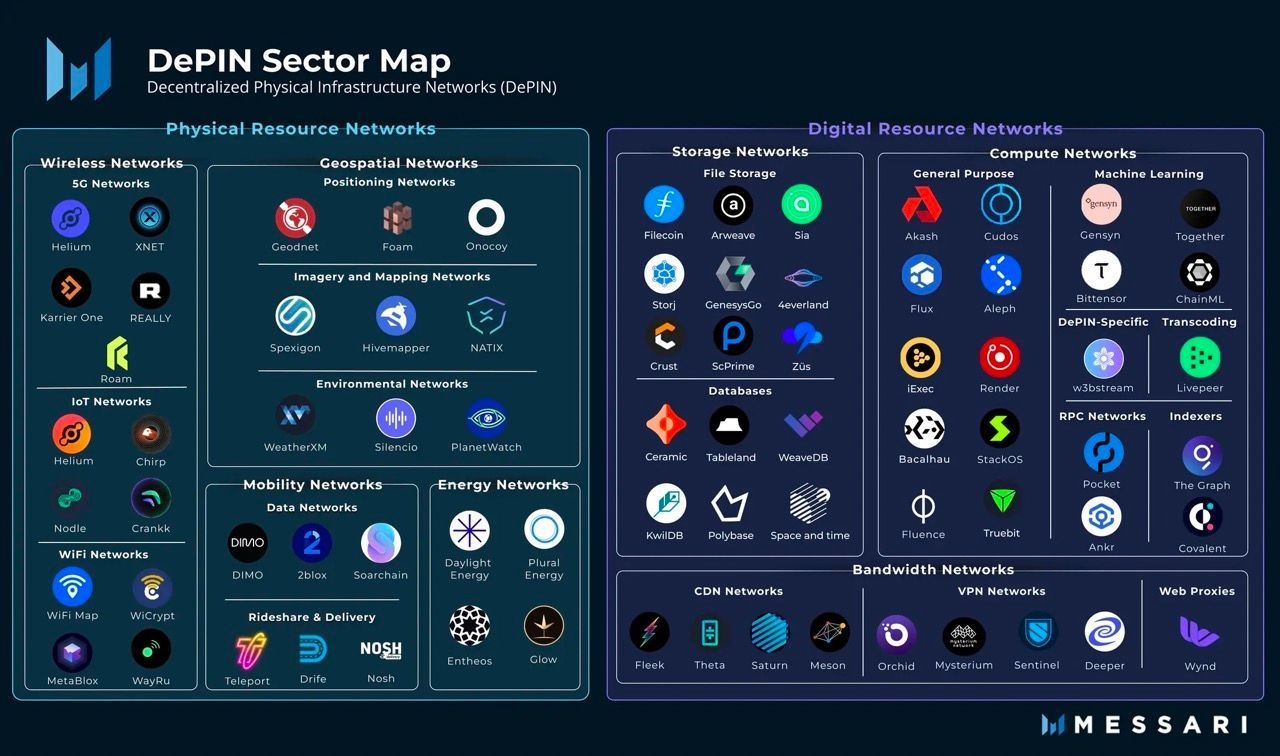
The DePIN ecosystem spans two main categories: Physical Resource Networks (PRNs) and Digital Resource Networks (DRNs). PRNs handle location-dependent infrastructure like wireless coverage and mapping, while DRNs manage location-independent digital resources like storage and computing power.
The Three Pillars of DePIN
1. Storage: Filecoin and the Decentralized Cloud
Remember when cloud storage meant trusting Amazon, Google, or Microsoft with your data? Filecoin flipped that model on its head. Since its mainnet launch in 2020, the network has grown to nearly 3,000 storage providers collectively safeguarding 1.5 exbibytes of data .
But here's what makes this revolutionary: Filecoin isn't just decentralized storage—it's programmable storage. With the Filecoin Virtual Machine (FVM), developers can create smart contracts that automatically manage data based on usage patterns, geographic distribution, and provider reliability. Machine learning algorithms optimize data placement across the global network, making it more efficient than traditional centralized solutions .
For contributors, that spare hard drive space in your home computer isn't just sitting there anymore—it's generating passive income while providing censorship-resistant storage for the world's data.
2. Connectivity: Helium's Wireless Revolution
Helium started with a bold vision in 2013: create a global wireless network built by the people, for the people. Today, that vision has materialized into one of crypto's most tangible success stories.
By hosting a Helium hotspot—a small device about the size of a router—you provide wireless coverage for IoT devices or 5G connectivity and earn HNT tokens. The network has expanded to offer unlimited talk, text, and data phone plans for just $25 per month , undercutting traditional carriers while providing coverage in areas they often ignore.
What's particularly fascinating is Helium's integration of AI. The network uses machine learning to analyze terrain data, coverage patterns, and population density to recommend optimal hotspot placement locations, ensuring efficient network growth .
3. Computing: The GPU Revolution
Perhaps the most timely DePIN application is decentralized computing. Projects like Render Network and io.net are addressing the critical shortage of GPU resources needed for AI training and 3D rendering.
Render connects artists and developers with idle GPU owners, creating a marketplace for high-performance computing that's significantly cheaper than centralized cloud providers. Meanwhile, io.net focuses specifically on AI workloads, allowing data centers and individual users to lease their unused GPU capacity .
In an era where AI compute demand is doubling every few months, these networks aren't just crypto experiments—they're essential infrastructure for the AI revolution.
Why DePIN Matters: The Economics of Decentralization
The DePIN model solves a fundamental problem in infrastructure economics: the cold start problem. Traditional infrastructure requires massive upfront capital investment before generating revenue. Telecom companies spend billions building networks before signing their first customer.
DePIN flips this script through token incentives. Early contributors are rewarded with tokens that may appreciate as the network grows, effectively allowing projects to bootstrap infrastructure without traditional venture capital. This creates a positive feedback loop: more contributors → better service → more users → higher token value → more contributors.
But the implications go deeper. By removing centralized gatekeepers, DePIN networks offer:
- Censorship resistance: No single entity can shut down the network or exclude participants
- Cost efficiency: Without corporate overhead, services are typically 50-90% cheaper than traditional alternatives
- Global accessibility: Anyone with internet can contribute or access services, bypassing geographic restrictions
- Resilience: Distributed networks have no single point of failure
The numbers tell the story. The combined market cap of leading DePIN projects now exceeds $30 billion , with the sector growing rapidly as real-world utility becomes undeniable.
The Technical Backbone: How It Actually Works
If you're wondering how physical resources get coordinated through blockchain without becoming a bureaucratic nightmare, the answer lies in elegant protocol design.
DePIN systems typically operate through four layers :
1. Blockchain Layer: Handles smart contracts, transactions, and token distribution
2. Physical/Digital Infrastructure: The actual resources being contributed (storage, bandwidth, computing)
3. Off-Chain Networks: Manage the actual transfer of resources while blockchain handles verification
4. Token Economics: Create incentive alignment between all participants
The blockchain doesn't handle every packet of data or every byte of storage—that would be inefficient. Instead, it verifies that contributions happened and distributes rewards accordingly. The heavy lifting occurs off-chain, with cryptographic proofs ensuring integrity.
Solana has emerged as a particularly popular platform for DePIN projects due to its high throughput and low transaction costs, hosting 27 active DePIN initiatives . However, Ethereum remains a strong contender, especially for projects prioritizing security and decentralization.
Real-World Impact: Beyond the Theory
DePIN isn't theoretical—it's already changing lives and industries:
Energy Markets: Projects like Power Ledger enable peer-to-peer energy trading, allowing solar panel owners to sell excess electricity directly to neighbors rather than back to the grid at wholesale rates.
Mapping and Geospatial: Hivemapper is building a decentralized Google Maps alternative, rewarding drivers with HONEY tokens for collecting street-level imagery through dashcams. This creates more current, detailed maps while compensating contributors fairly.
Internet Infrastructure: DAWN is developing decentralized internet backbone using "Black Box" nodes, allowing communities to maintain their own internet access points and potentially bypass traditional ISPs entirely .
These aren't just crypto projects—they're alternatives to some of the most centralized, monopolistic industries in the world.
The Road Ahead: Challenges and Opportunities
Like any emerging technology, DePIN faces hurdles. Physical security of hardware, regulatory compliance across jurisdictions, and maintaining network quality are ongoing challenges. The sector must also prove it can scale beyond early adopters to mainstream users.
However, the trajectory is clear. As AI drives demand for compute, as privacy concerns push users away from centralized cloud providers, and as the inefficiencies of traditional infrastructure become more apparent, DePIN offers a compelling alternative.
For those looking to enter the space, the opportunities are multifaceted:
As a Contributor: Start small. Run a Filecoin storage node, host a Helium hotspot, or contribute idle computing power. The barriers to entry are surprisingly low, and you'll gain firsthand experience while earning tokens.
As a Developer: Build applications that leverage decentralized infrastructure. The composability of DePIN protocols means you can mix and match storage, compute, and connectivity services without relying on AWS or Google Cloud.
As an Investor: Look beyond token price to actual network usage. The most sustainable DePIN projects are those with growing active users and real revenue from service provision, not just speculation.
The Bottom Line: Infrastructure Democracy
We're witnessing the early stages of what might be blockchain's most important application—not as a replacement for money, but as a coordination mechanism for physical resources. DePIN represents a shift from corporate infrastructure to community infrastructure, from rent-seeking middlemen to direct value exchange.
This matters because infrastructure shapes society. Who controls the servers, the networks, and the power grids has enormous influence over what information flows, who can participate in the digital economy, and how resources are distributed.
DePIN offers a credible path toward infrastructure that is owned by the people who use it and maintain it. In a world increasingly concerned about corporate concentration and technological sovereignty, that's not just a crypto narrative—it's a necessary evolution.
The question isn't whether decentralized infrastructure will become mainstream. It's whether you'll be a passive observer or an active participant in building it.
The future of infrastructure isn't being built in corporate boardrooms—it's being constructed by individuals around the world, one node at a time. And that might be exactly what we need.

