
Last week I used Claude to help me write a competitive analysis report. It did a good job. But after finishing, it couldn't go find a designer to format it, couldn't send the report to the client by itself, and couldn't automatically modify the third version based on client feedback. It can only sit in the dialogue box waiting for my next instruction.
This is the current bottleneck of AI: it has a brain but no hands or feet. It can think but cannot act.
The direction the industry is taking to solve this problem is called AI Agent—an AI agent that autonomously executes tasks. It's not a chatbot where you feed instructions one by one; you give it a goal, and it breaks down the steps, calls tools, completes the work, and handles payments. OpenAI is working on it, Google is working on it, and the whole Silicon Valley is betting on this.
But there's a question that is rarely raised: what happens to the money part when these AI agents execute tasks?
An AI agent books a hotel for you, purchases API computing power, pays designer fees, processes refunds—these are all real monetary transactions. You can’t have it swipe your credit card, nor can you manually approve every transaction. It needs a settlement system that can autonomously execute payments, with predictable costs and verifiable records for each transaction.
What does this system look like? @Vanarchain gives an answer.
Let’s first talk about the most basic layer. An AI agent may need to execute hundreds or thousands of microtransactions in a day—calling a data interface, paying a storage fee, completing a cross-service settlement. If the gas fee for each transaction fluctuates with the market, the AI agent simply cannot manage budgeting. Vanar’s gas fee is fixed at about $0.0005 per transaction, without bidding or fluctuation. This is 'cheap' for human users, and for AI agents, it's a 'programmable economic environment'—it can accurately calculate the total cost of ten thousand operations without suddenly spending ten times more due to network congestion.
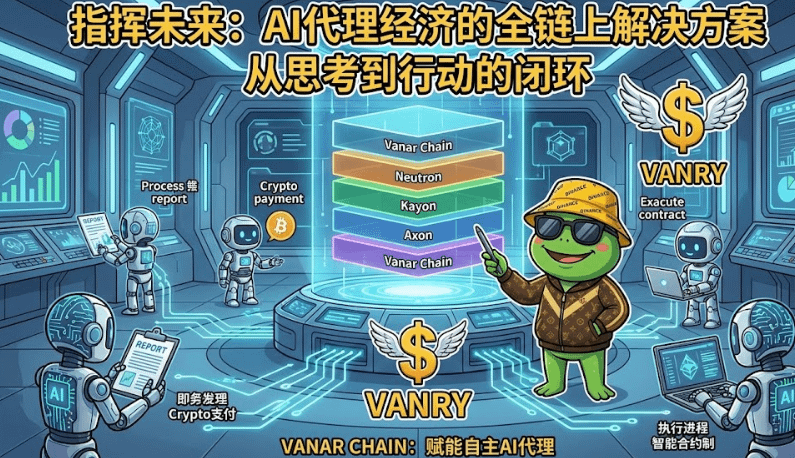
Let’s talk about the data layer. AI agents need to read information to make decisions. However, most of the data stored on-chain are just transaction records and hash pointers; the real data—contracts, reports, vouchers—are all off-chain. For AI agents to read these things, they have to jump off-chain, request external APIs, wait for responses, and handle format incompatibilities—every additional external dependency creates another point of failure. Vanar’s Neutron compresses files into on-chain Seeds, and the Kayon reasoning engine can directly understand the content of the Seed on-chain and respond to queries. AI agents can obtain all the information needed for decision-making without leaving the chain. Where the data is, the decision-making is.
Then there's the execution layer. #vanar The Axon currently under development is positioned as 'agent-ready smart contracts'—a smart contract system designed for AI agents. Traditional smart contracts are static: if condition A is met, execute action B. What Axon aims to do is allow contracts to dynamically adjust based on context—AI agents can decide to execute, pause, or modify a transaction based on the reasoning results returned by Kayon. Smart contracts evolve from a mechanical executor to an operator that can 'take suggestions'.
At the top is Flows—the workflow orchestration tool for on-chain AI agents. It strings multiple steps into an automated assembly line: receive task → query data (Neutron Seed) → analyze judgment (Kayon) → execute action (Axon contract) → record results → trigger the next step. The entire process requires no human intervention, and every step leaves a trace on-chain.
Look at these five layers stacked together:
Vanar Chain (underlying settlement) → Neutron (data compression and on-chain storage) → Kayon (on-chain reasoning) → Axon (smart contract automation) → Flows (agent workflow orchestration)
This is not five independent products, but an execution pipeline specifically designed for AI agents. From 'reading information' to 'understanding information' to 'making judgments' to 'executing actions' to 'orchestrating processes', everything is completed on-chain.
This also explains why Worldpay is partnering with Vanar to promote 'agentic payments' at the Abu Dhabi Financial Week—because Vanar's architecture is inherently suitable for the payment scenarios of AI agents. It's not about adding an AI plugin to a generic chain after the fact, but designing from day one with the assumption that 'AI agents will work here'.
'AI agent economy' itself is still in its early stages. Today, the number of AI agents that can autonomously execute tasks and handle payments on-chain could be counted on two hands. Vanar is building infrastructure for a large-scale market that does not yet exist, which is both a first-mover advantage and a gamble—if the bet is right, it’s a pioneer; if wrong, it’s a martyr.
But let me return to that initial scene. After I finished writing the report with AI, I needed to manually copy, manually format, manually send, and manually follow up. In the entire chain, AI was only responsible for 'thinking', with everything else relying on my fingers.
If one day, AI agents can complete the entire loop from thought to action themselves—and every step is traceable, auditable, and budgetable on-chain—
That chain needs to look something like what Vanar is building.
This future may be very near or very far. But things like infrastructure are always built before the demand arrives to hold value. Building it afterwards is just chasing.
