
Last month, gold hit a new cycle high, approaching $5,600, and it’s still up an impressive +427% since the 2016–2026 run began.
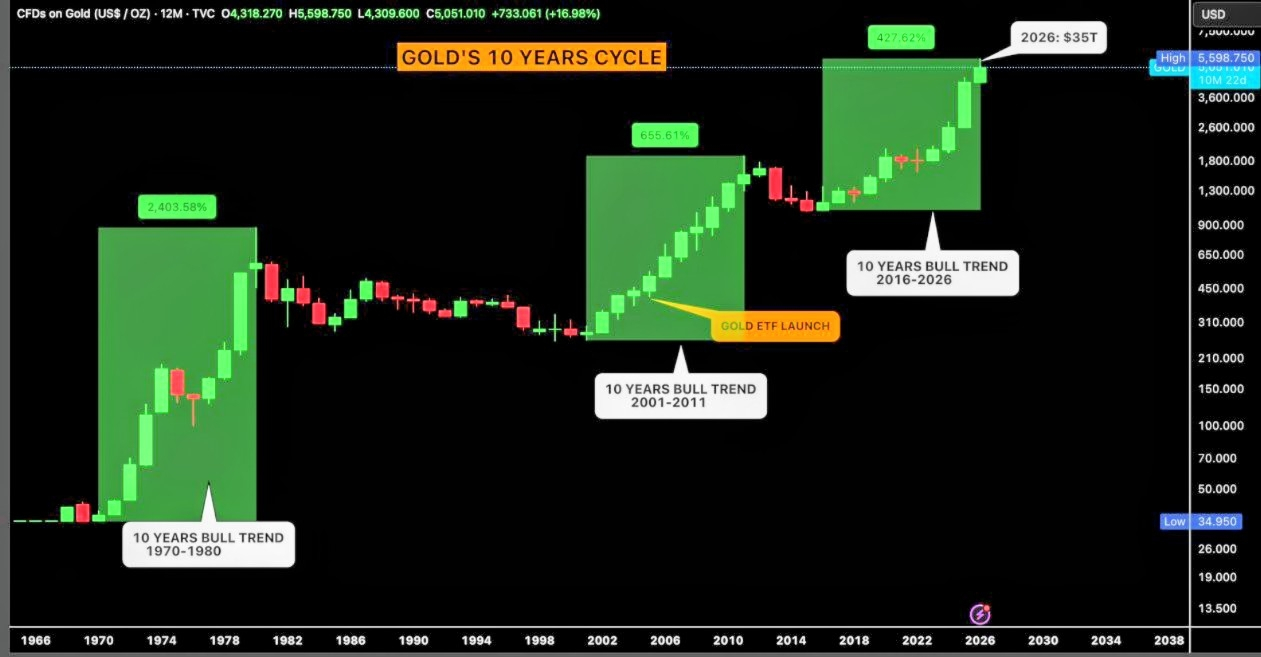
But let’s take a step back and really understand what this chart is telling us:
Gold $XAU Moves in Decade-Long Cycles
Looking at history, gold has followed a pattern of decade-long super runs:
1970–1980: +2,403%
2001–2011: +655%
2016–2026: +427% (so far)
The takeaway? Gold doesn’t just trend upwards indefinitely. It tends to surge for 9-10 years, then take a breather for years, or even decades.
So, What Typically Marks the End of a Gold $XAU Super Run?
Several factors usually come into play, including:
Inflation cooling off
Real interest rates rising
The Fed tightening policy for longer periods
The dollar stabilizing
A return of risk appetite in markets
This is why gold peaks often coincide with significant shifts in policy.
For instance:
• When gold hit its peak in 1980, it wasn’t the end of markets. It marked the beginning of a long rotation gold cooled off, while stocks entered a bull market that lasted for over 20 years.
• Similarly, when gold topped again in 2011, we saw it go sideways or decline for years, while equities enjoyed a strong bull run through the 2010s and beyond.
The Pattern: Gold Peaks, Then Capital Rotates into Growth Assets
Historically, the sequence looks like this:
Gold’s super run ends.
Capital shifts back into growth assets.
Equities get a long runway.
Right now, gold is pushing towards new highs ($5,600), following a strong multi-year climb. This doesn’t automatically signal a top, but it does tell us something crucial: we’re not in the early stages of this move anymore.
What’s Different This Time?
Here’s the key twist:
In 1980, there was no crypto. In 2011, Bitcoin was still in its infancy, barely on the radar. But by 2026, the crypto market is a whole new beast. With institutional involvement, ETFs, large platforms, and even public companies holding $BTC , the investor base is far larger than any previous cycle.
If the usual gold-to-stocks rotation happens again, it might not just be:
Gold → Stocks.
This time, it could look like:
Gold → Stocks + Bitcoin + High-Beta Crypto.
Because crypto is now firmly in the risk-on category.
Wrapping It Up
#GOLD has historically followed 10-year super trends, and when those cycles mature, stocks often have a long run ahead. This current cycle is in its late-stage phase, and crypto could very well absorb part of the capital that traditionally rotated into equities.
It’s a new market environment, and how capital moves in the next few years might look quite different than what we've seen in past cycles.
