
@Plasma is designed to make stablecoin payments feel effortless—like sending a text. No extra steps. No need to buy a native token first. No confusing friction that pushes everyday users away. Stablecoins are placed front and center, while everything else runs quietly in the background.
That’s why $XPL can seem confusing at first.
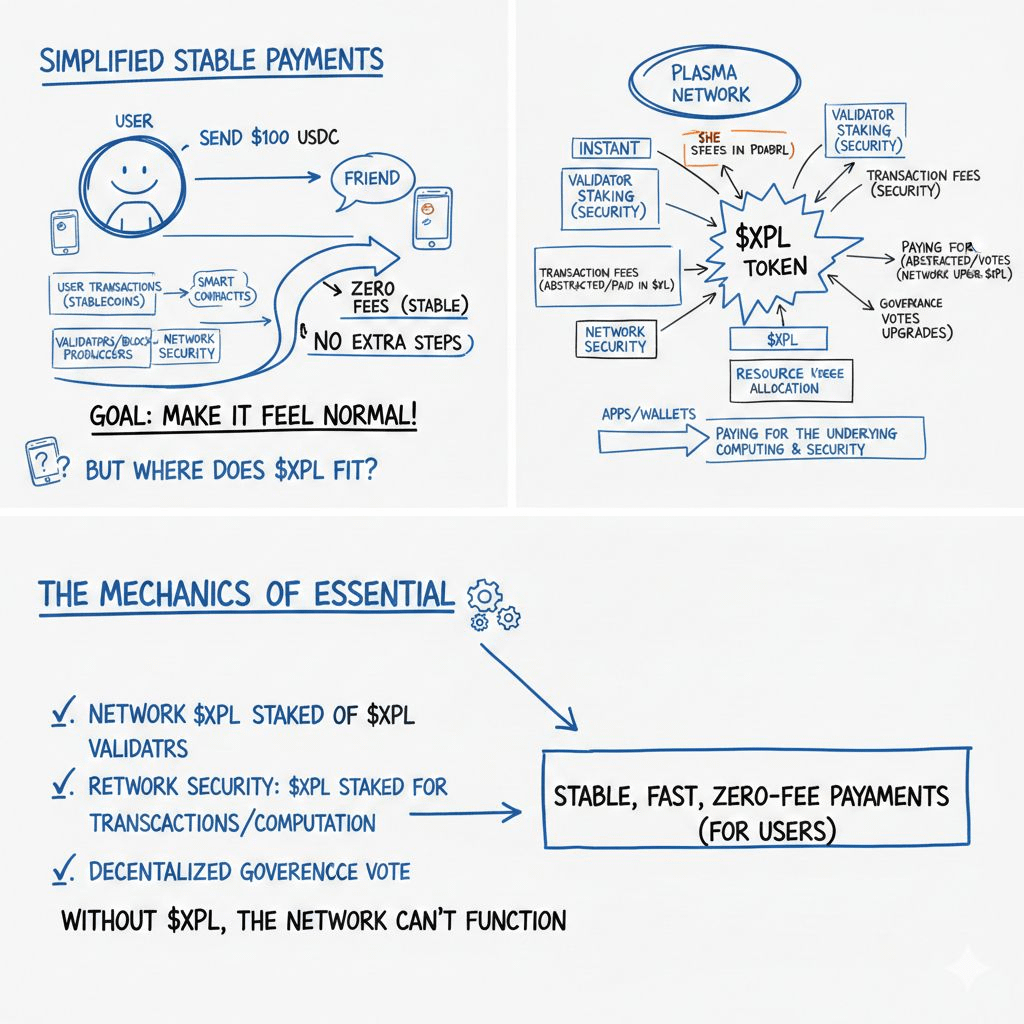
If users can send stablecoins with zero visible fees, and apps can abstract gas so people pay in stablecoins instead of a native token, where does XPL fit What’s its real purpose beyond marketing?
Here’s the straightforward answer: a Layer 1 blockchain can hide its token from the user experience, but it can’t eliminate the need for a native asset internally. The network still requires something to secure it, incentivize participants, and determine who produces blocks. That role belongs to $XPL.
First, staking. Plasma runs on Proof of Stake, meaning validators are responsible for producing blocks, finalizing transactions, and maintaining network integrity. To do that, they must commit capital by staking $XPL. Anyone who wants to become a validator needs to acquire it. Those who want to remain competitive typically need substantial stake. If delegation becomes widespread, validators will also need strong stake positions to attract delegators. This creates baseline demand simply because the chain exists.
Second, gas abstraction doesn’t mean the network operates for free. Even if users don’t directly see fees, validators still need compensation, blocks still need production, and spam protection still requires economic boundaries. The costs are simply routed differently. Plasma removes the “native token tax” from the user interface, but the underlying economic engine still depends on a native asset to price security and distribute rewards.
Then there’s fee burn. Inspired by models like EIP-1559, Plasma can burn base fees. The significance isn’t the concept of burning itself—it’s that real network activity can translate into long-term supply reduction. However, burn only becomes meaningful when paid activity scales. Sponsored stablecoin transfers may help onboarding, but they aren’t the main sink. The real impact comes when the chain supports contracts, app interactions, settlements, and more complex on-chain activity. As usage expands beyond simple transfers, burn can grow alongside it.
On the other side, staking rewards introduce new supply through inflation. Every Proof-of-Stake chain must pay for security, and staking rewards are part of that cost. That new issuance needs counterbalances. Two major ones are staking participation (which locks up supply) and fee burn (which reduces supply). When both strengthen, the system’s economic balance improves.
So what actually creates buy pressure for $XPL? A few clear drivers:
Validators entering or expanding operations—they must acquire XPL to stake.
Delegation opportunities attracting participants who buy xpl for yield.
Growth beyond sponsored transfers—more paid activity increases validator revenue and potential burn.
Ecosystem expansion that generates sustained, real usage rather than short-term incentives.
Ultimately, Plasma’s model prioritizes onboarding through stablecoins while relying on its native token to secure and coordinate the system underneath.xpl isn’t required for someone to send dollars—it exists because a Layer 1 needs a native security asset, validator incentives, and a mechanism to tie network activity to long-term economics.
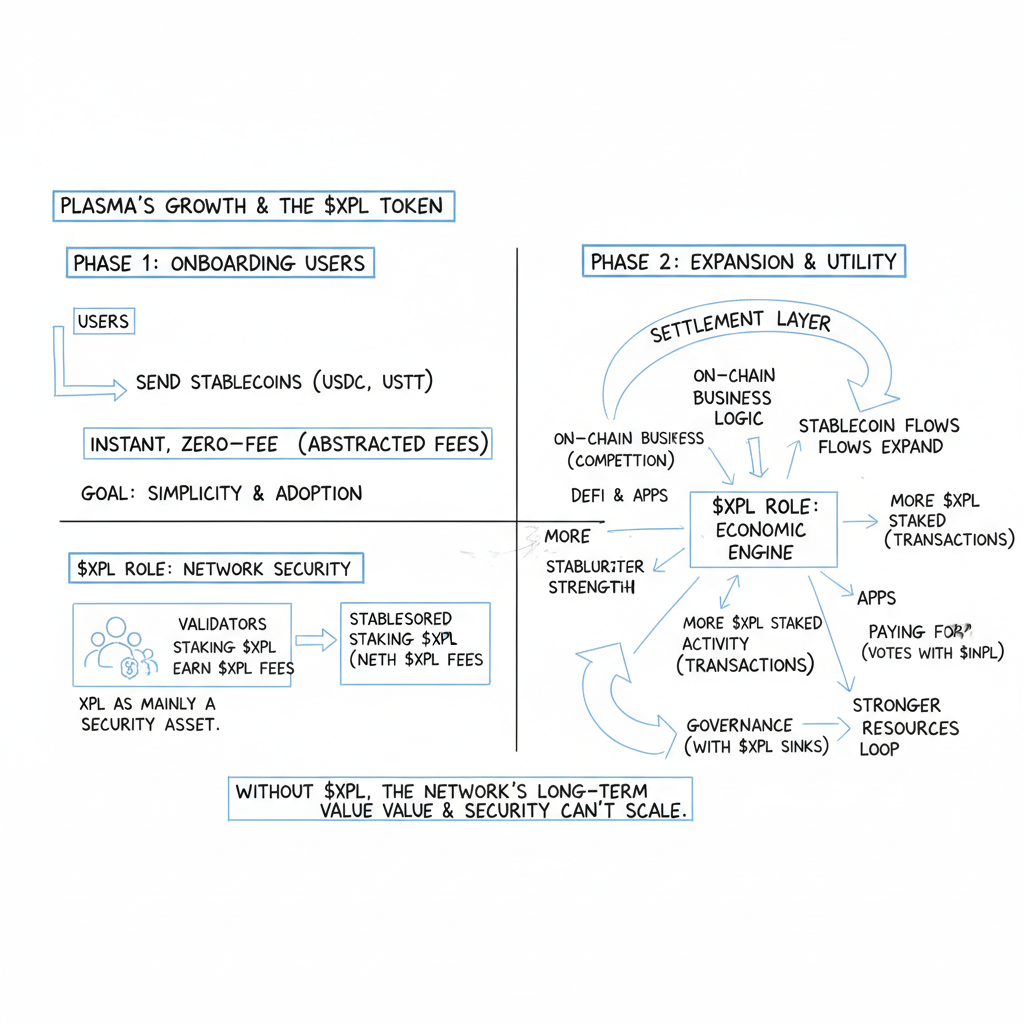
If Plasma remains primarily a chain for sponsored transfers, $XPL functions mainly as validator collateral. But if it evolves into a broader settlement layer with applications and sustained on-chain logic, the economic loop tightens: more validators compete, more stake is locked, more paid activity occurs, and sinks like burn gain weight.
That’s the real demand engine—not hype, but the mechanics that determine whether $XPL is simply the backbone of a chain, or the backbone of a network people genuinely use every day #plasma

