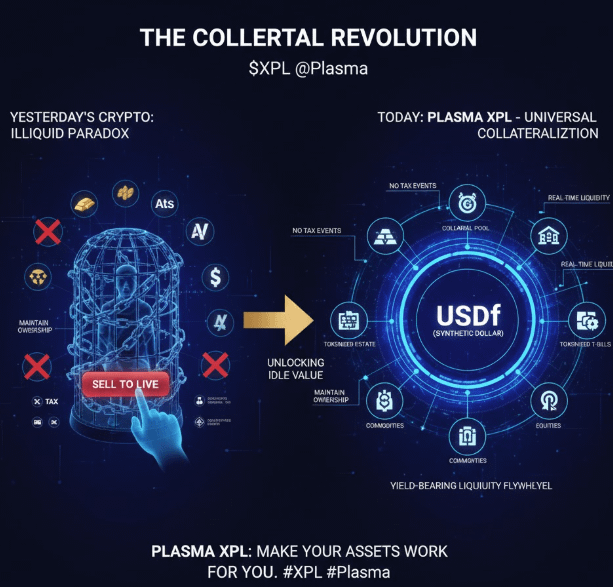
There is a peculiar irony baked into the foundation of decentralized finance. The system was built to liberate capital, to strip away the intermediaries, the gatekeepers, the institutions that told you what you could and couldn't do with your own wealth. And yet, for years, the most persistent problem in DeFi hasn't been regulation, hacks, or volatility. It's been a far more fundamental one: you cannot use your wealth without spending it.
Think about what that means in practice. A long-term holder of a high-conviction digital asset, someone who has watched their portfolio appreciate through cycles of euphoria and despair, still faces an impossible binary every time they need liquidity. Either they hold and watch opportunity pass them by, or they sell, triggering tax events, resetting their cost basis, and severing themselves from the very position they spent years building conviction around. The choice has always been: your assets or your liquidity. Pick one.
This is the problem Plasma XPL was built to end.
Plasma XPL is positioning itself as the first universal collateralization infrastructure: not a lending protocol, not a stablecoin issuer, not a yield aggregator, but something that sits upstream of all of those things. The distinction matters enormously. Most protocols in the collateralized debt space were designed with a narrow thesis: you deposit ETH, you borrow DAI, you go about your day. The architecture was clean but brittle. It assumed a world where collateral meant a small, curated basket of blue-chip on-chain assets, and where the only thing worth borrowing was a stablecoin pegged to the dollar through over-engineered mechanism design.
The world has moved on. The asset landscape in 2025 looks nothing like it did in 2020. There are tokenized US Treasury bills generating real yield. There are tokenized money market funds, tokenized real estate, tokenized private credit. The boundary between what is "on-chain" and what is "real world" is dissolving faster than most infrastructure has been able to keep pace with. And so the old collateral frameworks, designed for a world of ten assets and one use case, are creaking under the weight of a far more complex reality.
Plasma XPL's answer to this is architectural rather than incremental. The protocol accepts a broad spectrum of liquid assets as collateral, spanning conventional digital tokens and tokenized real-world assets alike. Against these deposits, it issues USDf, an overcollateralized synthetic dollar designed to give holders stable, accessible on-chain liquidity without forcing them to liquidate anything they own.
The word "overcollateralized" is doing significant work there, and it's worth slowing down to understand why. The history of synthetic dollars in DeFi is littered with the wreckage of undercollateralized ambition. Terra's UST collapse in 2022 didn't just erase $40 billion in value; it fundamentally reset the industry's trust in algorithmic stablecoins and anything that gestured toward unbacked monetary expansion. What followed was a period of almost reflexive conservatism, where the market rewarded transparency, reserves, and proof of backing above all else. USDf isn't trying to fight that instinct. It's leaning into it.
By maintaining overcollateralization, meaning the value backing each unit of USDf always exceeds its face value, the protocol builds in a structural cushion against the volatility that tends to make synthetic dollar projects unravel. The collateral is real, the peg is defended by economic substance rather than game-theoretic faith, and the user retains ownership of their underlying position throughout. This is not a new invention in isolation. MakerDAO pioneered this model with DAI. But where Plasma XPL departs from that template is in the breadth of what it considers acceptable collateral, and the infrastructure it's building to onboard assets that have historically been locked out of this kind of utility.
Consider what it means for a tokenized Treasury bill holder to be able to post that position as collateral and receive USDf in return. The Treasury bill continues to accrue yield. The holder doesn't give up their exposure. They simply unlock liquidity against an asset that has, until now, been almost entirely illiquid in the DeFi sense: you could hold it, but you couldn't really use it as productive infrastructure. Plasma XPL changes that equation. The asset becomes a lever, not just a store of value.
This is the broader thesis that underpins everything the protocol is building: every liquid asset, regardless of whether it originated on-chain or was tokenized from the real world, should be able to participate in the liquidity layer of decentralized finance. The infrastructure to make that possible doesn't yet exist at scale. Plasma XPL is trying to build it.
The implications extend well beyond individual users unlocking liquidity against their holdings. At the protocol level, a universal collateralization layer creates what might be called a yield-bearing liquidity flywheel. When diverse assets, each with their own yield profile, risk characteristics, and origination context, can all be deposited as collateral for a single synthetic dollar, the aggregate collateral pool becomes extraordinarily resilient to idiosyncratic shocks. A downturn in one asset class doesn't destabilize the whole system in the way it might if collateral were concentrated in a single token. The diversification is structural, not just advisory.
This also positions USDf as something more interesting than just another stablecoin. In a world where the collateral backing it includes real yield-generating assets like T-bills, money market instruments, and tokenized credit products, the USDf ecosystem can participate in yield distribution in ways that a purely fiat-backed stablecoin simply cannot. The infrastructure Plasma XPL is building isn't just about synthetic dollars. It's about creating a new class of productive, yield-adjacent stable liquidity that the market has never really had access to before.
There's a longer story being written here, and Plasma XPL understands that it's a character in a much larger narrative arc. The tokenization of real-world assets has been called the next great frontier in crypto for three or four consecutive years, but the infrastructure to actually make those tokenized assets useful, not just holdable but deployable, has lagged badly behind the ambition. You can tokenize a building, but if that token sits inert in a wallet generating nothing and unlocking nothing, the tokenization hasn't actually changed much. The utility has to extend beyond the token itself into the broader capital stack.
This is where universal collateralization becomes genuinely transformative. It's the connective tissue between the tokenized world and the DeFi world, the layer that lets real-world value flow into decentralized liquidity without being forced to abandon its fundamental nature. A tokenized building doesn't stop being a building when you borrow against it. A Treasury bill doesn't stop accruing yield when it's posted as collateral. Plasma XPL's architecture is designed to honor that continuity.
The protocol's approach to liquidity creation also reflects a more sophisticated understanding of how DeFi's relationship with the real economy is maturing. The earliest iteration of decentralized finance was almost deliberately insular, a closed loop of crypto assets playing elaborate yield games with each other, largely disconnected from the broader financial system. That model generated enormous excitement and equally enormous fragility. The next iteration, the one that protocols like Plasma XPL are helping to define, is about building bridges that are genuinely load-bearing. Infrastructure that can carry real economic weight because it's backed by real economic substance.
None of this happens easily, and it would be naive to pretend otherwise. Universal collateralization at scale requires solving hard problems in risk management, oracle design, liquidation mechanics, and legal compliance around tokenized real-world assets. The protocol needs to be able to price heterogeneous collateral accurately in real time, manage liquidations across asset classes with wildly different liquidity profiles, and navigate a regulatory environment that is still working out what tokenized real-world assets even are. These are not trivial engineering challenges. They are the reason this kind of infrastructure hasn't existed before.
What gives Plasma XPL's thesis its coherence is that it's addressing these challenges from a structural starting point rather than as bolted-on afterthoughts. The protocol isn't trying to retrofit a single-asset collateral engine to handle complexity it was never designed for. It's building for that complexity from the ground up, with collateral diversity as a first-class design parameter rather than a future roadmap item.
The on-chain economy is growing up. Assets are becoming more varied, more sophisticated, more connected to real-world value streams. The liquidity infrastructure underneath them needs to evolve at the same pace, and right now, the gap between what assets exist on-chain and what infrastructure exists to deploy them productively is one of the most significant constraints on where DeFi goes next.
Plasma XPL is making a direct bet on that gap. It's building the collateral layer that the next generation of on-chain finance will need, one where the question is no longer "do I sell or do I hold?" but "how do I make my assets work while I wait?"
That might sound like a small shift in framing. It isn't. It's the entire game.