


Plasma is trying to make stablecoin payments feel normal. Like sending money should be as simple as sending a text—no extra steps, no “go buy the native token first,” no friction that scares regular users away. That’s the whole point of the chain design: stablecoins sit in the front seat, and everything else works quietly in the background.
And that’s exactly why $XPL confuses people at first.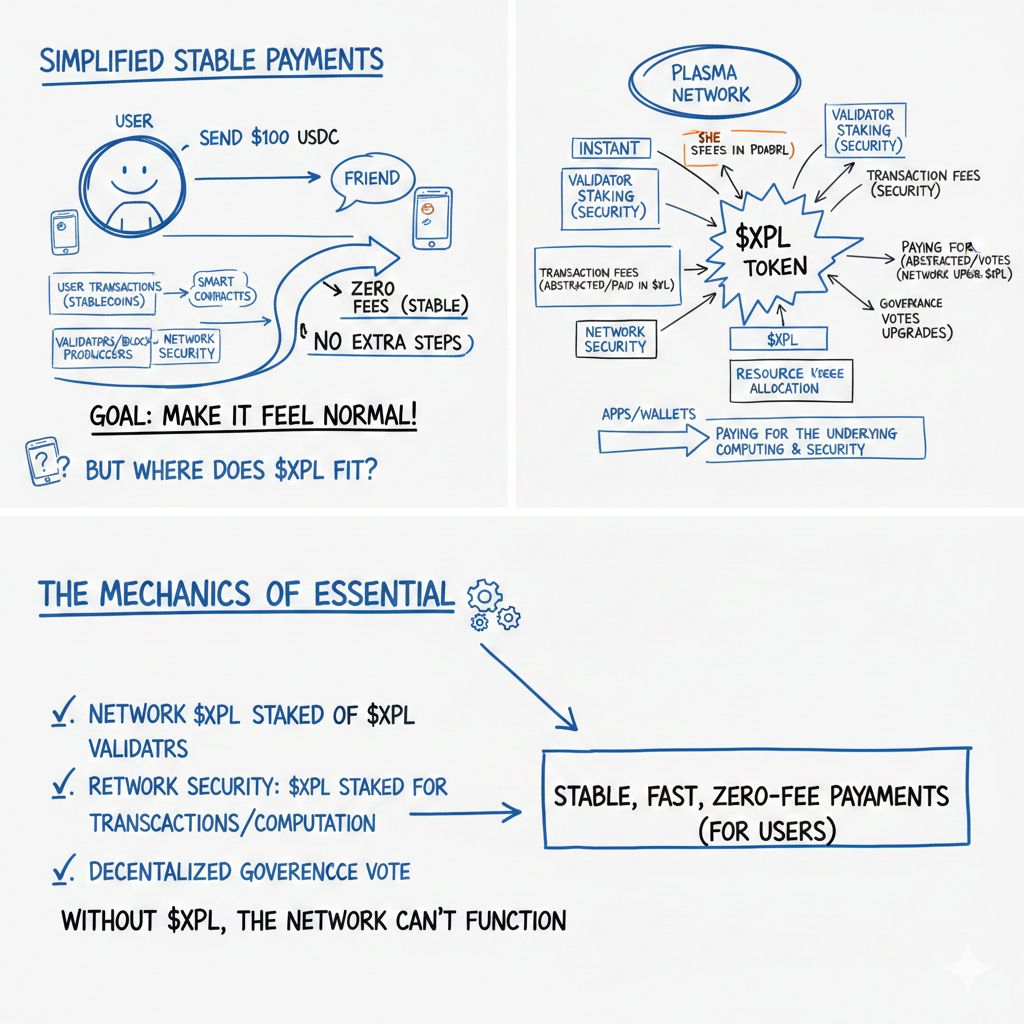
If someone can send stablecoins with zero fees in certain cases, and apps can even abstract gas so the user pays in stablecoins, then where does XPL fit? What’s the real reason it exists? Not the marketing reason—the real mechanical reason.
Here’s the clean answer: a Layer 1 can hide the token from the user experience, but it can’t remove the need for a native asset inside the system. The network still needs something to anchor security, incentives, and the rules of who gets to produce blocks. That anchor is $XPL.
The most direct utility is staking. Plasma is Proof of Stake, which means validators are the ones keeping the chain alive—producing blocks, finalizing transactions, and making sure the system doesn’t fall apart. To do that, they need to commit value to the network. They do it by staking $XPL. If someone wants to become a validator, they have to acquire $XPL. If they want to stay competitive, they usually need enough stake to be taken seriously. If delegation becomes active at scale, validators also need stake to attract delegators and keep their operation strong. That’s not a “nice to have.” That’s the baseline demand that exists simply because the chain exists.
Now the second part is where Plasma’s design gets clever, and where people misunderstand what’s happening. When Plasma says stablecoin transfers can be “gasless” or sponsored, it doesn’t mean the chain is running for free. It means the user doesn’t feel the cost directly. Blocks still have to be produced. Validators still need to be rewarded. Spam still needs a cost boundary. The protocol still needs a way to turn activity into incentives so the network keeps running safely.
So even when the user isn’t buying XPL to move stablecoins, the system still routes economics through the base layer. Think of it like this: Plasma is removing the “native token tax” from the user experience, but the chain still has an internal economic engine. That engine needs a native asset to price security and coordinate who gets paid for keeping the network honest.
Then you get to the part that actually behaves like a sink: fee burn. Plasma’s model references the EIP-1559 idea where base fees can be burned. The reason this matters isn’t because “burn” sounds cool. It matters because it’s one of the few mechanisms that can convert real network usage into supply reduction over time.
But here’s the detail that keeps it honest: burn only becomes meaningful when there’s meaningful paid activity. Sponsored stablecoin transfers are great for onboarding, but they’re not the core sink. The sink grows when the chain starts doing more than simple transfers—contracts, app interactions, settlement logic, account flows, all the things that show up when real usage expands beyond “send money.” That’s when fee burn can scale, and that’s when the token’s economic loop starts to feel tighter.
On the other side of the loop is inflation-based staking rewards. Every PoS chain pays for security somehow, and staking rewards are part of that cost. Those rewards create new supply that the market has to absorb. So the chain needs counterweights. Two big counterweights are staking participation (locking supply) and fee burn (reducing supply). The healthier those become, the cleaner the balance looks over time.
So when you ask, “What actually creates buy-pressure for $XPL?” it really comes down to a few triggers that are simple and measurable:
1. Validators joining or scaling up: they need to buy XPL to stake.
2. Delegation becoming attractive: people buy XPL to stake through validators for yield (when that’s active and accessible).
3. Activity moving beyond sponsored transfers: more paid actions mean more base fees and potentially more burn, and also better validator economics.
4. Ecosystem growth turning into sticky usage: incentives alone don’t equal demand, but if they create real flows that keep running, they feed the staking + fee loop.
And that’s the reality of Plasma’s token design: it’s built to onboard users with stablecoins first, then let the chain’s internal economics matter more as usage expands. The token isn’t there so someone can send dollars. The token is there because a Layer 1 needs a native security asset, a validator incentive system, and a way to align network activity with long-term economics.
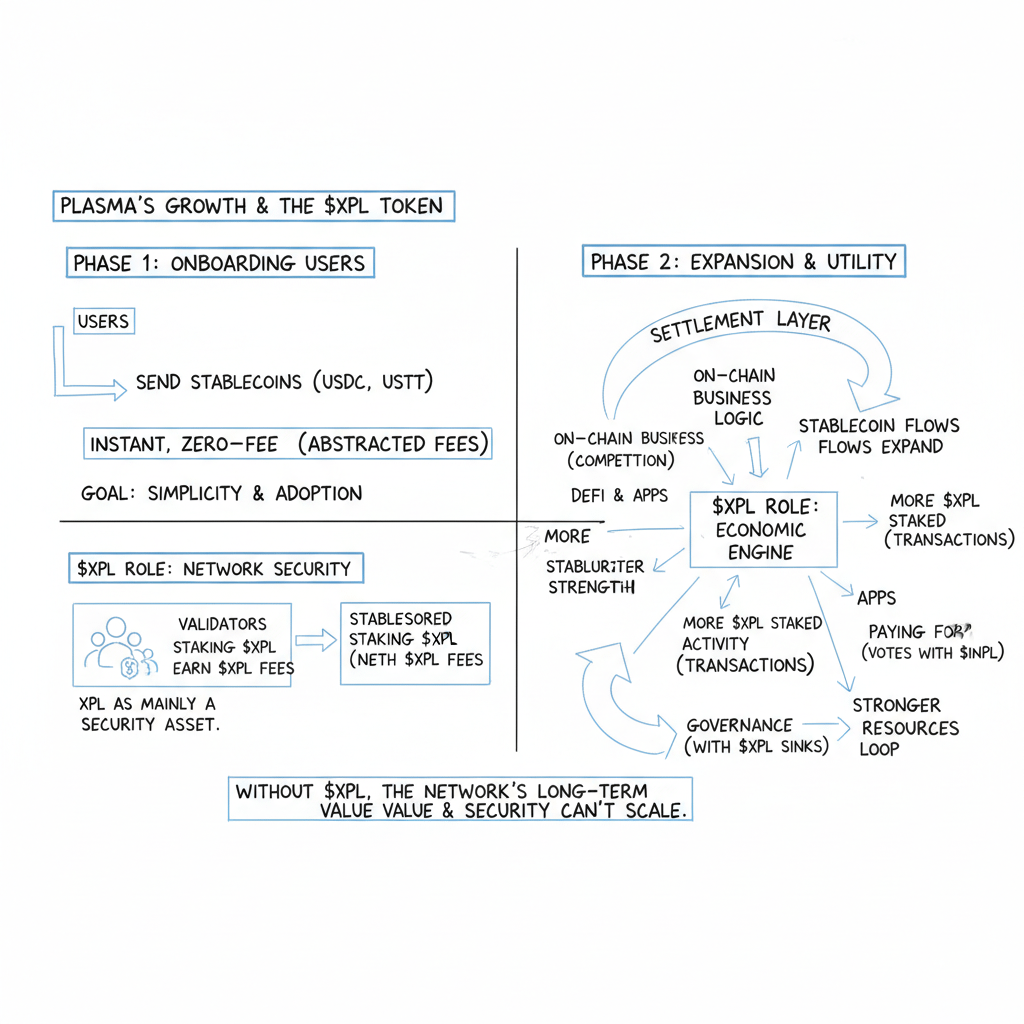
If Plasma stays mostly “sponsored transfers and nothing else,” then XPL behaves mainly like a security token for validators. But if Plasma grows into a settlement layer where stablecoin flows naturally expand into apps and on-chain business logic, then the loop gets stronger—more validators compete, more stake gets committed, more paid activity appears, and the sinks have more weight.
That’s the demand engine. Not hype. Just the mechanics that decide whether $XPL is simply the chain’s security spine, or the security spine of a network people actually use every day.

