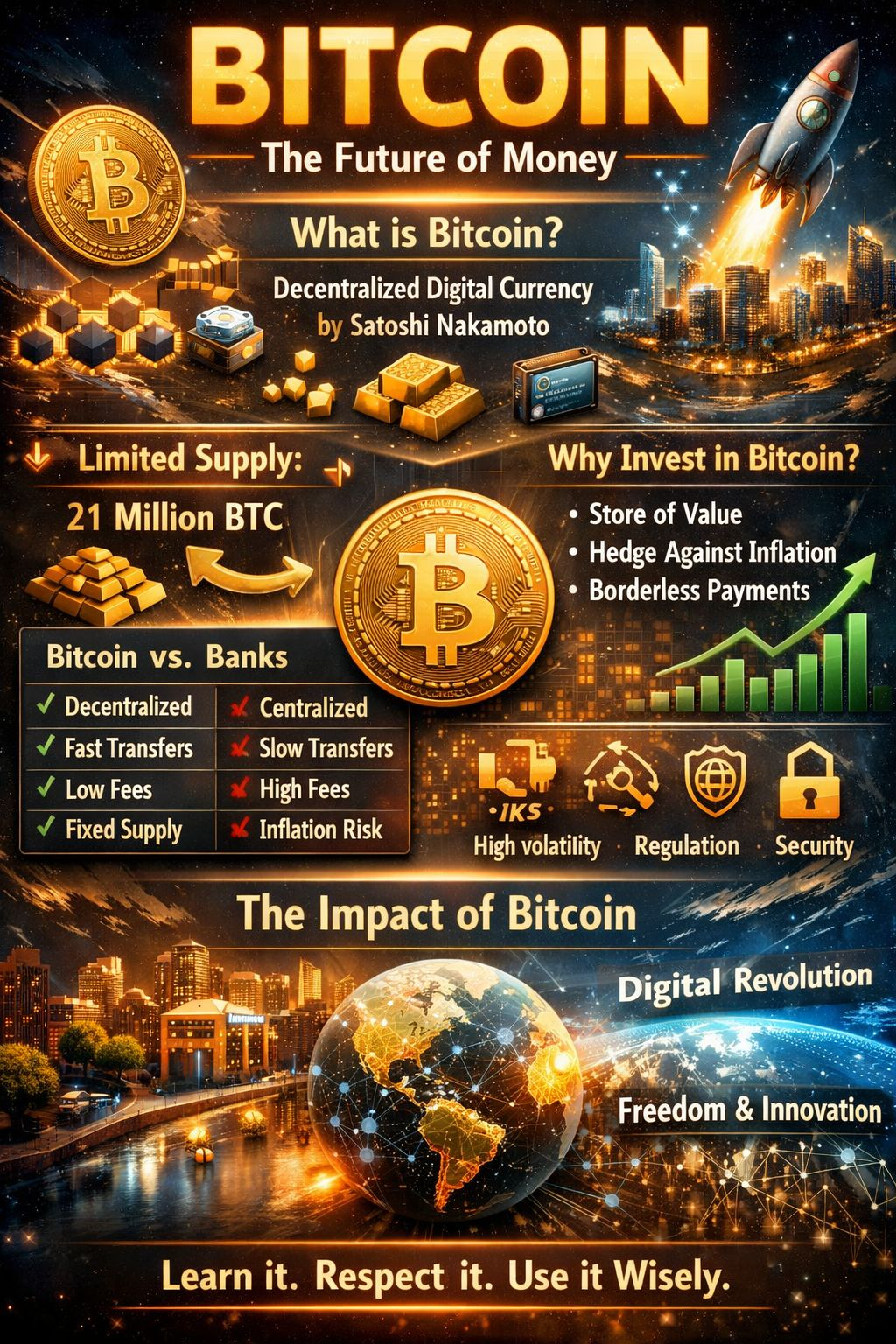
Bitcoin is not just a cryptocurrency — it’s a movement that changed how the world thinks about money. Since its creation in 2009, Bitcoin has grown from an idea shared on an online forum into a global financial asset worth trillions at its peak. Some people call it digital gold, others see it as the future of money. Either way, Bitcoin has already made history.
What Is Bitcoin?
Bitcoin is a decentralized digital currency that allows people to send money directly to each other without banks, governments, or middlemen. It was created by an anonymous person or group known as Satoshi Nakamoto.
Unlike traditional money:
Bitcoin is not printed
It is not controlled by any central authority
It runs on a technology called blockchain
This makes Bitcoin transparent, secure, and resistant to manipulation.
How Bitcoin Works
Bitcoin operates on a peer-to-peer network. Every transaction is recorded on the blockchain, which is a public digital ledger shared across thousands of computers worldwide.
Key Components:
Blockchain: A chain of blocks containing transaction data
Miners: Computers that verify transactions and secure the network
Proof of Work: A system that requires computational effort to add new blocks
Wallets: Used to store, send, and receive Bitcoin
Once a transaction is confirmed, it cannot be changed or reversed, making Bitcoin highly secure.
Limited Supply: Why Bitcoin Is Valuable
One of Bitcoin’s strongest features is its fixed supply.
Maximum supply: 21 million BTC
No more Bitcoin can ever be created beyond this limit
New Bitcoin is released through mining, and the reward halves every 4 years (called Bitcoin Halving)
This scarcity is why many investors compare Bitcoin to gold. As demand increases and supply stays limited, value tends to rise over time.
Bitcoin vs Traditional Banking
Bitcoin challenges the traditional financial system in many ways:
Traditional Banking
Bitcoin
Controlled by banks
Decentralized
Slow transfers
Fast global transfers
High fees
Low fees
Can be frozen
Censorship-resistant
Inflation risk
Fixed supply
With Bitcoin, you are your own bank.
Why People Invest in Bitcoin
People invest in Bitcoin for different reasons:
Store of value (digital gold)
Hedge against inflation
Long-term investment
Financial freedom
Borderless payments
Institutions, companies, and even governments have started adopting Bitcoin, increasing its credibility and demand.
Risks of Bitcoin
Bitcoin is powerful, but it’s not risk-free.
High volatility (price can move fast)
Market manipulation
Regulatory uncertainty
Security risks if wallets are mismanaged
Smart investors always manage risk and never invest more than they can afford to lose.
Bitcoin’s Impact on the World
Bitcoin has already:
Given financial access to millions of unbanked people
Changed how we view money and ownership
Inspired thousands of other cryptocurrencies
Created a new digital economy
It represents freedom, transparency, and innovation.
The Future of Bitcoin
No one can predict Bitcoin’s price perfectly, but one thing is clear:
Bitcoin is here to stay.
As adoption grows and supply becomes scarcer, Bitcoin continues to shape the future of finance. Whether as a currency, an asset, or a technology, Bitcoin remains one of the most important inventions of the modern era.
Final Thoughts
Bitcoin is more than a chart or a price — it’s a revolution.
Understanding Bitcoin means understanding the future of money.
Learn it. Respect it. Use it wisely.