


Plasma is taking a very specific angle in the stablecoin race. Instead of trying to be the best chain for everything, it is trying to be the best chain for one thing that already moves more real world value than most people admit: stablecoin payments. The idea is straightforward. If stablecoins are becoming the default way people move dollars across borders, then the chain that treats stablecoins as the main product can design the experience to feel like payments from the first transaction, not like crypto with extra steps.
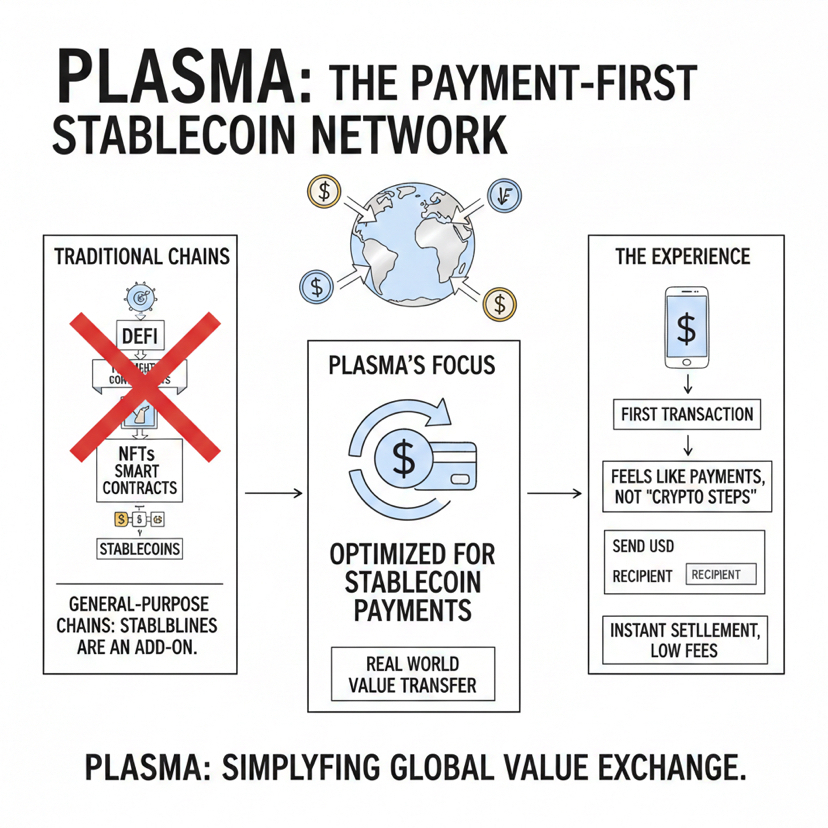
When you put Plasma next to TRON, the first thing to respect is that TRON already has what everyone wants but few can manufacture quickly: habit and distribution. A huge amount of USDt movement already flows there, especially in places where stablecoins are used daily. That kind of momentum is not just numbers on a dashboard. It is wallets choosing defaults, merchants choosing what works, and users choosing what feels familiar. Plasma does not beat that today. Where Plasma tries to open the door is by removing the small frictions that become huge at scale, especially for normal users. If someone is sending USDt, they do not want to think about holding a second token for fees. They do not want to learn a resource system or any extra mechanics. Plasma is built around the belief that stablecoin users should stay inside stablecoins, including how they pay fees, and in some cases not pay them at all. That is a real shot at one of TRONs weak points: TRON can be cheap, but the experience is not always clean and consistent for a mainstream payment user. The honest trade is simple. TRON wins on proven adoption and established corridors. Plasma is trying to win the first time user moment, where the smallest confusion kills conversion. Plasma still has to prove it can earn the same wallet reach and the same payment routes, because a smoother design only matters when it is everywhere.
Against Solana, the comparison feels different. Solana has already shown what high throughput can look like in production and it has real payment style performance. If your only goal is speed and low cost under heavy demand, Solana is one of the toughest benchmarks. The place where Plasma is pushing back is not by pretending Solana is slow. It is by saying the EVM world matters, not just for developers, but for the entire ecosystem of audits, libraries, tooling, integrations, and institutional comfort that already exists around Ethereum standards. Solana asks builders to move into a different runtime and a different set of tools. Some teams will do that. Many will not, especially if they already have EVM code in production. Plasma is trying to be the option where you keep the EVM stack and still target payment scale stablecoin settlement. The downside is obvious. Solana has years of hard earned operational experience at scale. Plasma will need to demonstrate that its approach can handle stablecoin heavy traffic reliably, not just in ideal conditions, but during stress when payments cannot afford surprises.
Base is the most practical rival in the sense that it lives right beside the biggest liquidity and application universe in crypto. For a lot of teams, Base feels like the easiest path because you get EVM familiarity and you stay close to Ethereum capital and integrations. That is a strong advantage for stablecoins, because liquidity and distribution often beat pure tech. Where Plasma is trying to stand apart is in how the payment experience is delivered. On most rollups, gas abstraction and fee sponsorship are usually implemented app by app. Some wallets do it well, some do not, and users see an inconsistent experience. Plasma is pushing the idea that the chain itself should provide stablecoin native payment plumbing so the default user journey is smoother across the board. If stablecoin based gas and gasless USDt transfers become common defaults on Plasma, it becomes easier for wallets and payment apps to feel consistent, because they are not reinventing the same systems repeatedly. The honest trade here is that Base wins on ecosystem gravity and the familiarity of being in the Ethereum neighborhood. Plasma is betting that payment rails need a tighter purpose built baseline than what a general rollup environment naturally delivers, and it is also leaning into a different security narrative with a Bitcoin anchored design.
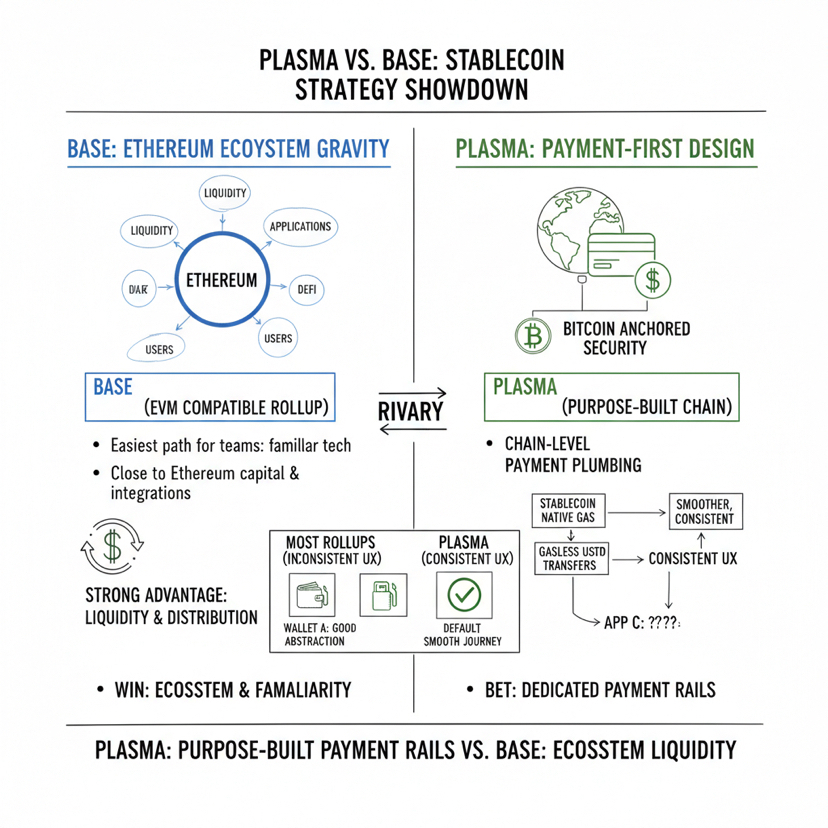
The single area where Plasma looks most uniquely positioned is not just speed or cost, because plenty of chains can compete there. It is the attempt to standardize stablecoin UX at the protocol level while staying fully EVM compatible. That means the chain is not only saying we are fast and cheap. It is saying you can build EVM payment products where the user never needs to care about a separate gas token, and where the heavy lifting for fee sponsorship and stablecoin first gas is shared infrastructure instead of custom engineering every time. If Plasma executes, that becomes a real wedge. TRON has the stablecoin flow but not a clean universal onboarding story. Solana has the performance but not the EVM compatibility. Base has the ecosystem but stablecoin native UX is still often a product decision rather than a chain default. Plasma is trying to land in the gap between them with one clear promise: stablecoins should behave like money the moment you arrive, without the usual crypto tax of learning gas.

