
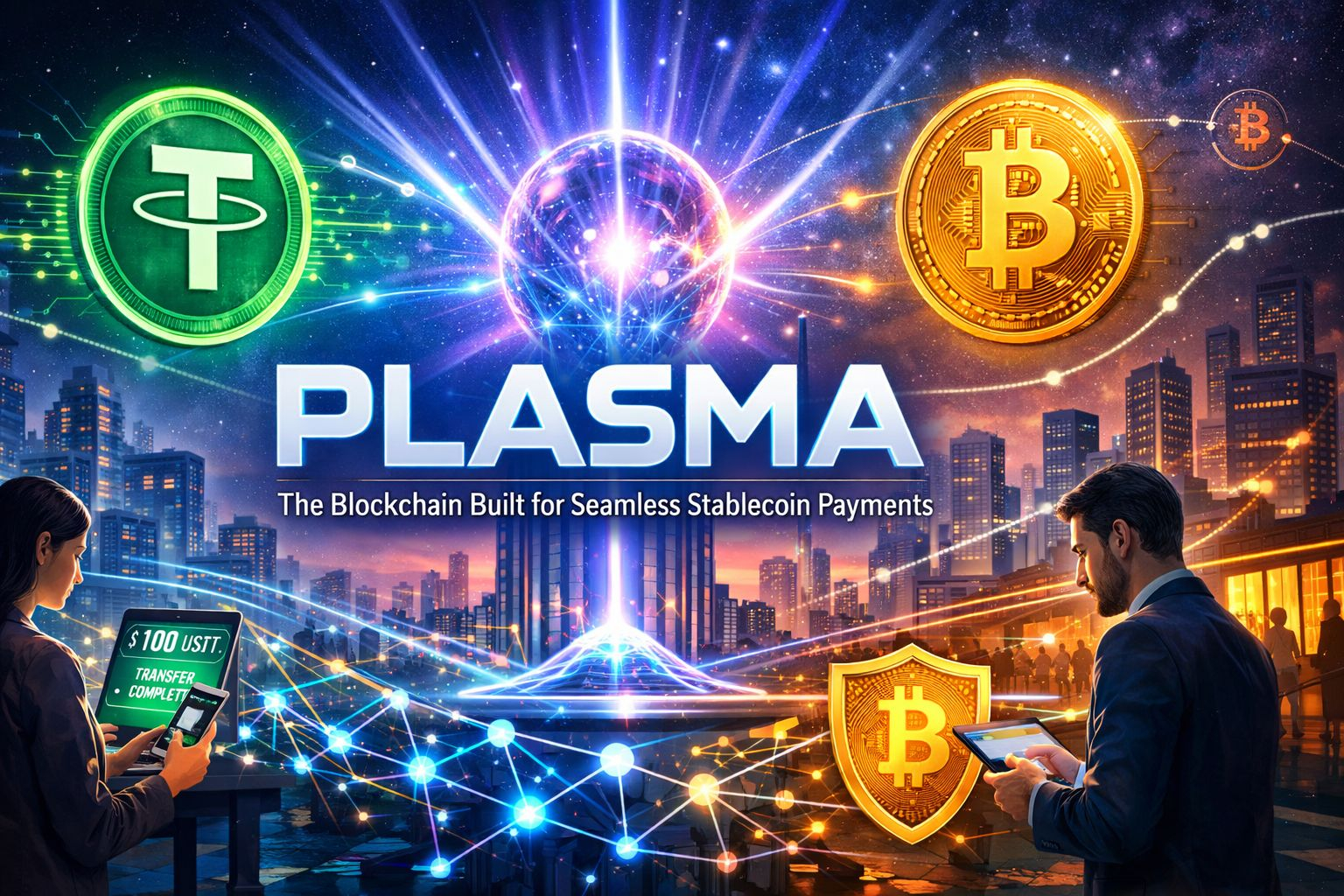
 Plasma emerged from the recognition that despite the proliferation of blockchains and decentralized finance, the fundamental promise of cryptocurrency as a reliable medium for everyday transactions had not yet been realized, and its origin story is rooted in the observation that stablecoins, which already serve as de facto currency in many parts of the world, were constrained by networks that were designed for experimentation rather than usability, requiring users to navigate volatile gas fees, slow finality, and fragmented liquidity, and from these constraints grew a vision of a Layer 1 blockchain purpose-built to make stablecoin settlement feel as seamless and natural as moving fiat through a bank, while simultaneously retaining the open, permissionless ethos of blockchain, a vision informed by careful analysis of existing Layer 1 and Layer 2 solutions, the limitations of Ethereum in high-throughput payments, and the security assurances of Bitcoin, which inspired Plasma’s anchoring strategy to enhance censorship resistance and network neutrality.
The purpose of Plasma is singular yet profound: to create a blockchain where the movement of stablecoins is frictionless, predictable, and secure, providing both retail users and institutional participants with a platform where value transfer does not require mastering cryptographic concepts or juggling multiple tokens, and where the promise of speed, low cost, and certainty aligns with the expectations of modern financial systems, such that a transfer of USD₮ is instantaneous, gasless from the user’s perspective, and fully final in sub-second timeframes, allowing commerce, remittance, and treasury operations to be conducted on a blockchain without compromise, bridging the gap between the existing financial infrastructure and the emerging world of digital assets while maintaining an environment that is transparent, auditable, and fully EVM-compatible so that developers can leverage familiar tools and smart contracts to innovate within a stable, predictable environment.
Plasma’s design reflects a careful balance between usability, speed, and security, combining full EVM compatibility through Reth with a consensus mechanism known as PlasmaBFT, an adaptation of fast Byzantine Fault Tolerant protocols that allows sub-second finality and high transaction throughput while remaining robust against network partitions, node failures, and malicious actors, and the network introduces stablecoin-first features, including gasless USDT transfers and paymaster systems that remove the need for users to acquire native gas tokens, enabling a user experience that mirrors traditional payment rails while preserving decentralization, and the economic model deliberately separates the roles of security and utility by introducing a native token primarily for staking and network incentives, while allowing the day-to-day transactions to be conducted entirely in stablecoins, ensuring that liquidity, pricing, and settlement remain stable even under heavy network load.
Mechanistically, Plasma integrates several layers of innovation, including custom gas token logic that allows fees to be paid in stablecoins, an architecture for sponsored transactions where relayers or paymasters cover costs on behalf of users, and cross-chain anchoring that leverages Bitcoin’s proof-of-work security to increase censorship resistance and bolster trust in settlements, all of which are implemented with careful attention to modularity and upgradeability, ensuring that bridges, relayers, and validator sets can evolve over time without compromising network integrity, and the protocol also anticipates developer needs by providing standard Ethereum tooling, compatible wallets, and composable DeFi primitives so that both institutional and retail ecosystems can adopt Plasma without reinventing their operational stacks, creating a foundation that is as familiar as Ethereum yet optimized for the unique demands of stablecoin settlement.
Looking toward the future, Plasma is positioned to expand both in technical capability and market reach, with plans to gradually decentralize validator operations, introduce advanced multi-chain interoperability, refine paymaster mechanisms to minimize abuse risk, and develop additional stablecoin-first financial primitives that could include automated liquidity routing, programmable merchant payment flows, and integration with global remittance networks, all while preserving the core promise of speed, predictability, and minimal friction, and the roadmap emphasizes that adoption will be driven not only by technical superiority but also by the ability to integrate seamlessly with existing financial and retail ecosystems, creating a blockchain environment where stablecoins function with the trust and reliability of traditional fiat while delivering the benefits of transparency, permissionless access, and programmable money.
The risks inherent in Plasma’s vision are notable and multifaceted, ranging from the technical challenges of bridging to Bitcoin and other networks without introducing exploitable attack surfaces, to the economic risks of incentivization misalignment among validators and relayers, to regulatory uncertainties surrounding stablecoin use in different jurisdictions, and while the network’s security model, anchored consensus, and paymaster systems are designed to mitigate these risks, careful monitoring, gradual deployment, third-party audits, and robust governance mechanisms remain essential, because even with innovative design, the interplay between liquidity, settlement finality, and cross-chain dependencies can introduce systemic vulnerabilities that demand constant attention and iterative improvement, and the project explicitly acknowledges that the path to widespread adoption requires both technical rigor and a proactive approach to ecosystem education and risk management.
The possibilities unlocked by Plasma are extraordinary, as it offers a vision of blockchain where stablecoins can finally fulfill their potential as global, frictionless mediums of exchange, enabling rapid peer-to-peer payments, scalable merchant settlement, and institutional treasury operations without the cognitive and financial burden of traditional crypto networks, and in doing so, it may catalyze a new wave of mainstream adoption where the blockchain becomes an invisible, reliable layer beneath everyday commerce, remittance, and financial infrastructure, and where the human experience of money regains its simplicity and certainty, proving that when technology is designed around human needs rather than novelty, the result can be both powerful and profoundly transformative, offering a future in which the promise of decentralized money is realized not as speculation, but as a trusted, universally usable tool for the movement of value.

